For thousands of years, the primary way that a human identified himself was through a community. And then came the Age of Enlightenment, the Light of Reason, the Way of the Individual. And we live amongst the confusion, a few centuries later, mired.
When people fail, we look at them with disappointment, assuming that they didn't take responsibility as an individual for their own life. We discount the role of their community and lift up too high the assumption that people have great power as an individual over their destiny.
We see people succeed and we admire them for taking their life by the reigns and victoriously surging forth as an individual. We downplay the contribution that any kind of community played in their life to prepare them for there accomplishments.
This downgrade of community and obsession with individuality has been part of our heritage for a few centuries now. It's too easy to look at our parents or older generation and reject their traditions and perspectives - for that's what they did in their days, and so on. We inherit from our parents the desire to think for ourselves - which means we must reject any accumulated wisdom they might be able to pass on. How smart is that?
What are the fears associated with a renewed emphasis on community? People don't like to be told what to do. They don't like to be forced into a routine, to have a tradition enforced. People don't like being accountable to people outside their family. People don't want to feel obligated to care for others outside their selective network of friends.
Christians are born into this aura of individualism. It's why we struggle so much with community. Yet Jesus places a high value on community, almost more so than on individualism. In our age, we think that community results from the gathering of individuals. But for Jesus, community is both the origins and nexus for individuality.
Christians are identified as the body of Christ - which implies that we only exist because of our connections to each other. How can a foot increase it's value to the body by insisting on its individuality? Of course the foot is a sort of individual, differentiated from the hand and heart. But it's value is not just that it is different, but that the difference plays a substantial role in giving life to the community to which is attached.
The greatest command for Christians is to love. God is love. We are go give God, to give love to the world. But we can't do that as individuals. Love can only happen in community. You can't love by yourself. You can't even come to know God or love by yourself. It requires a community to give birth to you and those ideas and structures and history from which you benefit and are nurtured. Love is can't be just an exchange between two individuals. Love is what makes community possible, what makes individuals able to be attached and make a contribution to the life of others.
It's almost as if you have to pick one: love or individualism. If you pick love you get community. If you pick individualism, you get yourself, your way of doing things, your thoughts, your attempts to relate to God and know love on your own terms. But God seems to insist on being first and primary - often at the expense of your individuality. God wants you to love and be loved, and that means embracing community, his way of becoming.
The funny thing is, people throw away their individuality in dozens of ways, all the while insisting that they are not going to be bound to community and let someone tell them what to do. So they live in this shadow world, rootless, anchorless, drifting. They claim to be an individual while at the same time embracing the fashion styles of celebrities. Just like a few million other fans. The individual asserts the ability to think for himself, and then aligns himself with a popular modern writer. Just like a few million others.
Oh, we want community. We want to be led. We want to be bound to tradition. We want love. But we've drank so long from the toxic well of the Enlightenment. Even our readings of Scripture, our thoughts on God are fueled by this pervasive attitude of individuality. We think of God as the supreme individual. Except that he exists as the Trinity. And he bound himself up to Israel, and the church. And the world. God lives in community. It's how he expresses love, himself.
We ought to reconsider our attachment to individuality. I am just as much an individualist as the next person. I was born into it, like everyone else. And yet. As powerful as the drug is, the call of community continues. The desire to love and be loved - God, my wife and children, friends, church - results in a draining of those individualistic energies that drive me towards loneliness. I want God's kingdom to come. I want to love. I want to see my city flourish. I want the church to prevail as a blessing. Those are all community-oriented themes that undermine my individuality. So be it.
Showing posts with label Reflection. Show all posts
Showing posts with label Reflection. Show all posts
Monday, December 05, 2011


Sunday, November 27, 2011
What is an Advent Sunday?
Today is the first Advent Sunday! There are four Advent Sundays leading up to Christmas Day. Today is also the first day of the church year. Interestingly, though, today is not the first day of the Christmas Season. Christmas begins on... Christmas Day - and lasts 12 days. It ends on Christmastide, January 5th.
 The word "advent" means "coming," connected to the idea of arrival, appearance, emergence, occurrence, birth, rise, development, approach. The church has for well over a thousand years celebrated the advent or birth or arrival of Christ by marking out the four Sundays before it as a season of preparation.
The church re-enters into the Nativity Story, imagining in a way that we are participants with Mary and Elizabeth, Simon and Joseph and others who sensed that God was about to appear in a new and radical way.
As you consider your life, don't you think you would benefit from some time of reflection on what the significance of God's advent as an infant? Do we assume we have a rich and robust grasp on the Incarnation? How could we spend four Sundays preparing for the celebration on Christmas Day of God becoming one of us?
When we consider the Advent of Christ, it carries two meanings. We remember the birth of Jesus, born into poverty, under the tyranny of a vicious king. We also remember the promise of Jesus that he would return, that he will come again, that there will be another, final, advent. The church starts the new year with four Sundays to consider the promises - then and now - of what the coming King Jesus will do when he arrives.
It's likely that the bewilderment and controversy that surrounded Jesus the first time he came will follow him the second time around. Maybe we need the four Sundays to remind us of how much we don't understand. Of our need for help when it comes to believing.
We think we understand the First and Second Advent of Christ. We need our Sundays to point us to Jesus - to help us understand what he actually said and did. The life of Jesus shapes our understanding of the Advent that was, and the Advent to come.
 Advent Sundays are not a substitute for celebrating Christmas. The church celebrates Christmas for twelve days. Advent Sundays point to Christmas, they challenge our understanding of Christmas, but they are not part of the Christmas season.
Some of us are sick of Christmas by the time we get to December 25th. We've spent so much time shopping and partying and stressing and getting wrapped up in the drama of family dysfunction around the holidays that Jesus gets the shaft.
Really, how much of your Christmas energies go into worship of Jesus? Attending a Christmas Eve or Christmas Day service is the classic way of worshiping the newborn King. But that is supposed to be the beginning of twelve days of worship, not the exhausted end.
There is plenty of material out there on how to prepare yourself during these four weeks of Advent. To the degree that you are interested in keeping Christ in Christmas, don't let your busyness cause you to push the baby Jesus off to the side. Keep it simple. Keep it intentional. Keep it focused on Jesus.
Some suggestions:
 * Read each Gospel - one a week, leading up to Christmas Day. (There are about 20ish chapters in each Gospel, read up to three chapters a day)
* List out all your questions about Jesus and his teachings on a piece of paper, and put it in your Bible. As you read through each Gospel, add to your list. Trust me, most of what you will read about Jesus will cause more questions. It should.
* Do some research into the history behind the Christmas hymns that we sing each year. Or the traditions that we observe each year. Or the origins of the Santa Claus myth.
* Spend time reflecting on your unconfessed sins each Sunday morning or evening The greatest gift you can give God and others and yourself is truth about the sins you hang on to, the sins you won't forgive - in yourself, and others. To forgive and let yourself be forgiven is the true fulfillment of Christmas.
* Look for a way to give away something good everyday. A good word, a good attitude, a good ear, a good hand, a good prayer - as prompted by the Spirit of Christ.
* Find a way to integrate Jesus into everything you do during what you consider the Christmas Season.
* Don't go in debt to buy presents for people as a celebration of Jesus' birth.
 * Pray the Lord's Prayer everyday - and reflect on how God's Kingdom has come through the First Advent, and will come in full with the Second Advent.
* Eagerly desire to let poverty into your life. Either take a vow of poverty, or give away your possessions such that you only have the bare necessities, or become friends with those who are poor. Jesus was born into poverty, lived in poverty, ministered amongst the poor, taught the poor, loved the poor.
* Put a Nativity scene in your front yard.
* Make your own list of how you will live this December in light of the Advent of Jesus?

The church re-enters into the Nativity Story, imagining in a way that we are participants with Mary and Elizabeth, Simon and Joseph and others who sensed that God was about to appear in a new and radical way.
As you consider your life, don't you think you would benefit from some time of reflection on what the significance of God's advent as an infant? Do we assume we have a rich and robust grasp on the Incarnation? How could we spend four Sundays preparing for the celebration on Christmas Day of God becoming one of us?
When we consider the Advent of Christ, it carries two meanings. We remember the birth of Jesus, born into poverty, under the tyranny of a vicious king. We also remember the promise of Jesus that he would return, that he will come again, that there will be another, final, advent. The church starts the new year with four Sundays to consider the promises - then and now - of what the coming King Jesus will do when he arrives.
It's likely that the bewilderment and controversy that surrounded Jesus the first time he came will follow him the second time around. Maybe we need the four Sundays to remind us of how much we don't understand. Of our need for help when it comes to believing.
We think we understand the First and Second Advent of Christ. We need our Sundays to point us to Jesus - to help us understand what he actually said and did. The life of Jesus shapes our understanding of the Advent that was, and the Advent to come.

Some of us are sick of Christmas by the time we get to December 25th. We've spent so much time shopping and partying and stressing and getting wrapped up in the drama of family dysfunction around the holidays that Jesus gets the shaft.
Really, how much of your Christmas energies go into worship of Jesus? Attending a Christmas Eve or Christmas Day service is the classic way of worshiping the newborn King. But that is supposed to be the beginning of twelve days of worship, not the exhausted end.
There is plenty of material out there on how to prepare yourself during these four weeks of Advent. To the degree that you are interested in keeping Christ in Christmas, don't let your busyness cause you to push the baby Jesus off to the side. Keep it simple. Keep it intentional. Keep it focused on Jesus.
Some suggestions:

* List out all your questions about Jesus and his teachings on a piece of paper, and put it in your Bible. As you read through each Gospel, add to your list. Trust me, most of what you will read about Jesus will cause more questions. It should.
* Do some research into the history behind the Christmas hymns that we sing each year. Or the traditions that we observe each year. Or the origins of the Santa Claus myth.
* Spend time reflecting on your unconfessed sins each Sunday morning or evening The greatest gift you can give God and others and yourself is truth about the sins you hang on to, the sins you won't forgive - in yourself, and others. To forgive and let yourself be forgiven is the true fulfillment of Christmas.
* Look for a way to give away something good everyday. A good word, a good attitude, a good ear, a good hand, a good prayer - as prompted by the Spirit of Christ.
* Find a way to integrate Jesus into everything you do during what you consider the Christmas Season.
* Don't go in debt to buy presents for people as a celebration of Jesus' birth.

* Eagerly desire to let poverty into your life. Either take a vow of poverty, or give away your possessions such that you only have the bare necessities, or become friends with those who are poor. Jesus was born into poverty, lived in poverty, ministered amongst the poor, taught the poor, loved the poor.
* Put a Nativity scene in your front yard.
* Make your own list of how you will live this December in light of the Advent of Jesus?
Saturday, November 26, 2011
Teaching Me To Love

Today, six and a half years later, I finished Works of Love. A lot of life has happened since then. It would seem that God has been helping me answer my own prayer, thanks to my wife and kids and family and friends and church. And Kierkegaard. I also realize how much more I have to learn about love. Or, what I learned was only the beginning of how to love.
The advantage of reading really old reflections on the works of love is rooted in its disconnection from our post-modern ways of thinking about God and relationships and self. But, 1847 was also among those nascent years of the Enlightenment, our Modern period of thinking. It's odd to read Kierkegaard's critiques on his culture and church - they sound so similar to ours today. What he has to say is relevant to our situations now.
I grew up in a loving home. I have loving parents and brothers and extended family. I have a loving wife and four loving children. I am part of a loving church. I am loved by many friends. There is much love in my life. What does that tell me? That I am an expert in loving? That I have much to teach about love? Or, that God has been helping answer my prayer. And that every opportunity I have to give love is also a revelation of how much more I have to learn.
If love is truly the greatest thing in all the world, then I'd be crazy to settle for a mediocre love. There is much left to understand in this world of how God gives love, of how God gives himself, of how Jesus is our supreme image of love at work in the world. There is so much confusion. So much hurt and rage. There is much discontent about the kind of love that is being offered up these days. How to enter into the most excellent way of love - and let that overflow onto all those connected to my life?
So in the final pages of Kierkegaard's thoughtful Works of Love, here are some disturbing and striving discourses on love:
Christianity's view is: forgiveness is forgiveness; your forgiveness is your forgiveness; your forgiveness of another is your own forgiveness; the forgiveness which you give, you receive, not contrariwise, that you give the forgiveness for which you receive.
It is as if Christianity would say: pray to God humbly and believing in your forgiveness for he really is compassionate in such a way as no human being is; but if you will test how it is with respect to the forgiveness, then observe yourself. If honestly before God you wholeheartedly forgive your enemy (but remember that if you do, God sees it), then you dare hope also for your forgiveness, for it is one and the same.
God forgives you neither more nor less nor otherwise than as you forgive your trespasses. It is only an illusion to imagine that one himself has forgiveness, although one is slack in forgiving others.
It is also conceit to believe in one's own forgiveness when one will not forgive, for how in truth should one believe in forgiveness if his own life is a refutation of the existence of forgiveness!
For, Christianly understood, to love human beings is to love God and to love God is to love human beings; what you do unto men you do unto God, and therefore what you do unto men God does unto you.
If you are embittered towards men who do you wrong, you are really embittered towards God, for ultimately it is still God who permits wrong to be done to you. If, however, you gratefully take the wrongs from God's hand "as a good and perfect gift," you do not become embittered towards men either.
If you will not forgive, you essentially want something else, you want to make God hard-hearted, that he should not forgive, either: how, then should this hard-hearted God forgive you? If you cannot beat the offences of men against you, how should God be able to bear your sins against him?
If you have never been solitary, you have also never discovered that God exists. But if you have been truly solitary, then you also learned that everything you say to and do to other human beings God simply repeats; he repeats it with the intensification of infinity. The word of blessing or judgment which you express concerning someone else, God repeats; he says the same word about you, and this same word is blessing or judgment over you.
Such a person will certainly avoid speaking to God about the wrongs of others towards him, about the speck in his brother's eye, for such a person will rather speak to God only about grace, lest this fateful word of justice lose everything for him through what he himself has called forth, the rigorous like-for-like.
Soren Kierkegaard, Works of Love, p348-353
Sunday, March 06, 2011
More Advent Quotes from C.S. Lewis

If you like the thoughtfulness of C.S. Lewis, if you want to think more deeply about the Incarnation, if you want to keep Christ in Christmas, read on.
Here is Week One of Advent
Week Two
Quest for Peace: Second Sunday of Advent
When the year dies in preparation for the birth
Of other seasons, not the same, on the same earth,
Then saving and calamity go together make
The Advent gospel, telling how the heart will break.
Therefore it was in Advent that the Quest began...
~ C.S. Lewis, "Launcelot", Narrative Poems, p95
The Gift of Judgement: Second Monday of Advent
Judgment is at hand, promise of judgment and threat of judgment.... It is the same sort of ambivalence which Christians have been taught to recognize in the season of Advent.
~ C.S. Lewis and Charles Williams, The Arthurian Torso, p157
God Shatters: Second Tuesday of Advent
My idea of God is not a divine idea. It has to be shattered time after time. He shatters it Himself. He is the great iconoclast. Could we not almost say that this shattering is one of the marks of His presence? The Incarnation is the supreme example; it leaves all previous ideas of the Messiah in ruins. And most are "offended" by the iconoclasm; and blessed are those who are not. But the same thing happens in our private prayers.
~ C.S. Lewis, A Grief Observed, p78
What We Can Understand: Second Wednesday of Advent
We cannot conceive how the Divine Spirit dwelled within the created and human spirit of Jesus.... What we can understand...is that our own...existence is...but a faint image of the Divine Incarnation itself - the same theme in a very minor key.
~ C.S. Lewis, Miracles, p147
Just Like Your Father: Second Thursday of Advent
The Son of God became a man to enable men to become the Sons of God. We do not know...how things would have worked if the human race had never rebelled against God and joined the enemy.... You and I are concerned with the way things work now.
~ C.S. Lewis, Mere Christianity, p178
Test of Greatness: Second Friday of Advent
[The great French writer] Montaigne became kittenish with his kitten but [it] never talked philosophy to him. Everywhere the great enters the little - its power to do so is almost the test of its greatness.
~ C.S. Lewis, Miracles, p147
Excitement Of A Child: Second Saturday of Advent
I have read [your book] Treasure on Earth and I don't believe you have any notion how good it is.... I've never seen the hushed internal excitement of a child on Christmas Eve better done. That is something we can all recognize.
~ C.S. Lewis, from "Letter to Mrs. Phyllis Sandeman", Dec. 10, 1952, Lewis' Collected Letters, III, pp261ff
Week Three
His Name In This World: Third Sunday of Advent
Dear Hida (is that right?) Newman,
Thank you so much for your lovely letter and pictures.... As to Aslan's other name, well I want you to guess. Has there never been anyone in the world who (1.) arrived at the same time as Father Christmas. (2.) Said he was the son of the Great Emperor. (3.) Gave himself up for someone else's fault to be jeered at and killed by wicked people. (4.) Came to life again. (5.) Is sometimes spoken of as a Lamb.... Don't you really know His name in this world? Think it over and let me know your answer.
~ C.S. Lewis, from "Letter to Hila Newman," June 3, 1953, Lewis' Collected Letters, III, p.334
To Tell His Story: Third Monday of Advent
My brother and I took a day off last week, put sandwiches in our pockets, and tramped sixteen miles..from Dorchester Abbey to Oxford.... You would be surprised if you could see the unspoilt beauty and charm which can still be found.... I hope to send you the autographed children's book by Christmas, but will probably know more about its progress this afternoon, as I am going out to lunch with my publisher.
~ C.S. Lewis, "Letter to Miss Vera Mathews," September 20, 1950, Lewis' Collected Letters, III, p54
Greatness Comes In Smallness: Third Tuesday of Advent
"It seems, then", said Tirian..."that the Stable seen from within and the Stable seen from without are two different places."
"Yes," said the Lord Digory. "Its inside is bigger than its outside."
"Yes," said Queen Lucy. "In our world too, a Stable once had something inside it that was bigger than our whole world."
~ C.S. Lewis, The Last Battle, p141
To Glorify And Enjoy: Third Wednesday of Advent
The Scotch catechism says that man's end is 'to glorify God and enjoy Him forever'. But we shall then know that these are the same thing. Fully to enjoy is to glorify. In commanding us to glorify Him, God is inviting us to enjoy him.
~ C.S. Lewis, Reflections on the Psalms, p97
A Gift To You For Others: Third Thursday of Advent
"Hadn't we better take what we want and get out again?" said Edmund.
"We must take the Gifts," said Peter.
For long ago at a Christmas in Narnia he and Susan and Lucy had been given certain presents which they valued more than their whole kingdom.... They all agreed...and there, sure enough, the gifts were still hanging. Lucy's was the smallest for it was only a little bottle.
~ C.S. Lewis, Prince Caspian, p23
Christmas Shopping: Third Friday of Advent
From the waist upwards he was like a man, but his legs were shaped like a goat's.... One of his hands...held an umbrella: in the other arm he carried several brown paper parcels. What with the parcels and the snow it looked just as if he had been doing his Christmas shopping. He was a Faun. And when he saw Lucy he gave such a start of surprise that he dropped all his parcels.
~ C.S. Lewis, The Lion, the Witch and the Wardrobe, p8
Any Point In Going On?: Third Saturday of Advent
[The Queen of Narnia] "isn't a real queen at all," answered Lucy. "She is a horrible White Witch.... She has made an enchantment over the whole country so that it is always winter here and never Christmas."
"I wonder if there's any point in going on," said Susan.... "What about just going home?"
~ C.S. Lewis, The Lion, the Witch and the Wardrobe, p56
Week Four
Jesus Saves: Fourth Sunday of Advent
Most of my books are evangelistic, addressed to [those outside the faith].
~ C.S. Lewis, from "Rejoinder to Dr. Pittenger," God in the Dock, p181
Peace On Earth: Fourth Monday of Advent
There! They're at it again. "'Ark, the errol hygel sings".... Boxing Day [December 26] is only two and a half weeks [away]; then perhaps we shall have a little quiet in which to remember the birth of Christ.
~ C.S. Lewis, "Delinquints in the Snow," God in the Dock, p310
Very Many Thanks: Fourth Tuesday of Advent
Once more, very many thanks to all your great goodness to me and mine: and with all best wishes for a happy Christmas.
~ C.S. Lewis, from Letter to Dr. Warfield Firor, Nov. 6, 1948, Lewis' Collected Letters, II, p889
Campaign of Sabotage: Fourth Wednesday of Advent
Enemy-occupied territory - that is what this world is. Christianity is the story of how the rightful king has landed...and is calling us all to take part in a great campaign of sabotage. When you go to church you are really listening-in to the secret wireless from our friends: that is why the enemy is so anxious to prevent us from going.
~ C.S. Lewis, Mere Christianity, p46
Bring Religion Into Everything: Fourth Thursday of Advent
Just a hurried line...to tell a story which puts the contrast between our feast of the Nativity and all this ghastly "Xmas" racket at its lowest. My brother heard a woman on a bus say, as the bus passed a church with a Crib outside it, "Oh Lor'! They bring religion into everything. Look - they're dragging it even into Christmas now!"
~ C.S. Lewis, Letters to an American Lady, Dec. 29, 1958, p80
Give More Than We Can Spare: Fourth Friday of Advent
Charity - giving to the poor - is an essential part of Christian morality.... I do not believe on can settle how much we ought to give. I am afraid the only safe rule is to give more than we can spare.
~ C.S. Lewis, Mere Christianity, p86
Friday, March 04, 2011
What To Do With The Bad Things That Happen To Good People
What's your initial reaction when something bad happens to someone who doesn't deserve it, someone you care about?
Anger is the appropriate response. Righteous anger is fueled by injustice, unfairness, oppression of the innocents. This kind of anger ought to move us to reflective and righteous action - respond to the cries of the wounded, intercede on behalf of the suffering.
Frustration is another response. We want to make sense of our world, to have adequate explanations for why stuff happens. We want a reason for what caused the long string of events that led up to the tragedy. And the simmering frustration can lead to bitterness, to despair, to giving up.
Job of Uz was afflicted by great tragedy. In the course of a week his possessions were stolen, his wealth wiped out, and all his children and their families murdered. The following week his body broke out in great seeping sores. His wife in great rage and bitterness implored her husband to curse God and die. Job's friends sat with him in in consoling silence for the traditional mourning for seven days.
If only the friends would have left after that - instead they opened their mouth and tried to help Job accept his situation. They insisted that God is just and therefore Job deserved this tragedy. Job angrily resisted their insights, stubbornly maintaining his innocence:
 Job knew he was righteous before God. He knew God was righteous. His mind and soul were being torn apart by the seeming incongruity caused by the unexplainable suffering. And an explanation is never given. Even though God speaks to Job, He does not reveal the reasons for the excruciating pain.
And that's part of the lesson: God will not give us explanations for the suffering of the innocents. God does something else though - he blesses the righteous, and he blesses others through the righteous. Suffering will be part of life - whether you are righteous or unrighteous. Whether you are a good person or bad person, unexplainable hard times will come upon you.
We don't have the example of Job because we ought to imitate him. He have the story because it reflects what one man's experience was like. If we're going to imitate someone who suffered, we ought to consider the way of Jesus.
His story has many similar points as that of Job. Jesus, like Job, cries out: My God, My God, why have you forsaken me? But unlike Job, at the end, Jesus also whispers: Father, forgive them, for they know not what they do.
What will you do with the bad things that happen to you? The bad things you don't think you deserve? Obviously we are not talking about the bad things that happen to you which are consequences of your stupid, unthinking, selfish, stubborn choices. Those bad things are your own fault. We're talking about the hard times that come which someone else inflicts on you that is not connected to your choices. What will you do?
Like Job and Jesus, you can cry out to God and rage against the injustice of it - the seeming abandonment of God. Yet like Jesus, you remember that God is there, suffering with you, and he is the one hope you have for emerging from this painfulness. Your whisper of forgiveness, of letting go of the bitterness and rage, begins the process of what you ought to do next. Your desire for forgiveness, combined with your desire for justice, will keep you open towards God and his desire for bringing good and grace into the situation.
God has promised that he will right every wrong. God has promised that righteousness will prevail. God has promised that he will avenge. We must pursue justice. We must pursue truth. We must pursue righteousness. But in the end, if our pursuit results in us becoming bitter, jaded, and despairing, we lose. Our choice to forgive, to trust God, and to follow the way of Jesus in response to pain and suffering - this opens us up to new possibilities of healing and hope.
Anger is the appropriate response. Righteous anger is fueled by injustice, unfairness, oppression of the innocents. This kind of anger ought to move us to reflective and righteous action - respond to the cries of the wounded, intercede on behalf of the suffering.
Frustration is another response. We want to make sense of our world, to have adequate explanations for why stuff happens. We want a reason for what caused the long string of events that led up to the tragedy. And the simmering frustration can lead to bitterness, to despair, to giving up.
Job of Uz was afflicted by great tragedy. In the course of a week his possessions were stolen, his wealth wiped out, and all his children and their families murdered. The following week his body broke out in great seeping sores. His wife in great rage and bitterness implored her husband to curse God and die. Job's friends sat with him in in consoling silence for the traditional mourning for seven days.
If only the friends would have left after that - instead they opened their mouth and tried to help Job accept his situation. They insisted that God is just and therefore Job deserved this tragedy. Job angrily resisted their insights, stubbornly maintaining his innocence:
I cry out to you, God, but you do not answer,
I stand up, but you merely look at me.
You turn on me ruthlessly
With the might of your hand you attack me.
As surely as God lives, who has denied me justice,
The Almighty has made my life bitter.
I will never admit you are right,
Until I die, I will not deny my integrity.
I will maintain my innocence and never let go of it.
I rescued the poor who cried for help,
And the fatherless who had none to assist them.
Those who were dying blessed me,
I made the widows heart sing.
I put on righteousness as my clothing,
Justice was my robe and turban.
I was the eyes of the blind, feet to the lame.
I was a father to the needy, I took up the case of the stranger.
 Job knew he was righteous before God. He knew God was righteous. His mind and soul were being torn apart by the seeming incongruity caused by the unexplainable suffering. And an explanation is never given. Even though God speaks to Job, He does not reveal the reasons for the excruciating pain.
And that's part of the lesson: God will not give us explanations for the suffering of the innocents. God does something else though - he blesses the righteous, and he blesses others through the righteous. Suffering will be part of life - whether you are righteous or unrighteous. Whether you are a good person or bad person, unexplainable hard times will come upon you.
We don't have the example of Job because we ought to imitate him. He have the story because it reflects what one man's experience was like. If we're going to imitate someone who suffered, we ought to consider the way of Jesus.
His story has many similar points as that of Job. Jesus, like Job, cries out: My God, My God, why have you forsaken me? But unlike Job, at the end, Jesus also whispers: Father, forgive them, for they know not what they do.
What will you do with the bad things that happen to you? The bad things you don't think you deserve? Obviously we are not talking about the bad things that happen to you which are consequences of your stupid, unthinking, selfish, stubborn choices. Those bad things are your own fault. We're talking about the hard times that come which someone else inflicts on you that is not connected to your choices. What will you do?
Like Job and Jesus, you can cry out to God and rage against the injustice of it - the seeming abandonment of God. Yet like Jesus, you remember that God is there, suffering with you, and he is the one hope you have for emerging from this painfulness. Your whisper of forgiveness, of letting go of the bitterness and rage, begins the process of what you ought to do next. Your desire for forgiveness, combined with your desire for justice, will keep you open towards God and his desire for bringing good and grace into the situation.
God has promised that he will right every wrong. God has promised that righteousness will prevail. God has promised that he will avenge. We must pursue justice. We must pursue truth. We must pursue righteousness. But in the end, if our pursuit results in us becoming bitter, jaded, and despairing, we lose. Our choice to forgive, to trust God, and to follow the way of Jesus in response to pain and suffering - this opens us up to new possibilities of healing and hope.
Tuesday, March 01, 2011
Solution of a Problem
...the solution of a problem always demands that we descend to a deeper level.
We must leave the level of conflicts and dilemmas to the level of self-examination under the searching light of God. We then can understand that a dilemma is a sign; it is a sign that there are deeper discoveries to be made, a new order to perceive which will transform the whole nature of the problem.
True meditation is this descent to the deeper level under God's direction. There it is that really new inspirations come, to set us free from our dilemmas, to transform our relationships with ourselves, with others, with God.
Under every dilemma is hidden several fears: the fear of openly resisting, the fear of giving in, the fear of fighting, and the fear of being beaten. It is love which drives back fear.

All is not thus solved. Everyday we shall find ourselves before the most perplexing questions, even if we sincerely seek for divine guidance.
Yet these can be for us an opportunity for deeper, inner experience through which alternatives we thought to be incompatible may be resolved in new synthesis.
We used to set doubt in opposition to faith, acceptance to rebellion, self-affirmation to self-surrender, and resistance to giving in. We do so no longer.
Here it is that real life always unites into a marvelous harmony those movements of the inner person which we judged to be contradictory. They are shown to be complementary.
The real believer is not the man who hides from himself those persistent doubts deep down but irremovable. The opposite is the truth: "I believe; help my unbelief!" (Mark 9:24).
The strong man is not he who hides his own failings from himself, but he who knows them well. Surrendering our life to God is at the same time our supreme giving-in and our supreme act of self-affirmation!
~Paul Tournier, To Resist or To Surrender, pgs 60-1
Tuesday, March 02, 2010
Ideas & Seeds
Ideas are powerful, much like little seeds. Apple tree seeds, oak tree seeds, huckleberrry seeds, okra seeds...
Here are some ideas that have gotten planted inside me this past summer. Spring is coming...
Some of us feel curiously charged by the volatile conditions...rough patches force new sources of courage and character. The best thing you can bring to a crisis is a filled up you: refreshed, Spirit-filled, God-connected.
The kindest form of management is the truth.
All too often our churches are not magnetic, catalytic or embracing. They could be vibrant, resilient, and adaptive.
The world is changing exponentially fast, the world is becoming more turbulent faster than churches are becoming more resilient.
Entropy applies to everything. The future is not unknowable; it is unpalatable. Humility is not just a virtue, it is about survival. Be as unconventional as God needs us to be.
Leadership is a journey, take your own path, own way, own time. Not every reader is a leader, but every leader is a reader. Leadership can be lonely. If you want to go fast, go alone; if you want to go far, go together. Who the communicator is matters as much as what is said.
In the midst of change, focus on the bright spots! Look for what is working. Shrink the change. With big problems, look for small solutions. In tough times people are skittish and lazy.
A sermon is provocation, loaded language, warning. It is sub-version: there is another story. It is a reminder: the way things are is NOT how God had in mind. A sermon opens you up to new possibilities. It can be misinterpreted, yet revolutionary.
A sermon, then, is the continuing insistence that through the resurrection of Jesus a whole new world is bursting forth and everybody everywhere can be part of it.
A sermon, then, is about helping people see this creation with their own eyes of what God is doing.
A sermon, then, brings hope rooted not in escape but engagement, not in evacuation but in reclamation, not in leaving but in staying and overcoming.
A sermon, then, is never surprised when grace, beauty, meaning, order, compassion, truth and love show up in all sorts of unexpected people and places because it always has been God's world, it is God's world, and it will always be God's world.
A revolution seeks to change the whole structure; an insurrection lives that change now until the revolution is complete. We need substantial change, not just intellectual. Mother Teresa was violent - her compassion wrecked the Hindu caste system of India.
Images create a shared experience, but words unleash the imagination.
Thursday, August 23, 2007
Hey Ben...
Hey Ben,
We stopped by your tombstone this evening. Thirteen years now, we've been gathering on the worn grass above your buried body. You lived with us for thirteen years, and now you've been absent from us for thirteen years. Next year you will reach the age where you will have been dead longer than you were alive.
Sorry for the melancholy letter; I am sad - I miss you, your big smile, your silly antics, your loud jokes, your ambling walk, your butch-wax lathered hair, your amiable attitude, your budding faith. August 23 is always a different day; I want to remember your life, but that means also remembering you are dead.
The gatherings get more fun as the years go by, your neices and nephews add a lot of noise and silliness to the event. Though they never knew you, we tell them stories, show them pictures; we constantly tell Emma that she has inherited your booming voice! Tonight Emma, Levi and Isaac were playing on your tombstone, happily oblivious to the pain of death.
As I watched them frolic, holding Eli close to my chest, I felt a deep strain in my soul. There was this angry surge, this stubborn resistance to reality, to the fact of your absence. Though it lasted only for a few seconds, it was a powerful moment; I don't want you dead, I want you here. It's one of the few things I want more than anything, and it is completely impossible to resolve.
You know all of this; I suppose having been dead for thirteen years, you've had plenty of time to reflect on what you are missing out on as well. Your 27th birthday is coming up...hard to imagine you all grown up, responsible, with a family. I like to imagine it though, it makes me smile.
We think of you often, we miss you always, and we seek to honor your life by laughing, by singing silly ditties; by enduring hardships with quiet resolve, by relying on God's providence when what we want is unattainable.
Here are some pics of the day together. We got together at my house first for pizza, fruit, cupcakes and icecream. We also gave Eli his first haircut, Tara reluctantly cut off the long hair hanging over his collar. No more mullet!


Just before leaving, Emma, in her boistrous enthusiasm, grabbed Eva in a bear hug and started waddling down the hallway. She lost her balance and Eva's forehead fell into some metal part of Grandpa's old desk he made for us when we were wee little tykes. It left a nasty gash; after the bleeding stopped Eva began to get sick. Jerm and Maria had to take her to the ER where she got stitches. Emma felt so bad about it, but we're glad Eva will be alright. The rest of us set off to Huntington to visit your tombstone and tell stories. What good stories you lived...


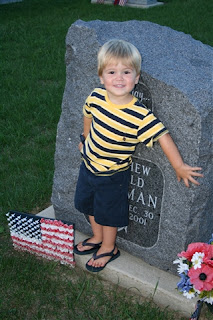

We stopped by your tombstone this evening. Thirteen years now, we've been gathering on the worn grass above your buried body. You lived with us for thirteen years, and now you've been absent from us for thirteen years. Next year you will reach the age where you will have been dead longer than you were alive.
Sorry for the melancholy letter; I am sad - I miss you, your big smile, your silly antics, your loud jokes, your ambling walk, your butch-wax lathered hair, your amiable attitude, your budding faith. August 23 is always a different day; I want to remember your life, but that means also remembering you are dead.
The gatherings get more fun as the years go by, your neices and nephews add a lot of noise and silliness to the event. Though they never knew you, we tell them stories, show them pictures; we constantly tell Emma that she has inherited your booming voice! Tonight Emma, Levi and Isaac were playing on your tombstone, happily oblivious to the pain of death.

As I watched them frolic, holding Eli close to my chest, I felt a deep strain in my soul. There was this angry surge, this stubborn resistance to reality, to the fact of your absence. Though it lasted only for a few seconds, it was a powerful moment; I don't want you dead, I want you here. It's one of the few things I want more than anything, and it is completely impossible to resolve.
You know all of this; I suppose having been dead for thirteen years, you've had plenty of time to reflect on what you are missing out on as well. Your 27th birthday is coming up...hard to imagine you all grown up, responsible, with a family. I like to imagine it though, it makes me smile.
We think of you often, we miss you always, and we seek to honor your life by laughing, by singing silly ditties; by enduring hardships with quiet resolve, by relying on God's providence when what we want is unattainable.
Here are some pics of the day together. We got together at my house first for pizza, fruit, cupcakes and icecream. We also gave Eli his first haircut, Tara reluctantly cut off the long hair hanging over his collar. No more mullet!


Just before leaving, Emma, in her boistrous enthusiasm, grabbed Eva in a bear hug and started waddling down the hallway. She lost her balance and Eva's forehead fell into some metal part of Grandpa's old desk he made for us when we were wee little tykes. It left a nasty gash; after the bleeding stopped Eva began to get sick. Jerm and Maria had to take her to the ER where she got stitches. Emma felt so bad about it, but we're glad Eva will be alright. The rest of us set off to Huntington to visit your tombstone and tell stories. What good stories you lived...


Sunday, August 05, 2007
But I Have Calmed Myself...
Psalm 131
I've read through the Bible before, and I've read through the Book of Psalms before, but this morning's reading struck me as new, as if I'd never seen it before. It's a brief hymn, though potent:
My heart is not proud, LORD;
my eyes are not haughty;
I do not concern myself with great matters
or things too wonderful for me.
But I have calmed myself
and quieted my ambitions.
I am like a weaned child with its mother;
like a weaned child I am content.
Israel, put your hope in the LORD
both now and forevermore.
********
Not only does it seem as if I've never read this poem before, it is one that strikes me between the eyes...I need the truth of this song in my life both now and forevermore. The other day I was reflecting on my pridefulness, how it was darkening my soul. This was coupled with a deep level anxiety that continues to push itself into the forefront of my life...which has sparked numerous comments to others that I need to calm down.
I am so worked up over being a good pastor, of teaching and leading a church towards grace and peace; over becoming more holy and making a great big difference in this brief and turbulent world. I worry, I fret, I obssess, I ponder, I fear...and on it goes with my life. I used to think that I was a calm person, unrattled, cool and collected; I may be on the outside, but on the inside...well I've not yet learned to quiet my ambitions.
My counselor friend Dan Boen once asked me why I wanted to make a difference in the world. At the time of the question, I thought it was connected to the death of my brothers Matt and Ben. They lived brief lives, and I may have a brief life; so in the time I have left (however short it may be) I want to make a difference in this world. But when will it be enough? And what kind of difference can I make motivated by fear?
One of my immediate tasks, if I am to make a difference in the world, is to not despair of God (which has been a struggle...), and to trust his desires for my life, however brief it may be. I must trust him today, now, in the moment; I tend to always focus on the future, and I end up missing the joy of today. So here and now, I calm myself...put to rest my ambitions for now...and trust God with all my life for this morning.
I've read through the Bible before, and I've read through the Book of Psalms before, but this morning's reading struck me as new, as if I'd never seen it before. It's a brief hymn, though potent:
My heart is not proud, LORD;
my eyes are not haughty;
I do not concern myself with great matters
or things too wonderful for me.
But I have calmed myself
and quieted my ambitions.
I am like a weaned child with its mother;
like a weaned child I am content.
Israel, put your hope in the LORD
both now and forevermore.
********
Not only does it seem as if I've never read this poem before, it is one that strikes me between the eyes...I need the truth of this song in my life both now and forevermore. The other day I was reflecting on my pridefulness, how it was darkening my soul. This was coupled with a deep level anxiety that continues to push itself into the forefront of my life...which has sparked numerous comments to others that I need to calm down.
I am so worked up over being a good pastor, of teaching and leading a church towards grace and peace; over becoming more holy and making a great big difference in this brief and turbulent world. I worry, I fret, I obssess, I ponder, I fear...and on it goes with my life. I used to think that I was a calm person, unrattled, cool and collected; I may be on the outside, but on the inside...well I've not yet learned to quiet my ambitions.
My counselor friend Dan Boen once asked me why I wanted to make a difference in the world. At the time of the question, I thought it was connected to the death of my brothers Matt and Ben. They lived brief lives, and I may have a brief life; so in the time I have left (however short it may be) I want to make a difference in this world. But when will it be enough? And what kind of difference can I make motivated by fear?
One of my immediate tasks, if I am to make a difference in the world, is to not despair of God (which has been a struggle...), and to trust his desires for my life, however brief it may be. I must trust him today, now, in the moment; I tend to always focus on the future, and I end up missing the joy of today. So here and now, I calm myself...put to rest my ambitions for now...and trust God with all my life for this morning.
Thursday, July 12, 2007
Quotes on Crisis, Difficulties, and Problems
Crisis refines life. In them you discover what you are.
- Allan Knight Chalmers, pg 51
To be mature means to face, and not evade, every fresh crisis that comes.
- Fritz Kunkel
The Chinese write the word "crisis" with two characters. One means danger, and the other means opportunity. Together they spell "crisis".
- Saul D. Alinsky (and others), pg 50
Sunshine without rain is the recipe for a desert.
- Arabian Proverb, pg 60
A man of character finds a special attractiveness in difficulty, since it is only by coming to grips with difficulty that he can realize his potentials.
- Charles De Gaulle, pg 61
There is no education like adversity.
- Benjamin Disraeli
The greatest difficulties lie where we are not looking for them.
- Johann Wolfgang Von Goethe
Prosperity is a great teacher; adversity is a greater one. Possession pampers the mind; privation trains and strengthens it.
- William Hazlitt
Adversity has the effect of eliciting talents which in prosperous circumstances would have lain dormant.
- Horace
Adversity is the state in which a man most easily becomes acquainted with himself, being especially free from admirers then.
- Samuel Johnson
He knows not his own strength who hath not met adversity.
- Ben Johnson, pg 62
People don't seem to realize that doing what's right is no guarantee against misfortune.
- William McFee
Ninety-nine percent of problems are like sparks; they will burn out if they are not fanned. The early approach of leaders should be to keep conflicts calm.
- Leith Anderson, pg 164
Most problems have either many answers or no answer. Only a few problems have a single answer.
-Edmund Berkeley, pg 165
All cases are unique and very similar to others.
- T.S. Eliot
Problems worthy of attack prove their worth by hitting back.
- Piet Hein, pg 167
The biggest problem in the world could have been solved when it was small.
- Lao-Tzu
Each success only buys an admission ticket to a more difficult problem.
- Henry Kissinger
* quotes come from: Never Scratch a Tiger with a Stick, and other quotes for leaders, by Gordon S. Jackson
- Allan Knight Chalmers, pg 51
To be mature means to face, and not evade, every fresh crisis that comes.
- Fritz Kunkel
The Chinese write the word "crisis" with two characters. One means danger, and the other means opportunity. Together they spell "crisis".
- Saul D. Alinsky (and others), pg 50
Sunshine without rain is the recipe for a desert.
- Arabian Proverb, pg 60
A man of character finds a special attractiveness in difficulty, since it is only by coming to grips with difficulty that he can realize his potentials.
- Charles De Gaulle, pg 61
There is no education like adversity.
- Benjamin Disraeli
The greatest difficulties lie where we are not looking for them.
- Johann Wolfgang Von Goethe
Prosperity is a great teacher; adversity is a greater one. Possession pampers the mind; privation trains and strengthens it.
- William Hazlitt
Adversity has the effect of eliciting talents which in prosperous circumstances would have lain dormant.
- Horace
Adversity is the state in which a man most easily becomes acquainted with himself, being especially free from admirers then.
- Samuel Johnson
He knows not his own strength who hath not met adversity.
- Ben Johnson, pg 62
People don't seem to realize that doing what's right is no guarantee against misfortune.
- William McFee
Ninety-nine percent of problems are like sparks; they will burn out if they are not fanned. The early approach of leaders should be to keep conflicts calm.
- Leith Anderson, pg 164
Most problems have either many answers or no answer. Only a few problems have a single answer.
-Edmund Berkeley, pg 165
All cases are unique and very similar to others.
- T.S. Eliot
Problems worthy of attack prove their worth by hitting back.
- Piet Hein, pg 167
The biggest problem in the world could have been solved when it was small.
- Lao-Tzu
Each success only buys an admission ticket to a more difficult problem.
- Henry Kissinger
* quotes come from: Never Scratch a Tiger with a Stick, and other quotes for leaders, by Gordon S. Jackson
Wednesday, June 13, 2007
So You Want to Become a Christian?
There is an interesting blogpost at Out of Ur about the consequences of our Gospel presentation upon the life of our church in our culture. Scot McKnight, theologian, blogger (Jesus Creed), and writer, has thought deeply about what is written in the Scriptures about becoming a Christian and living Christianly. In the blogpost he contrasts two forms of "Gospel Presentation"; what people "sign up for" when they become Christians often profoundly shapes what the rest of their Christian life is like. Thus, if you want a robust Christian life, one needs to consider what kind of Gospel is initially offered to them.
Below is an extended quote from the Out of Ur blogpost concerning this issue:
"Scot McKnight summarized the “Standard Gospel Presentation” this way:
God loves you and has a wonderful plan for your life.
Your problem is that you are sinful; God can’t admit sinners into his presence.
Jesus died for you to deal with your “sin-problem.”
If you trust in Christ, you can be admitted into God’s presence.
"He went on to say that the problems with this popular evangelical gospel include:
1. No one in the New Testament really preaches this gospel.
2. This gospel is about one thing: humans gaining access to God’s presence.
3. This gospel creates an individualist Christian life.
4. This gospel sets the tone for the entire evangelical movement.
5. This gospel leads to spiritual formation being entirely about “me and God.”
6. The evangelical gospel has created a need for evangelical monasteries.
7. The evangelical gospels turns the local church into a volunteer society that is unnecessary.
8. The evangelical gospel is rooted in Theism or Deism, but not the Trinity.
"In contrast to this anemic gospel, McKnight believes a more accurate and “robust” gospel presentation would include the following features:
1. A robust gospel cannot be “tractified” (meaning, reduced to a formula).
2. God made you as an eikon (Greek for “image”) to relate in love to God, to self, to others, and to the world.
3. The “fall” cracked the eikon in all directions.
4. Bible readers cannot skip from Genesis 3 to Romans 3.
5. Genesis 4-11 reveals the “problem” of sin: the climax is a society of eikons trying to build their way to God.
6. Genesis 12 begins to restore the eikon by a covenantal commitment and forming the family of faith. The rest of the Bible is about this elected family of faith.
7. The “problem” is finally resolved in “four atoning moments”: the life of Jesus, the death of Jesus, the resurrection of Jesus, and the gift of the Holy Spirit.
8. The “locus” of resolution is the family of faith: three big words in the Bible that describe this family of faith are Israel, the Kingdom, and the Church.
As I reflected on this article, I was particularly struck by Problem #7 "The evangelical gospel turns the local church into a volunteer society that is unecessary." Lately I've been wondering about the point of the church gathering on Sundays, of recruiting volunteers to serve during these and other church gatherings...does it matter if people do this stuff? What about all the other people who have gifts and desires to serve Jesus - but who aren't a good fit for Sunday School, ushers, greeters, music stuff, mowing, and general event volunteer opportunities. Even if people do all of that stuff, does it really matter? Does it matter why people do that stuff, or just that they do it? Does it matter how they do it, or just that it gets done? I think of our regular Sunday gatherings and often despair: not that our gathering is a painful experience, but rather that something significant is not embraced by most of those gathered. There is little sense of how gathering together is essential to the ongoing following of Jesus Christ in everyday life. Some get it, but even then it is amongst a distraction of duties on Sunday morning.
The line in the nineties used to be "unchurched"; if you were unchurched, the goal was to get you churched. Thus we redesigned the purpose and activities of churches to get the unchurched involved in events, tasks, programs and experiences. But becoming churched did not necessarily mean becoming a Christ-follower. It could, but not in most cases. From my perspective, I'm not that impressed with churches as an institution; I know they have a role in the kingdom of God and in our culture. But when it comes to Jesus-followers gathering together as part of their following of Jesus, I'm just not convinced that what we do on Sunday morning contributes to that sense.
I'm striving to find words for what I sense; I'm striving to understand what I'm being led towards. The New Testament word for church is ekklesia; of which the common translation was often "assembly" or "gathering". For obvious reasons, the ekklesia of God has become primarily understood as an institution; but at its heart, the ekklesia of God in Jesus is about people devoted to the apostles teaching, to the fellowship, to the breaking of bread and prayer; to providing awesome miracles and meeting the needs of all. Obviously if people organize themselves to better live out this kind of life, their is an institutional determinism that results.
But rather than focus on the virtues or vices of institutionalism, I think it is more fruitful to focus on the Scriptures Gospel Presentation: what is Jesus proclaiming to us, and how do we proclaim it for our culture? Institutions that get God's Gospel right are powerful; local gatherings of Jesus-followers who get God's Gospel are potent. I want Anchor, our ekklesia, to get God's Gospel.
Below is an extended quote from the Out of Ur blogpost concerning this issue:
"Scot McKnight summarized the “Standard Gospel Presentation” this way:
God loves you and has a wonderful plan for your life.
Your problem is that you are sinful; God can’t admit sinners into his presence.
Jesus died for you to deal with your “sin-problem.”
If you trust in Christ, you can be admitted into God’s presence.
"He went on to say that the problems with this popular evangelical gospel include:
1. No one in the New Testament really preaches this gospel.
2. This gospel is about one thing: humans gaining access to God’s presence.
3. This gospel creates an individualist Christian life.
4. This gospel sets the tone for the entire evangelical movement.
5. This gospel leads to spiritual formation being entirely about “me and God.”
6. The evangelical gospel has created a need for evangelical monasteries.
7. The evangelical gospels turns the local church into a volunteer society that is unnecessary.
8. The evangelical gospel is rooted in Theism or Deism, but not the Trinity.
"In contrast to this anemic gospel, McKnight believes a more accurate and “robust” gospel presentation would include the following features:
1. A robust gospel cannot be “tractified” (meaning, reduced to a formula).
2. God made you as an eikon (Greek for “image”) to relate in love to God, to self, to others, and to the world.
3. The “fall” cracked the eikon in all directions.
4. Bible readers cannot skip from Genesis 3 to Romans 3.
5. Genesis 4-11 reveals the “problem” of sin: the climax is a society of eikons trying to build their way to God.
6. Genesis 12 begins to restore the eikon by a covenantal commitment and forming the family of faith. The rest of the Bible is about this elected family of faith.
7. The “problem” is finally resolved in “four atoning moments”: the life of Jesus, the death of Jesus, the resurrection of Jesus, and the gift of the Holy Spirit.
8. The “locus” of resolution is the family of faith: three big words in the Bible that describe this family of faith are Israel, the Kingdom, and the Church.
As I reflected on this article, I was particularly struck by Problem #7 "The evangelical gospel turns the local church into a volunteer society that is unecessary." Lately I've been wondering about the point of the church gathering on Sundays, of recruiting volunteers to serve during these and other church gatherings...does it matter if people do this stuff? What about all the other people who have gifts and desires to serve Jesus - but who aren't a good fit for Sunday School, ushers, greeters, music stuff, mowing, and general event volunteer opportunities. Even if people do all of that stuff, does it really matter? Does it matter why people do that stuff, or just that they do it? Does it matter how they do it, or just that it gets done? I think of our regular Sunday gatherings and often despair: not that our gathering is a painful experience, but rather that something significant is not embraced by most of those gathered. There is little sense of how gathering together is essential to the ongoing following of Jesus Christ in everyday life. Some get it, but even then it is amongst a distraction of duties on Sunday morning.
The line in the nineties used to be "unchurched"; if you were unchurched, the goal was to get you churched. Thus we redesigned the purpose and activities of churches to get the unchurched involved in events, tasks, programs and experiences. But becoming churched did not necessarily mean becoming a Christ-follower. It could, but not in most cases. From my perspective, I'm not that impressed with churches as an institution; I know they have a role in the kingdom of God and in our culture. But when it comes to Jesus-followers gathering together as part of their following of Jesus, I'm just not convinced that what we do on Sunday morning contributes to that sense.
I'm striving to find words for what I sense; I'm striving to understand what I'm being led towards. The New Testament word for church is ekklesia; of which the common translation was often "assembly" or "gathering". For obvious reasons, the ekklesia of God has become primarily understood as an institution; but at its heart, the ekklesia of God in Jesus is about people devoted to the apostles teaching, to the fellowship, to the breaking of bread and prayer; to providing awesome miracles and meeting the needs of all. Obviously if people organize themselves to better live out this kind of life, their is an institutional determinism that results.
But rather than focus on the virtues or vices of institutionalism, I think it is more fruitful to focus on the Scriptures Gospel Presentation: what is Jesus proclaiming to us, and how do we proclaim it for our culture? Institutions that get God's Gospel right are powerful; local gatherings of Jesus-followers who get God's Gospel are potent. I want Anchor, our ekklesia, to get God's Gospel.
Wednesday, May 30, 2007
Kierkegaard on Suffering and Obedience
Kierkegaard cites this Scripture, Hebrews 5:8 "Jesus learned obedience from what he suffered."
 He then makes this observation: "Now, if obedience directly followed suffering, it would be easy to learn. But learning obedience is not that easy. Humanly viewed, suffering is dangerous. But even more terrible is failing to learn obedience! Yes suffering is a dangerous schooling, but only if you do not learn obedience - ah, then it is terrible, just as when the most powerful medicine has the wrong reaction. In this danger a person needs God's help; otherwise he does not learn obedience. And if he does not learn this, then he may learn what is most corrupting: to learn craven despondency, learn to quench the spirit, learn to deaden any noble fervor in it, learn defiance and despair."
- pg 162, Provocations
The past few months have included many conversations with couples that are struggling to stay together, some are on the brink of dissolution, others are trying to stop the pain, and a few are just trying to figure out how to be happy together. What they all have in common is suffering, and they also include heavy doses of disobedience. There is this tenuous and beautiful moment available to each couple: in the suffering they have inflicted upon themselves and each other, they can gain wise insight into their own life and surrender their situation to Jesus. To obey is to love God more than the other or even themself, and to obey is to love the other like Christ loves the church, and to submit to one another like the church submits to Christ. To obey is to love with unending patience, generous kindness, avoidance of arrogance and boasting, death to envy and jealousy. To obey is to yield your will to the desires and wants of God.
The suffering that these couples are enduring could produce in them an obedient, yielded spirit to Jesus - which could bring about an end to that kind of suffering and make possible a kind of joy with each other that is both mature, wise, and lasting. But every couple needs to take stock of their contribution to the ongoing suffering they experience in their marriage, and consider who their disobedience is fueling the pain, and how the suffering could be used by God to bring about obedience and joy and redemption.
Kierkegaard goes on to write: " Without suffering you cannot really learn obedience. In the school of suffering...we learn the difficult lesson that it is indeed God who still rules, despite the suffering. This is the key to finding rest in your suffering. There is only one way in which rest is to be found: to let God rule in everything. Whatever else you might come to learn only pertains to how God has willed to rule. But as soon as unrest begins, the cause for it is due to your unwillingness to obey, your unwillingness to surrender yourselrf to God."
- pg 164, Provocations
Are you suffering? Be rigorous in your self-examination of how your disobedience has contributed to your pain. And then surrender to God's will.
 He then makes this observation: "Now, if obedience directly followed suffering, it would be easy to learn. But learning obedience is not that easy. Humanly viewed, suffering is dangerous. But even more terrible is failing to learn obedience! Yes suffering is a dangerous schooling, but only if you do not learn obedience - ah, then it is terrible, just as when the most powerful medicine has the wrong reaction. In this danger a person needs God's help; otherwise he does not learn obedience. And if he does not learn this, then he may learn what is most corrupting: to learn craven despondency, learn to quench the spirit, learn to deaden any noble fervor in it, learn defiance and despair."
- pg 162, Provocations
The past few months have included many conversations with couples that are struggling to stay together, some are on the brink of dissolution, others are trying to stop the pain, and a few are just trying to figure out how to be happy together. What they all have in common is suffering, and they also include heavy doses of disobedience. There is this tenuous and beautiful moment available to each couple: in the suffering they have inflicted upon themselves and each other, they can gain wise insight into their own life and surrender their situation to Jesus. To obey is to love God more than the other or even themself, and to obey is to love the other like Christ loves the church, and to submit to one another like the church submits to Christ. To obey is to love with unending patience, generous kindness, avoidance of arrogance and boasting, death to envy and jealousy. To obey is to yield your will to the desires and wants of God.
The suffering that these couples are enduring could produce in them an obedient, yielded spirit to Jesus - which could bring about an end to that kind of suffering and make possible a kind of joy with each other that is both mature, wise, and lasting. But every couple needs to take stock of their contribution to the ongoing suffering they experience in their marriage, and consider who their disobedience is fueling the pain, and how the suffering could be used by God to bring about obedience and joy and redemption.
Kierkegaard goes on to write: " Without suffering you cannot really learn obedience. In the school of suffering...we learn the difficult lesson that it is indeed God who still rules, despite the suffering. This is the key to finding rest in your suffering. There is only one way in which rest is to be found: to let God rule in everything. Whatever else you might come to learn only pertains to how God has willed to rule. But as soon as unrest begins, the cause for it is due to your unwillingness to obey, your unwillingness to surrender yourselrf to God."
- pg 164, Provocations
Are you suffering? Be rigorous in your self-examination of how your disobedience has contributed to your pain. And then surrender to God's will.
Saturday, April 07, 2007
A Black Sabbath Made White as Snow
Today is Holy Saturday, also known as Black Sabbath - the darkest sabbath of the year. Jesus was placed in a tomb Friday evening, thus he was entombed the whole sabbath day, God in Jesus tasted death...rather death consumed him and bound him in cloth and laid his still body on cold stone. The Son of Light saw none in that dark cavern on Black Sabbath.
So today, as I meditated on the event (or non-event) of this day, I watched with dismay as snow fell softly - sometimes furiously - to the ground. Snowing on Easter Eve...it just didn't seem right. But Jesus dead in a tomb doesn't seem right either. And as the snow fell, making our world white...I obviously thought of how the blood of Jesus can cleanse us from our sins and make us white and pure as snow.
To be honest, I was quite irritated with the snow. It is supposed to be sunny and warm, my tulips and daffodils are supposed to be blooming soon. I planted a Bleeding Heart earlier in the week, and now it is wilted and frozen to death. Stupid freezing weather. But my irritation sooned turned to meditation as I sought to redeem the uncharacteristic weather: Jesus' heart was cold on this day as well, and his bleeding heart eventually ceased, as if frozen to death.
And so I wait. If I wait as a character in that first story, I wait with no end in sight. The end has already come and gone: Jesus is dead and God is further away then possibly imagined. There is no hope anymore. Let winter reign for a hundred years. It is a cold, bleak sabbath - with a kind of resting from which one does not get up from again.
But it uncharacteristically snowed, and so there is faint hope that God will uncharacteristically show us a miracle: it is spring...new life will emerge. All that was dead and dirty is made white as snow...and the melting provides the moistness out of which tulips and daffodils can break forth from under the frozen crust. Today was a bleak, black sabbath made white as snow...a foretaste of how Jesus will cover over my darkness and bring forth a spring full of redeemed beauty.
Come, Lord Jesus...
So today, as I meditated on the event (or non-event) of this day, I watched with dismay as snow fell softly - sometimes furiously - to the ground. Snowing on Easter Eve...it just didn't seem right. But Jesus dead in a tomb doesn't seem right either. And as the snow fell, making our world white...I obviously thought of how the blood of Jesus can cleanse us from our sins and make us white and pure as snow.
To be honest, I was quite irritated with the snow. It is supposed to be sunny and warm, my tulips and daffodils are supposed to be blooming soon. I planted a Bleeding Heart earlier in the week, and now it is wilted and frozen to death. Stupid freezing weather. But my irritation sooned turned to meditation as I sought to redeem the uncharacteristic weather: Jesus' heart was cold on this day as well, and his bleeding heart eventually ceased, as if frozen to death.
And so I wait. If I wait as a character in that first story, I wait with no end in sight. The end has already come and gone: Jesus is dead and God is further away then possibly imagined. There is no hope anymore. Let winter reign for a hundred years. It is a cold, bleak sabbath - with a kind of resting from which one does not get up from again.
But it uncharacteristically snowed, and so there is faint hope that God will uncharacteristically show us a miracle: it is spring...new life will emerge. All that was dead and dirty is made white as snow...and the melting provides the moistness out of which tulips and daffodils can break forth from under the frozen crust. Today was a bleak, black sabbath made white as snow...a foretaste of how Jesus will cover over my darkness and bring forth a spring full of redeemed beauty.
Come, Lord Jesus...
Friday, April 06, 2007
A Crucifixion Friday Lament
As Jesus' life expired on the cross, he moaned these words: My God, My God, Why Have You Forsaken Me?
Today's Scripture reading out of Job 30 includes the following lament, one that echoes the pain of Psalm 22, from which Jesus quotes his agonizing moan of abandonment.
The death God died through Jesus is real...and dreadful. The power of Evil - its tentacles choking the hope out of Job, and draining the life out of Jesus, and which afflicts the souls of all men, women and children, this power must be overthrown. Evil pierces the bones of God in Jesus...and it would seem that terror will overwhelm the world.
Oh the forsakenness that Jesus must have felt in his limbs for our sake...
***********
Terrors overwhelm me;
my dignity is driven away by the wind,
my safety vanishes like a cloud.
And now my life ebbs away;
days of suffering grip me.
Night pierces my bones;
my gnawing pains never rest.
In his great power, God...throws me into the mud,
and I am reduced to dust and ashes.
I cry out to you, God, but you do not answer;
I stand up, but you merely look at me.
You turn on me ruthlessly;
with the might of your hand you attack me.
You snatch me up and drive me before the wind;
you toss me about in the storm.
I know you will bring me down to death,
to the place appointed for all the living.
Today's Scripture reading out of Job 30 includes the following lament, one that echoes the pain of Psalm 22, from which Jesus quotes his agonizing moan of abandonment.
The death God died through Jesus is real...and dreadful. The power of Evil - its tentacles choking the hope out of Job, and draining the life out of Jesus, and which afflicts the souls of all men, women and children, this power must be overthrown. Evil pierces the bones of God in Jesus...and it would seem that terror will overwhelm the world.
Oh the forsakenness that Jesus must have felt in his limbs for our sake...
***********
Terrors overwhelm me;
my dignity is driven away by the wind,
my safety vanishes like a cloud.
And now my life ebbs away;
days of suffering grip me.
Night pierces my bones;
my gnawing pains never rest.
In his great power, God...throws me into the mud,
and I am reduced to dust and ashes.
I cry out to you, God, but you do not answer;
I stand up, but you merely look at me.
You turn on me ruthlessly;
with the might of your hand you attack me.
You snatch me up and drive me before the wind;
you toss me about in the storm.
I know you will bring me down to death,
to the place appointed for all the living.
Thursday, March 22, 2007
What is Undivided Love?
This morning's devotions from the writings of Dietrich Bonhoeffer included these quotes:
"What is undivided love? Love which shows no special favor to those who love us in return."
"We can love our kith and kin, our fellow countrymen and our friends whether we are Christians or not, and there is no need for Jesus to teach us that."
"But he takes that kind of love for granted, and in contrast asserts that we must love our enemies."
"Thus he shows us what he means by love, and the attitude we must display toward it."
- from A Testament to Freedom 320 (A Year with Dietrich Bonhoeffer)

For all the enemies we have in society, could a person from the outside looking in describe our treatment of criminals, outcasts, perverts, warmongers, bullies, thieves, liars, murderers, rapists, molesters, etc as one of vengeance and vendetta, or love. Some Christians might defend our prison system or capital punishments laws as tough love. I wonder if Jesus' command to us about loving our enemies is more rooted in restorative justice and redemptive love then tough love.
And what about our military machine...and our response to enemy dictators and violent religions...does our hate, fear and contempt for those nations/peoples who threaten our way of life the best response for Christians? I don't know how to love my enemies. I just know how to be quiet, shy, timid and afraid of conflict. Loving my enemies is not absence of some bad quality. It is action which sacrifices, gives generously, acts with no favoritism.
Who will teach me to love my enemies?
"What is undivided love? Love which shows no special favor to those who love us in return."
"We can love our kith and kin, our fellow countrymen and our friends whether we are Christians or not, and there is no need for Jesus to teach us that."
"But he takes that kind of love for granted, and in contrast asserts that we must love our enemies."
"Thus he shows us what he means by love, and the attitude we must display toward it."
- from A Testament to Freedom 320 (A Year with Dietrich Bonhoeffer)

For all the enemies we have in society, could a person from the outside looking in describe our treatment of criminals, outcasts, perverts, warmongers, bullies, thieves, liars, murderers, rapists, molesters, etc as one of vengeance and vendetta, or love. Some Christians might defend our prison system or capital punishments laws as tough love. I wonder if Jesus' command to us about loving our enemies is more rooted in restorative justice and redemptive love then tough love.
And what about our military machine...and our response to enemy dictators and violent religions...does our hate, fear and contempt for those nations/peoples who threaten our way of life the best response for Christians? I don't know how to love my enemies. I just know how to be quiet, shy, timid and afraid of conflict. Loving my enemies is not absence of some bad quality. It is action which sacrifices, gives generously, acts with no favoritism.
Who will teach me to love my enemies?
Tuesday, March 06, 2007
Father to Daughter Quotes - 1
The title is from a little book Jan Clark gave me when Emma was born, the rest of the title: Life Lessons on Raising a Girl by Harry H. Harrison Jr.
Here are some of my favorites - they come out of my delightful experiences with Emma who will be four in the middle of March.

#8 Take part in her life now. Don't wait until she's 15 to try and develop a relationship.
I took this to heart - I've regularly changed diapers, fed in the middle of the night, done bathtime, done the bedtime routine, made meals, etc. We go for walks, we talk about the day, I answer every "Why" question as honestly and understandably as possible. It helps that Emma is a quick learner!
# 20 Give her baths. Do not leave this to Mom alone. It is pure magic.
#16 Make her part of your world - let her see you shave, work, read, and relax. She'll love spending time with you, no matter what you're doing. Enjoy it while it lasts.
All the kids love to watch me shave my face...I always tease them that I'll dab their cheeks with the shaving gel - which they squeal whenever I get it too close. What fun!
#23 When she babbles at you in baby talk, always respond with a positive: "Yes." "Of Course." "You're right." Soon enough you will be telling her "No" all the time.
This was really helpful...and very prophetic!
#28 Emotionally, phyically, and spiritually healthy girls are raised in a loving atmosphere. Do all you can to create a tranquil, harmonious home.
This was/is such good insight that should seem so obvious...
Here are some of my favorites - they come out of my delightful experiences with Emma who will be four in the middle of March.

#8 Take part in her life now. Don't wait until she's 15 to try and develop a relationship.
I took this to heart - I've regularly changed diapers, fed in the middle of the night, done bathtime, done the bedtime routine, made meals, etc. We go for walks, we talk about the day, I answer every "Why" question as honestly and understandably as possible. It helps that Emma is a quick learner!
# 20 Give her baths. Do not leave this to Mom alone. It is pure magic.
#16 Make her part of your world - let her see you shave, work, read, and relax. She'll love spending time with you, no matter what you're doing. Enjoy it while it lasts.
All the kids love to watch me shave my face...I always tease them that I'll dab their cheeks with the shaving gel - which they squeal whenever I get it too close. What fun!
#23 When she babbles at you in baby talk, always respond with a positive: "Yes." "Of Course." "You're right." Soon enough you will be telling her "No" all the time.
This was really helpful...and very prophetic!
#28 Emotionally, phyically, and spiritually healthy girls are raised in a loving atmosphere. Do all you can to create a tranquil, harmonious home.
This was/is such good insight that should seem so obvious...
Tuesday, February 20, 2007
Today is Mardi Gras, Tomorrow is Ash Wednesday
Did you know that Ash Wednesday is the day after Mardi Gras, otherwise known as Shrove Tuesday?
Ash Wednesday marks the beginning of a forty day spiritual experience, the Lenten Season, marked by fasting, abstinence from meat, and repentance of sins. Shrove Tuesday is the Carnival day where one has a final experience of non-fasting, non-abstinence, and non-repentance (apparently Carnival in Latin means "farewell, meat").
Though Ash Wednesday has not been a day observed in my religious heritage, I will be acknowledging it this year by fasting and repentance of sins. During Lent I plan on abstaining from some items that I have chosen which, by doing without, I believe will be a good experience for my soul.
How about you? Are you interested in observing Lent this year? Do you feel a prompting to begin fasting once a week? Do you sense that there is something you should abstain from for the sake of your soul? Do you have somethings you need to repent of in the next forty days?
Maybe Ash Wednesday could be a New Day for you?
Ash Wednesday marks the beginning of a forty day spiritual experience, the Lenten Season, marked by fasting, abstinence from meat, and repentance of sins. Shrove Tuesday is the Carnival day where one has a final experience of non-fasting, non-abstinence, and non-repentance (apparently Carnival in Latin means "farewell, meat").
Though Ash Wednesday has not been a day observed in my religious heritage, I will be acknowledging it this year by fasting and repentance of sins. During Lent I plan on abstaining from some items that I have chosen which, by doing without, I believe will be a good experience for my soul.
How about you? Are you interested in observing Lent this year? Do you feel a prompting to begin fasting once a week? Do you sense that there is something you should abstain from for the sake of your soul? Do you have somethings you need to repent of in the next forty days?
Maybe Ash Wednesday could be a New Day for you?
Saturday, February 17, 2007
Kierkegaard on Sin
What is sin? It is the pact of an evil conscience with darkness.
What else has a memory like that of a bad conscience?
What sin cries to heaven? The very one that hides most secretly and most quietly within. What the adulterers, murderers, and thieves do cries out already here on earth.
To be a mere observer is actually sin.
Whenever sin is thought of as a disease, or as an abnormality, it is falsified.
Oh my God, even when I go wrong, your guidance is over me, lovingly overruling innumberable possiblities, so that even this error becomes beneficial to me.
To sin against God is to punish yourself.
It is not dreadful that I have to suffer punishment when I have acted badly. No, it would be dreadful if I could act badly - and there were no punishment.
It is small things that irritate and so embitter one's life. I can gladly fight against a storm so that my blood almost bursts from my veins; but the wind that blows a grain of dust into my eyes can irritate me to such an extent that I stamp with rage.
The opposite of sin is faith. And this is one of the most decisive definitions of all Christianity - that the opposite of sin is not virtue but faith.
- pgs 376-378, Provocations: spiritual writings of Kierkegaard
What else has a memory like that of a bad conscience?
What sin cries to heaven? The very one that hides most secretly and most quietly within. What the adulterers, murderers, and thieves do cries out already here on earth.
To be a mere observer is actually sin.
Whenever sin is thought of as a disease, or as an abnormality, it is falsified.
Oh my God, even when I go wrong, your guidance is over me, lovingly overruling innumberable possiblities, so that even this error becomes beneficial to me.
To sin against God is to punish yourself.
It is not dreadful that I have to suffer punishment when I have acted badly. No, it would be dreadful if I could act badly - and there were no punishment.
It is small things that irritate and so embitter one's life. I can gladly fight against a storm so that my blood almost bursts from my veins; but the wind that blows a grain of dust into my eyes can irritate me to such an extent that I stamp with rage.
The opposite of sin is faith. And this is one of the most decisive definitions of all Christianity - that the opposite of sin is not virtue but faith.
- pgs 376-378, Provocations: spiritual writings of Kierkegaard
Monday, February 12, 2007
Through Time Immortal...
Through time immortal,
my eyes have traveled.
Empires rise and empires fall.
Through war and famine
my eternal eyes have seen
death, depravity, and sins unmentionable.
My eyes travel and see.
My eyes have seen man at his worst.
But in the darkest of times
my eyes have seen the brightest of hope.
As brother slays brother,
stranger saves stranger.
As neighbor betrays neighbor,
stranger heals stranger.
My eternal eyes travel
and have fallen upon you.
What will I see?
- Daniel Alexander
my eyes have traveled.
Empires rise and empires fall.
Through war and famine
my eternal eyes have seen
death, depravity, and sins unmentionable.
My eyes travel and see.
My eyes have seen man at his worst.
But in the darkest of times
my eyes have seen the brightest of hope.
As brother slays brother,
stranger saves stranger.
As neighbor betrays neighbor,
stranger heals stranger.
My eternal eyes travel
and have fallen upon you.
What will I see?
- Daniel Alexander
Tuesday, February 06, 2007
More Bob Roberts - Nine Things He is Unlearning/Learning: Read This Now!
Bob Roberts on church and mission:
9 Things I'm Learning and Unlearning
I'm learning … that mission begins with Christology not ecclesiology. Following Jesus leads us to mission, which leads to churches gathering.
I'm unlearning … my assumption that starting churches naturally leads to mission. It doesn't. Churches default to self-focus unless a commitment to be like Jesus in the world comes first.
I'm learning … that being glocal means decentralizing power, decision making, information, all of it. The kingdom of God means ministry opportunities are available to almost everyone.
I'm unlearning … the American church's traditional focus on a super-star speaker, worship leader, educator, and shepherd, which serves mainly to attract spectators rather than igniting the power of everyone else.
I'm learning … that we serve not to convert but because we have been converted. We serve because Christ has changed us and made us servants to people who are hurting and lost.
I'm unlearning … the assumption that "Christian" is defined primarily as acknowledging a moment of conversion. Becoming a follower of Jesus depends on what happens after that.
I'm learning … to love people, which means to see them healed, educated, and given the same opportunities that we have.
I'm unlearning … that the Christian faith is all about heaven. I believe the church has denied the future by just waiting for the Second Coming. We need a story that includes the future.
I'm learning … the kingdom will be established not by human power or entertainment, but by realizing God's concern for humanity and the whole of society.
******
Amen and Amen - may it be true for Anchor...
*****
This article can be found at http://www.christianvisionproject.com/2007/01/we_arent_about_weekends.html
9 Things I'm Learning and Unlearning
I'm learning … that mission begins with Christology not ecclesiology. Following Jesus leads us to mission, which leads to churches gathering.
I'm unlearning … my assumption that starting churches naturally leads to mission. It doesn't. Churches default to self-focus unless a commitment to be like Jesus in the world comes first.
I'm learning … that being glocal means decentralizing power, decision making, information, all of it. The kingdom of God means ministry opportunities are available to almost everyone.
I'm unlearning … the American church's traditional focus on a super-star speaker, worship leader, educator, and shepherd, which serves mainly to attract spectators rather than igniting the power of everyone else.
I'm learning … that we serve not to convert but because we have been converted. We serve because Christ has changed us and made us servants to people who are hurting and lost.
I'm unlearning … the assumption that "Christian" is defined primarily as acknowledging a moment of conversion. Becoming a follower of Jesus depends on what happens after that.
I'm learning … to love people, which means to see them healed, educated, and given the same opportunities that we have.
I'm unlearning … that the Christian faith is all about heaven. I believe the church has denied the future by just waiting for the Second Coming. We need a story that includes the future.
I'm learning … the kingdom will be established not by human power or entertainment, but by realizing God's concern for humanity and the whole of society.
******
Amen and Amen - may it be true for Anchor...
*****
This article can be found at http://www.christianvisionproject.com/2007/01/we_arent_about_weekends.html
Subscribe to:
Posts (Atom)