What do you say to a man grieving amidst a trajedy? What words do you use for a woman with a broken-heart?
Job is a lesson in what NOT to say to someone enduring a difficult time.
In our Scripture reading through Job, we've read the first response of Eliphaz to Job, and we've read a portion of Job's response to Eliphaz. Argumentative would be a good adjective for Job's response. Accusatory would be a good description for Eliphaz's.
Maybe this style isn't so bad, sometimes the awkwardness that people demonstrate around grieving, hurting people is worse then the controversial statements that some venture to make.
No... after thinking about it for a minute, I'd prefer silence. If you don't have anything helpful to say, don't say anything at all. Of course this phrase wouldn't apply to anyone because everyone qualifies their statements to people in pain as "helpful."
But for those thoughtful people who know that they have nothing to say, they make the other tragic mistake: they don't show up! They figure that if they have nothing to say, they should stay away. Yes, that is so helpful, stay away so that the struggling person can add lonliness to his long list of woes.
Eliphaz and his friends show up and spend SEVEN DAYS in SILENCE with Job. What a gift they are to him. Now if only they had left after the week of weeping. But then again, the dialogue they have with Job is essential to all of them gaining a better understanding of what is going on. Only in dialogue can people try to make sense of their complicated lives. If Eliphaz and friends had not shown up, God would not have shown up.
Note throughout the book of Job that the four friends who make speeches are trying to help Job understand why he is suffering; AND they are trying to figure out why Job is suffering. It doesn't make sense to them, and his suffering messes up their understanding of how the world works, and how God works.
So, if you are suffering, let people be with you, and let them make stupid comments; they are only trying to make sense of the complicated situation. If you have a friend going through a hard time, it is essential that you show up; say something if you want, say nothing if you want - either way it may be awkward...BUT IT IS BETTER THEN NOT SHOWING UP!!!!!
Enjoy Job...it is classic ancient poetry - you renaissance man you!
Tim
Monday, October 23, 2006


Saturday, October 21, 2006
The Gospel of John
Did you notice how much the topic of truth came up in the gospel reading this week?
Chapter 16 talked about the Spirit of truth, getting in trouble because of the truth
Chapter 17 Jesus prayed that the truth might be made known
Chapter 18 Jesus declares to Pilate that whoever knows truth knows Him - to which Pilate famously replies, "What is truth?"
When you think about Jesus' murder from a human perspective, it was his truth-telling that got him killed. From a religious perspective they labeled him a blasphemer. From a political perspective they labeled him an insurrectionist. If you are a religious leader with political power, Jesus is a huge threat. Jesus is more popular with the crowds then the religious leaders in power, and thus Jesus could undermine the influence and prestige of these leaders. The religious leaders murdered Jesus more so for their own positional security then for blasphemy (that was their key word for smoke-screening their real motives). Jesus' actions and words exposed the motives of the leaders, he was such a contrast and elicited such a hateful response from them.
So that is an overgeneralized overview of why the religious leaders with political power wanted Jesus assasinated (funny how assasination is still a popular form of silencing opposing voices...); but why did the crowds clamour for his death?
Maybe it was disillusionment. Maybe it was because they couldn't handle the truth? Or, what I think is more likely...they didn't like the reality Jesus was offering, so they silenced his voice. They wanted Jesus to say what they wanted him to say. And the only way to stop Jesus was to terminate him.
The Jesus of John 16-18 is a fascinating character. His final speech in chapter 16 just doesn't have the same ring as William Wallace at Sterling, of Aragorn at Helm's Deep. His speech actually leaves his disciples confused and more worried then when he started the speech, and then when they do think they understand him and declare some kind of tentative confidence, Jesus admonishes them and then tries to comfort them. I'm not sure Jesus the Good Shepherd means that he was cuddly and patted people on the head when they got a right answer. I think Jesus was hard to take sometimes, he just didn't seem to know how to say the right thing at the right time, not what you'd expect. Take his speech to Pilate, no wonder Pilate said what he said, he probably didn't understand what Jesus was saying.
Chapter 17 is called Jesus' Priestly Prayer - it is the longest prayer of Jesus recorded in Scripture. Just as the Lord's Prayer in Matthew 6 is often described as a pattern of prayer, the same could be said of this prayer - except it's alot longer. Maybe this was the pattern of prayer Jesus used when he would get alone in the mountainsides. Beautiful prayer.
So, don't put Jesus in a box.
Jesus will usually act contrary to popular opinion and wishes.
Jesus gets along with children just fine, but he gets under the skin of religious adults.
Jesus only speaks the truth and always has greater power then the people he is around, which means others get jealous of him and resent him.
Jesus sees right through you - there is no posing, no ulterior motives, no masks, no faked naivety, no false pretensions...he sees it and usually calls you out on it.
If you pursue truth, you'll find Jesus. If you find Jesus, you'll find truth. This is a hard road to take. Narrow, I believe he called it. Not many people really want to know the truth - they just want the world to make sense, and often times the truth of something is too hard to work into the preconceived ideas people hold in their heads about this life.
But the truth will set you free, especially if it is truth grounded in Jesus. (This is not a religious statement, it is philosophical).
In the words of Jesus, "I give them a mission in the world. I'm consecrating myself for their sakes. So they'll be truth-consecrated in their mission." (John 17, The Message).
Chapter 16 talked about the Spirit of truth, getting in trouble because of the truth
Chapter 17 Jesus prayed that the truth might be made known
Chapter 18 Jesus declares to Pilate that whoever knows truth knows Him - to which Pilate famously replies, "What is truth?"
When you think about Jesus' murder from a human perspective, it was his truth-telling that got him killed. From a religious perspective they labeled him a blasphemer. From a political perspective they labeled him an insurrectionist. If you are a religious leader with political power, Jesus is a huge threat. Jesus is more popular with the crowds then the religious leaders in power, and thus Jesus could undermine the influence and prestige of these leaders. The religious leaders murdered Jesus more so for their own positional security then for blasphemy (that was their key word for smoke-screening their real motives). Jesus' actions and words exposed the motives of the leaders, he was such a contrast and elicited such a hateful response from them.
So that is an overgeneralized overview of why the religious leaders with political power wanted Jesus assasinated (funny how assasination is still a popular form of silencing opposing voices...); but why did the crowds clamour for his death?
Maybe it was disillusionment. Maybe it was because they couldn't handle the truth? Or, what I think is more likely...they didn't like the reality Jesus was offering, so they silenced his voice. They wanted Jesus to say what they wanted him to say. And the only way to stop Jesus was to terminate him.
The Jesus of John 16-18 is a fascinating character. His final speech in chapter 16 just doesn't have the same ring as William Wallace at Sterling, of Aragorn at Helm's Deep. His speech actually leaves his disciples confused and more worried then when he started the speech, and then when they do think they understand him and declare some kind of tentative confidence, Jesus admonishes them and then tries to comfort them. I'm not sure Jesus the Good Shepherd means that he was cuddly and patted people on the head when they got a right answer. I think Jesus was hard to take sometimes, he just didn't seem to know how to say the right thing at the right time, not what you'd expect. Take his speech to Pilate, no wonder Pilate said what he said, he probably didn't understand what Jesus was saying.
Chapter 17 is called Jesus' Priestly Prayer - it is the longest prayer of Jesus recorded in Scripture. Just as the Lord's Prayer in Matthew 6 is often described as a pattern of prayer, the same could be said of this prayer - except it's alot longer. Maybe this was the pattern of prayer Jesus used when he would get alone in the mountainsides. Beautiful prayer.
So, don't put Jesus in a box.
Jesus will usually act contrary to popular opinion and wishes.
Jesus gets along with children just fine, but he gets under the skin of religious adults.
Jesus only speaks the truth and always has greater power then the people he is around, which means others get jealous of him and resent him.
Jesus sees right through you - there is no posing, no ulterior motives, no masks, no faked naivety, no false pretensions...he sees it and usually calls you out on it.
If you pursue truth, you'll find Jesus. If you find Jesus, you'll find truth. This is a hard road to take. Narrow, I believe he called it. Not many people really want to know the truth - they just want the world to make sense, and often times the truth of something is too hard to work into the preconceived ideas people hold in their heads about this life.
But the truth will set you free, especially if it is truth grounded in Jesus. (This is not a religious statement, it is philosophical).
In the words of Jesus, "I give them a mission in the world. I'm consecrating myself for their sakes. So they'll be truth-consecrated in their mission." (John 17, The Message).
Friday, October 20, 2006
Islamic Middle East, Christian America, 9/11/01
This fall at Trinity Evangelical Divinity School I am taking a course called Anthropology for Missions, in it we learn how to study culture. One of our assignments is to read anthropological journals and find articles with insights for ministry. The article below is a revised version of one I found in American Anthropologist, Vol. 104, No 3 September 2002. It concerns Ameria's view of Muslims and gives some (not all) of the reasons for why "terrorists" exist and why "they hate us."
The article at first was a bit hard to read, but once into it I found myself disgusted, enlightened, and perplexed. America is not what you think. Global Islam is not what you think. Global Christianity is not what you think. Everything is more complex than one realizes, which is why people resort to overgeneralizations as a means to make some kind of sense of the world.
I hate what terrorists (who are Muslim) did to American on 9/11.
I hate what intelligence operatives (who are Chrisitans) did to Afghanistan in the Cold War.
You reap what you sow.
Blessed are the peacemakers.
Blessed are you when people persecute you for doing what is right.
I'd be suprised if anybody reads this whole article, it is lengthy...but if you want a fresh historical perspective on how Terrorism and America met on 9/11, do read this article.
*****************************
SOCIAL SCIENCE RESEARCH COUNCIL / AFTER SEPT. 11
Good Muslim, Bad Muslim – An African Perspective
Mahmood Mamdani, Herbert Lehman Professor of Government and Anthropology, Columbia University
Ever since September 11, there has been a growing media interest in Islam. What is the link, many seem to ask, between Islam and terrorism?The Spectator, a British weekly, carried a lead article a few weeks ago that argued that the link was not with all of Islam, but with a very literal interpretation of it. This version, Wahhabi Islam, it warned, was dominant in Saudi Arabia, from where it had been exported both to Afghanistan and the US. This argument was echoed widely in many circles, more recently in the New York Times. This article is born of dissatisfaction with the new wisdom that we must tell apart the Good Muslim from the Bad Muslim.
Culture Talk
Is our world really divided into two, so that one part makes culture and the other is a prisoner of culture? Are there really two meanings of culture? Does culture stand for creativity, for what being human is all about, in one part of the world? But in the other part of the world, it stands for habit, for some kind of instinctive activity, whose rules are inscribed in early founding texts, usually religious, and museumized in early artifacts?
When I read of Islam in the papers these days, I often feel I am reading of museumized peoples. I feel I am reading of people who are said not to make culture, except at the beginning of creation, as some extraordinary, prophetic, act. After that, it seems they just conform to culture. Their culture seems to have no history, no politics, and no debates. It seems just to have petrified into a lifeless custom.
Even more, these people seem incapable of transforming their culture, the way they seem incapable of growing their own food. The implication is that their only salvation lies, as always, in philanthropy, in being saved from the outside.
When I read this, or something like this, I wonder if this world of ours is after all divided into two: on the one hand, savages who must be saved before they destroy us all and, on the other, the civilized whose burden it is to save all?
We are now told to give serious attention to culture. It is said that culture is now a matter of life and death.
But is it really true that people’s public behavior, specifically their political behavior, can be read from their religion? Could it be that a person who takes his or her religion literally is a potential terrorist? And only someone who thinks of the text as not literal, but as metaphorical or figurative, is better suited to civic life and the tolerance it calls for?
How, one may ask, does the literal reading of religious texts translate into hijacking, murder, and terrorism?
Some may object that I am presenting a caricature of what we read in the press. After all, is there not less and less talk of the clash of civilizations, and more and more talk of the clash inside civilizations? Is that not the point of the articles I referred to earlier, those in The Spectator and The New York Times? After all, we are now told to distinguish between good Muslims and bad Muslims. Mind you, not between good and bad persons, nor between criminals and civic citizens, who both happen to be Muslims, but between good Muslims and bad Muslims.
We are told that there is a fault line running through Islam, a line that divides moderate Islam, called genuine Islam, and extremist political Islam. The terrorists of September 11, we are told, did not just hijack planes; it is said that they also hijacked Islam, meaning genuine Islam!
Here is one version of the argument that the clash is inside – and not between – civilizations. It is my own construction, but it is not a fabrication. I think of it as an enlightened version, because it does not just speak of the other, but also of self. It has little trace of ethnocentrism. This is how it goes.
Islam and Christianity have one thing in common. Both share a deeply messianic orientation. Each has a conviction that it possesses the truth. Both have a sense of mission to civilize the world. Both consider the world beyond a sea of ignorance, one that needs to be redeemed. Think, for example, of the Arabic word al-Jahaliya, which I have always known to mean the domain of ignorance.
This conviction is so deep-seated that it is even found in its secular version, as in the old colonial notion of “a civilizing mission,” or in its more racialized version, “the White Man’s Burden.” Or simply, in the 19th century American conviction of a “manifest destiny.”
In both cultures, Christian and Muslim, these notions have been the subject of prolonged debates. Even if you should claim to know what is good for humanity, how do you proceed? By persuasion or force? Do you convince others of the validity of your truth or do you proceed by imposing it on them? The first alternative gives you reason and evangelism; the second gives you the Crusades.
Take the example of Islam, and the notion of Jihad, which roughly translated means struggle. A student of mine gave me a series of articles written by the Pakistani academic and journalist, Eqbal Ahmed, in the Karachi-based newspaper, Dawn. In one of these articles, Eqbal distinguished between two broad traditions in the understanding of Jihad. The first, called “little Jihad,” thinks of Jihad as a struggle against external enemies of Islam. It is an Islamic version of the Christian notion of “just war”. The second, called “big Jihad,” thinks of Jihad as more of a spiritual struggle against the self in a contaminated world.
All of this is true, but I don’t think it explains terrorism. I remain deeply skeptical that we can read people’s political behavior from their religion, or from their culture. Remember, it was not so long ago that some claimed that the behavior of others could be read from their genes. Could it be true that an orthodox Muslim is a potential terrorist? Or, the same thing, that an Orthodox Jew is a potential terrorist and only a Reform Jew is capable of being tolerant of those who do not share his convictions?
I am aware that this does not exhaust the question of culture and politics. How do you make sense of politics that consciously wears the mantle of religion? Take, for example the politics of Osama bin Laden and al-Qaida, both of whom claim to be waging a Jihad, a just war against the enemies of Islam? How do we make sense of this?
I want to suggest that we turn the cultural theory of politics on its head. Rather than see this politics as the outcome of an archaic culture, I suggest we see neither the culture not the politics as archaic, but both as very contemporary outcomes of equally contemporary conditions, relations and conflicts. Instead of dismissing history and politics as does culture talk, I suggest we place cultural debates in historical and political contexts. Terrorism is not a cultural residue in modern politics. Rather, terrorism is a modern construction. Even when it tries to harness one or another aspect of tradition and culture, it puts this at the service of a modern project.
In what follows, I would like to offer you a perspective on contemporary terrorism from an African vantage point.
An African Perspective on Contemporary Terrorism
Eqbal Ahmed writes of a television image from 1985, of Ronald Reagan meeting a group of turbaned men, all Afghani, all leaders of the Mujaheddin. After the meeting, Reagan brought them out into the White House lawn, and introduced them to the media in these words: “These gentlemen are the moral equivalents of America’s founding fathers.”
This was the moment when official America tried to harness one version of Islam in a struggle against the Soviet Union. Before exploring the politics of it, let me clarify the historical moment.
1975 was the year of American defeat in Indochina. 1975 was also the year the Portuguese empire collapsed in Africa. It was the year the center of gravity of the Cold War shifted from Southeast Asia to Southern Africa. The question was: who would pick up the pieces of the Portuguese empire, the US or the Soviet Union?
As the center of gravity of the Cold War shifted, from Southeast Asia to Southern Africa, there was also a shift in US strategy. The Nixon Doctrine had been forged towards the closing years of the Vietnam War but could not be implemented at that late stage – the doctrine that “Asian boys must fight Asian wars” – was really put into practice in Southern Africa. In practice, it translated into a US decision to harness, or even to cultivate, terrorism in the struggle against regimes it considered pro-Soviet. In Southern Africa, the immediate result was a partnership between the US and apartheid South Africa, accused by the UN of perpetrating “a crime against humanity.” Reagan termed this new partnership “constructive engagement.”
South Africa became both conduit and partner of the US in the hot war against those governments in the region considered pro-Soviet. This partnership bolstered a number of terrorist movements: Renamo in Mozambique, and Unita in Angola. Their terrorism was of a type Africa had never seen before. It was not simply that they were willing to tolerate a higher level of civilian casualties in military confrontations – what official America nowadays calls collateral damage. The new thing was that these terrorist movements specifically targeted civilians. It sought specifically to kill and maim civilians, but not all of them. Always, the idea was to leave a few to go and tell the story, to spread fear. The object of spreading fear was to paralyze government.
In another decade, the center of gravity of the Cold War shifted to Central America, to Nicaragua and El Salvador. And so did the center of gravity of US-sponsored terrorism. The Contras were not only tolerated and shielded by official America; they were actively nurtured and directly assisted, as in the mining of harbors.
The shifting center of gravity of the Cold War was the major context in which Afghanistan policy was framed. But it was not the only context. The minor context was the Iranian Revolution of 1979. Ayatullah Khomeini anointed official America as the “Great Satan,” and official Islam as “American Islam.” But instead of also addressing the issues – the sources of resentment against official America – the Reagan administration hoped to create a pro-American Islamic lobby.
The grand plan of the Reagan administration was two-pronged. First, it drooled at the prospect of uniting a billion Muslims around a holy war, a Crusade, against the evil empire. I use the word Crusade, not Jihad, because only the notion of Crusade can accurately convey the frame of mind in which this initiative was taken. Second, the Reagan administration hoped to turn a religious schism inside Islam, between minority Shia and majority Sunni, into a political schism. Thereby, it hoped to contain the influence of the Iranian Revolution as a minority Shia affair.
This is the context in which an American/Saudi/Pakistani alliance was forged, and religious madresas turned into political schools for training cadres. The Islamic world had not seen an armed Jihad for centuries. But now the CIA was determined to create one. It was determined to put a version of tradition at the service of politics. We are told that the CIA looked for a Saudi Prince to lead this Crusade. It could not find a Prince. But it settled for the next best, the son of an illustrious family closely connected to the royal family. This was not a backwater family steeped in pre-modernity, but a cosmopolitan family. The Bin Laden family is a patron of scholarship. It endows programs at universities like Harvard and Yale.
The CIA created the Mujaheddin and Bin Laden as alternatives to secular nationalism. Just as, in another context, the Israeli intelligence created Hamas as an alternative to the secular PLO.
Contemporary “fundamentalism” is a modern project, not a traditional leftover. When the Soviet Union was defeated in Afghanistan, this terror was unleashed on Afghanistan in the name of liberation. As different factions fought over the liberated country – the Northern Alliance against the Taliban – they shelled and destroyed their own cities with artillery.
The Question of Responsibility
To understand the question of who bears responsibility for the present situation, it will help to contrast two situations, that after the Second World War and that after the Cold War, and compare how the question of responsibility was understood and addressed in two different contexts.
In spite of Pearl Harbor, World War Two was fought in Europe and Asia, not in the US. It was not the US which faced physical and civic destruction at the end of the war. The question of responsibility for postwar reconstruction did not just arise as a moral question; it arose as a political question. In Europe, its urgency was underlined by the changing political situation in Yugoslavia, Albania, and particularly, Greece. This is the context in which the US accepted responsibility for restoring conditions for decent life in noncommunist Europe. That initiative was called the Marshall Plan.
The Cold War was not fought in Europe, but in Southeast Asia, in Southern Africa, and in Central America. Should we, ordinary humanity, hold official America responsible for its actions during the Cold War? Should official America be held responsible for napalm bombing and spraying Agent Orange in Vietnam? Should it be held responsible for cultivating terrorist movements in Southern Africa and Central America?
Perhaps no other society paid a higher price for the defeat of the Soviet Union than did Afghanistan. Out of a population of roughly 15 million, a million died, another million and a half were maimed, and another five million became refugees. Afghanistan was a brutalized society even before the present war began.
After the Cold War and right up to September 10 of this year, the US and Britain compelled African countries to reconcile with terrorist movements. The demand was that governments must share power with terrorist organizations in the name of reconciliation – as in Mozambique, in Sierra Leone, and in Angola.
If terrorism was an official American Cold War brew, it was turned into a local Sierra Leonean or Angolan or Mozambican or Afghani brew after the Cold War. Whose responsibility is it? Like Afghanistan, are these countries hosting terrorism, or are they also hostage to terrorism? I think both.
Official America has a habit of not taking responsibility for its own actions. Instead, it habitually looks for a high moral pretext for inaction. I was in Durban at the World Congress Against Racism (WCAR) when the US walked out of it. The Durban conference was about major crimes of the past, about racism, and xenophobia, and related crimes. I returned from Durban to listen to Condoleeza Rice talk about the need to forget slavery because, she said, the pursuit of civilized life requires that we forget the past.
It is true that, unless we learn to forget, life will turn into revenge-seeking. Each of us will have nothing but a catalogue of wrongs done to a long line of ancestors. But civilization cannot be built on just forgetting. We must not only learn to forget, we must also not forget to learn. We must also memorialize, particularly monumental crimes. America was built on two monumental crimes: the genocide of the Native American and the enslavement of the African American. The tendency of official America is to memorialize other peoples’ crimes and to forget its own – to seek a high moral ground as a pretext to ignore real issues.
Conclusion
I would like to conclude with the question of responsibility. It is a human tendency to look for others in times of adversity. We seek friends and allies in times of danger. But in times of prosperity, the short-sighted tend to walk away from others. This is why prosperity, and not adversity, is the real litmus test of how we define community. The contemporary history of Southern Africa, Central America, and Afghanistan testifies to this tendency.
Modernity in politics is about moving from exclusion to inclusion, from repression to incorporation. By including those previously excluded, we give those previously alienated a stake in things. By doing so, we broaden the bounds of lived community, and of lived humanity. That perhaps is the real challenge today. It is the recognition that the good life cannot be lived in isolation.
I think of civilization as a constant creation whereby we gradually expand the boundaries of community, the boundaries of those with whom we share the world – this is why it is so grotesque to see bombs and food parcels raining on the defenseless people of Afghanistan from the same source.
Social Science Research Council | 810 Seventh Avenue | New York, NY 10019 USA | 212-377-2700/2727 fax
The article at first was a bit hard to read, but once into it I found myself disgusted, enlightened, and perplexed. America is not what you think. Global Islam is not what you think. Global Christianity is not what you think. Everything is more complex than one realizes, which is why people resort to overgeneralizations as a means to make some kind of sense of the world.
I hate what terrorists (who are Muslim) did to American on 9/11.
I hate what intelligence operatives (who are Chrisitans) did to Afghanistan in the Cold War.
You reap what you sow.
Blessed are the peacemakers.
Blessed are you when people persecute you for doing what is right.
I'd be suprised if anybody reads this whole article, it is lengthy...but if you want a fresh historical perspective on how Terrorism and America met on 9/11, do read this article.
*****************************
SOCIAL SCIENCE RESEARCH COUNCIL / AFTER SEPT. 11
Good Muslim, Bad Muslim – An African Perspective
Mahmood Mamdani, Herbert Lehman Professor of Government and Anthropology, Columbia University
Ever since September 11, there has been a growing media interest in Islam. What is the link, many seem to ask, between Islam and terrorism?The Spectator, a British weekly, carried a lead article a few weeks ago that argued that the link was not with all of Islam, but with a very literal interpretation of it. This version, Wahhabi Islam, it warned, was dominant in Saudi Arabia, from where it had been exported both to Afghanistan and the US. This argument was echoed widely in many circles, more recently in the New York Times. This article is born of dissatisfaction with the new wisdom that we must tell apart the Good Muslim from the Bad Muslim.
Culture Talk
Is our world really divided into two, so that one part makes culture and the other is a prisoner of culture? Are there really two meanings of culture? Does culture stand for creativity, for what being human is all about, in one part of the world? But in the other part of the world, it stands for habit, for some kind of instinctive activity, whose rules are inscribed in early founding texts, usually religious, and museumized in early artifacts?
When I read of Islam in the papers these days, I often feel I am reading of museumized peoples. I feel I am reading of people who are said not to make culture, except at the beginning of creation, as some extraordinary, prophetic, act. After that, it seems they just conform to culture. Their culture seems to have no history, no politics, and no debates. It seems just to have petrified into a lifeless custom.
Even more, these people seem incapable of transforming their culture, the way they seem incapable of growing their own food. The implication is that their only salvation lies, as always, in philanthropy, in being saved from the outside.
When I read this, or something like this, I wonder if this world of ours is after all divided into two: on the one hand, savages who must be saved before they destroy us all and, on the other, the civilized whose burden it is to save all?
We are now told to give serious attention to culture. It is said that culture is now a matter of life and death.
But is it really true that people’s public behavior, specifically their political behavior, can be read from their religion? Could it be that a person who takes his or her religion literally is a potential terrorist? And only someone who thinks of the text as not literal, but as metaphorical or figurative, is better suited to civic life and the tolerance it calls for?
How, one may ask, does the literal reading of religious texts translate into hijacking, murder, and terrorism?
Some may object that I am presenting a caricature of what we read in the press. After all, is there not less and less talk of the clash of civilizations, and more and more talk of the clash inside civilizations? Is that not the point of the articles I referred to earlier, those in The Spectator and The New York Times? After all, we are now told to distinguish between good Muslims and bad Muslims. Mind you, not between good and bad persons, nor between criminals and civic citizens, who both happen to be Muslims, but between good Muslims and bad Muslims.
We are told that there is a fault line running through Islam, a line that divides moderate Islam, called genuine Islam, and extremist political Islam. The terrorists of September 11, we are told, did not just hijack planes; it is said that they also hijacked Islam, meaning genuine Islam!
Here is one version of the argument that the clash is inside – and not between – civilizations. It is my own construction, but it is not a fabrication. I think of it as an enlightened version, because it does not just speak of the other, but also of self. It has little trace of ethnocentrism. This is how it goes.
Islam and Christianity have one thing in common. Both share a deeply messianic orientation. Each has a conviction that it possesses the truth. Both have a sense of mission to civilize the world. Both consider the world beyond a sea of ignorance, one that needs to be redeemed. Think, for example, of the Arabic word al-Jahaliya, which I have always known to mean the domain of ignorance.
This conviction is so deep-seated that it is even found in its secular version, as in the old colonial notion of “a civilizing mission,” or in its more racialized version, “the White Man’s Burden.” Or simply, in the 19th century American conviction of a “manifest destiny.”
In both cultures, Christian and Muslim, these notions have been the subject of prolonged debates. Even if you should claim to know what is good for humanity, how do you proceed? By persuasion or force? Do you convince others of the validity of your truth or do you proceed by imposing it on them? The first alternative gives you reason and evangelism; the second gives you the Crusades.
Take the example of Islam, and the notion of Jihad, which roughly translated means struggle. A student of mine gave me a series of articles written by the Pakistani academic and journalist, Eqbal Ahmed, in the Karachi-based newspaper, Dawn. In one of these articles, Eqbal distinguished between two broad traditions in the understanding of Jihad. The first, called “little Jihad,” thinks of Jihad as a struggle against external enemies of Islam. It is an Islamic version of the Christian notion of “just war”. The second, called “big Jihad,” thinks of Jihad as more of a spiritual struggle against the self in a contaminated world.
All of this is true, but I don’t think it explains terrorism. I remain deeply skeptical that we can read people’s political behavior from their religion, or from their culture. Remember, it was not so long ago that some claimed that the behavior of others could be read from their genes. Could it be true that an orthodox Muslim is a potential terrorist? Or, the same thing, that an Orthodox Jew is a potential terrorist and only a Reform Jew is capable of being tolerant of those who do not share his convictions?
I am aware that this does not exhaust the question of culture and politics. How do you make sense of politics that consciously wears the mantle of religion? Take, for example the politics of Osama bin Laden and al-Qaida, both of whom claim to be waging a Jihad, a just war against the enemies of Islam? How do we make sense of this?
I want to suggest that we turn the cultural theory of politics on its head. Rather than see this politics as the outcome of an archaic culture, I suggest we see neither the culture not the politics as archaic, but both as very contemporary outcomes of equally contemporary conditions, relations and conflicts. Instead of dismissing history and politics as does culture talk, I suggest we place cultural debates in historical and political contexts. Terrorism is not a cultural residue in modern politics. Rather, terrorism is a modern construction. Even when it tries to harness one or another aspect of tradition and culture, it puts this at the service of a modern project.
In what follows, I would like to offer you a perspective on contemporary terrorism from an African vantage point.
An African Perspective on Contemporary Terrorism
Eqbal Ahmed writes of a television image from 1985, of Ronald Reagan meeting a group of turbaned men, all Afghani, all leaders of the Mujaheddin. After the meeting, Reagan brought them out into the White House lawn, and introduced them to the media in these words: “These gentlemen are the moral equivalents of America’s founding fathers.”
This was the moment when official America tried to harness one version of Islam in a struggle against the Soviet Union. Before exploring the politics of it, let me clarify the historical moment.
1975 was the year of American defeat in Indochina. 1975 was also the year the Portuguese empire collapsed in Africa. It was the year the center of gravity of the Cold War shifted from Southeast Asia to Southern Africa. The question was: who would pick up the pieces of the Portuguese empire, the US or the Soviet Union?
As the center of gravity of the Cold War shifted, from Southeast Asia to Southern Africa, there was also a shift in US strategy. The Nixon Doctrine had been forged towards the closing years of the Vietnam War but could not be implemented at that late stage – the doctrine that “Asian boys must fight Asian wars” – was really put into practice in Southern Africa. In practice, it translated into a US decision to harness, or even to cultivate, terrorism in the struggle against regimes it considered pro-Soviet. In Southern Africa, the immediate result was a partnership between the US and apartheid South Africa, accused by the UN of perpetrating “a crime against humanity.” Reagan termed this new partnership “constructive engagement.”
South Africa became both conduit and partner of the US in the hot war against those governments in the region considered pro-Soviet. This partnership bolstered a number of terrorist movements: Renamo in Mozambique, and Unita in Angola. Their terrorism was of a type Africa had never seen before. It was not simply that they were willing to tolerate a higher level of civilian casualties in military confrontations – what official America nowadays calls collateral damage. The new thing was that these terrorist movements specifically targeted civilians. It sought specifically to kill and maim civilians, but not all of them. Always, the idea was to leave a few to go and tell the story, to spread fear. The object of spreading fear was to paralyze government.
In another decade, the center of gravity of the Cold War shifted to Central America, to Nicaragua and El Salvador. And so did the center of gravity of US-sponsored terrorism. The Contras were not only tolerated and shielded by official America; they were actively nurtured and directly assisted, as in the mining of harbors.
The shifting center of gravity of the Cold War was the major context in which Afghanistan policy was framed. But it was not the only context. The minor context was the Iranian Revolution of 1979. Ayatullah Khomeini anointed official America as the “Great Satan,” and official Islam as “American Islam.” But instead of also addressing the issues – the sources of resentment against official America – the Reagan administration hoped to create a pro-American Islamic lobby.
The grand plan of the Reagan administration was two-pronged. First, it drooled at the prospect of uniting a billion Muslims around a holy war, a Crusade, against the evil empire. I use the word Crusade, not Jihad, because only the notion of Crusade can accurately convey the frame of mind in which this initiative was taken. Second, the Reagan administration hoped to turn a religious schism inside Islam, between minority Shia and majority Sunni, into a political schism. Thereby, it hoped to contain the influence of the Iranian Revolution as a minority Shia affair.
This is the context in which an American/Saudi/Pakistani alliance was forged, and religious madresas turned into political schools for training cadres. The Islamic world had not seen an armed Jihad for centuries. But now the CIA was determined to create one. It was determined to put a version of tradition at the service of politics. We are told that the CIA looked for a Saudi Prince to lead this Crusade. It could not find a Prince. But it settled for the next best, the son of an illustrious family closely connected to the royal family. This was not a backwater family steeped in pre-modernity, but a cosmopolitan family. The Bin Laden family is a patron of scholarship. It endows programs at universities like Harvard and Yale.
The CIA created the Mujaheddin and Bin Laden as alternatives to secular nationalism. Just as, in another context, the Israeli intelligence created Hamas as an alternative to the secular PLO.
Contemporary “fundamentalism” is a modern project, not a traditional leftover. When the Soviet Union was defeated in Afghanistan, this terror was unleashed on Afghanistan in the name of liberation. As different factions fought over the liberated country – the Northern Alliance against the Taliban – they shelled and destroyed their own cities with artillery.
The Question of Responsibility
To understand the question of who bears responsibility for the present situation, it will help to contrast two situations, that after the Second World War and that after the Cold War, and compare how the question of responsibility was understood and addressed in two different contexts.
In spite of Pearl Harbor, World War Two was fought in Europe and Asia, not in the US. It was not the US which faced physical and civic destruction at the end of the war. The question of responsibility for postwar reconstruction did not just arise as a moral question; it arose as a political question. In Europe, its urgency was underlined by the changing political situation in Yugoslavia, Albania, and particularly, Greece. This is the context in which the US accepted responsibility for restoring conditions for decent life in noncommunist Europe. That initiative was called the Marshall Plan.
The Cold War was not fought in Europe, but in Southeast Asia, in Southern Africa, and in Central America. Should we, ordinary humanity, hold official America responsible for its actions during the Cold War? Should official America be held responsible for napalm bombing and spraying Agent Orange in Vietnam? Should it be held responsible for cultivating terrorist movements in Southern Africa and Central America?
Perhaps no other society paid a higher price for the defeat of the Soviet Union than did Afghanistan. Out of a population of roughly 15 million, a million died, another million and a half were maimed, and another five million became refugees. Afghanistan was a brutalized society even before the present war began.
After the Cold War and right up to September 10 of this year, the US and Britain compelled African countries to reconcile with terrorist movements. The demand was that governments must share power with terrorist organizations in the name of reconciliation – as in Mozambique, in Sierra Leone, and in Angola.
If terrorism was an official American Cold War brew, it was turned into a local Sierra Leonean or Angolan or Mozambican or Afghani brew after the Cold War. Whose responsibility is it? Like Afghanistan, are these countries hosting terrorism, or are they also hostage to terrorism? I think both.
Official America has a habit of not taking responsibility for its own actions. Instead, it habitually looks for a high moral pretext for inaction. I was in Durban at the World Congress Against Racism (WCAR) when the US walked out of it. The Durban conference was about major crimes of the past, about racism, and xenophobia, and related crimes. I returned from Durban to listen to Condoleeza Rice talk about the need to forget slavery because, she said, the pursuit of civilized life requires that we forget the past.
It is true that, unless we learn to forget, life will turn into revenge-seeking. Each of us will have nothing but a catalogue of wrongs done to a long line of ancestors. But civilization cannot be built on just forgetting. We must not only learn to forget, we must also not forget to learn. We must also memorialize, particularly monumental crimes. America was built on two monumental crimes: the genocide of the Native American and the enslavement of the African American. The tendency of official America is to memorialize other peoples’ crimes and to forget its own – to seek a high moral ground as a pretext to ignore real issues.
Conclusion
I would like to conclude with the question of responsibility. It is a human tendency to look for others in times of adversity. We seek friends and allies in times of danger. But in times of prosperity, the short-sighted tend to walk away from others. This is why prosperity, and not adversity, is the real litmus test of how we define community. The contemporary history of Southern Africa, Central America, and Afghanistan testifies to this tendency.
Modernity in politics is about moving from exclusion to inclusion, from repression to incorporation. By including those previously excluded, we give those previously alienated a stake in things. By doing so, we broaden the bounds of lived community, and of lived humanity. That perhaps is the real challenge today. It is the recognition that the good life cannot be lived in isolation.
I think of civilization as a constant creation whereby we gradually expand the boundaries of community, the boundaries of those with whom we share the world – this is why it is so grotesque to see bombs and food parcels raining on the defenseless people of Afghanistan from the same source.
Social Science Research Council | 810 Seventh Avenue | New York, NY 10019 USA | 212-377-2700/2727 fax
I Love Coffee Crisp!

NESTLÉ ® COFFEE CRISP™ bar is finally coming to the USA!
For years you've been waiting for COFFEE CRISP to cross the Canadian border and come to the US. Many of you have called our offices, written letters, and even created a COFFEE CRISP fan website! We're thrilled to let you know that at last we're heeding your call. After all this time, we're finally bringing COFFEE CRISP to the US.

You can find COFFEE CRISP at the following stores near you - like Scott's on 14/Scott Rd.
Clink on the link below to visit the Official Coffee Crisp website.
http://www.nestle-coffeecrisp.com/
Click here (or copy paste into your browser) to visit the Fan Club of the Coffee Crisp
http://www.coffeecrisp.org/
What other candy bar has a fan club like Coffee Crisp!
If you've never tried one, and you like coffee, you'll love Coffee Crisp too!
Having grown up in Canada, we took our Coffee Crisp for granted. When we moved to Michigan, we were distressed to find a famine of Coffee Crisp in America. Funny how Americans can act so snobby towards Canadiens, and yet they don't have any Coffee Crisp...wierdos.
Several weeks ago I went to Scott's on an early Saturday morning run to get maple syrup and maple link sausages for our weekly tradition of pancake and sausage breakfast (Emma, Levi and Isaac all help make it), when in the foreign food aisle (it was a shortcut to the back of the store), there laid a Coffee Crisp...not just one Coffee Crisp, not just two Coffee Crisp, but almost a dozen of them!!!!! I bought five of them on the spot and took them home and held them up for my wife and children to see...my eyes glistened as I announced with great pride "Coffee Crisps are in America!!!!!". I bought a Coffee Crisp for each person in my family. Then I made Isaac and Levi split one so I could secretly eat theirs later!
I hear that Meijers may carry them as well...at least that is what the website said.
The next time you're out, grap one, buy it, unwrap it and savor the light chocolate and coffee wafer delight that millions of Canadiens have savored for decades. They cost about $1.29. It is worth it!!!!! I just bought three more the other day (one for me and for my parents...they weren't quite as excited as I was about it, but they smiled when I told them about it). Since my wife is pregnant, maybe I'll let her have mine...which shows you how much I adore and treasure my wife.

In case you missed the point of this note: I LOVE COFFEE CRISP!
Tim
P.S. October is Pastor Appreciation Month...If everybody in the church bought me just one Coffee Crisp apiece, I'd be set for the rest of the year!!!
P.P.S. Cut and paste this link to read a Fox News report about this candy bar:
http://www.foxnews.com/story/0,2933,219040,00.html
I Can't Believe the Mets Lost!!! Aarrgh...

What was Willie Randolph thinking? Why oh why did he stick in Billy "I let people hit homeruns off of me" Wagner? Wagner lost if for the Astros last year...no wonder they let him go. I'm sure he's a nice guy, and I'm sure he feels real bad about letting Molina hit a two-run shot over left field...but why did he have to throw such an easy pitch to crush...in the ninth inning, no less. And what was Beltran thinking...he gets struck out looking? He's paid millions of dollars to hit RBI's, two men on with two out, bottom of the ninth...you don't go out looking at strike three!

Chavez redeemed himself by snagging a homerun from Rolen...Chavez popped out in earlier innings with two outs and with bases loaded, and prior to that at-bat, popped out with two men on base. Mets had their chance to win it...they let the Cardinals back into the series. Oh well...
Go Tigers!!!!!
Thursday, October 19, 2006
The Psalms
What do you think of the Psalms?
I know of some people who don't really care for them that much, they prefer Proverbs or Ecclesiastes instead.
What about you?
The Psalms are emotional, intense, creative, expressive, direct, bold, sometimes unnerving and uncomfortable. But they are enduring...some of these Psalms date back to David, King of Israel around 1000BC! That is over 3000 years ago...you are reading ancient poetry...don't let that fact slip away too easily. Yes it is Scripture, so it is timeless, but it is also a product of human imagination, devotion, hopes and fears, etc. It is rooted in a culture, a society, a worldview, a set of values, a frame of mind, an attitude that is unique to humanity. The Psalms can be meaningful without knowing the context under which it was written, but they can't really be understood. If you want to match understanding and meaningfulness to your Psalm reading, do some background study on the Psalms.

The Psalms are poetry, they are songs used for worship in the Temple of God. They are not ditties put together based on musical preferences (we prefer music based on music style - country, rock, jazz, etc). For us it doesn't really matter what the words say in a song, as long as they are catchy and true and the melody is palatable. With Hebrew singing the rhythm of the song was not that big of deal, but the ideas expressed in the song meant everything, they were the point of the song/psalm/poem/hymn.
Psalms fall under several different categories: Psalms of Lament (expressing sorrow, grief, etc); Psalms of Praise/Thankfulness (expressing gratitude towards God, exalting His characteristics and actions), Psalms of Wisdom (expressing the right way to live); Psalms of Royalty (expressing God's rule over His people). These are the basic categories, so now when you read a Psalm, try and identify what category it fits in and see if that opens up some more meaning to you...what is the psalmist lamenting? for what is he praising/thanking God? etc.
The Psalms are a legitimate source of theology - they are not just overexaggerations about God and his work. The Prophets and Jesus and Paul all quote the Psalms to make theological points about God and his Work in the world.
What a people sing is what a people value. (It was not uncommon, and even today it is not uncommon for devout orthodox Jews to memorize all 150 psalms. People memorize/remember what they value. (That is why wives always hit their husbands when they can't confidently state a birthday or wedding anniversary date at the spur of the moment).

What do you remember or memorize? Is it worth it? What benefit might come for you to remember or memorize differnent ideas/truths about life/yourself?
Maybe you need to reread Psalm 1 - it is the gateway for understanding the purpose of the Psalms. (Be sure to note the tree metaphor.)
Peace to you...
Tim
I know of some people who don't really care for them that much, they prefer Proverbs or Ecclesiastes instead.
What about you?
The Psalms are emotional, intense, creative, expressive, direct, bold, sometimes unnerving and uncomfortable. But they are enduring...some of these Psalms date back to David, King of Israel around 1000BC! That is over 3000 years ago...you are reading ancient poetry...don't let that fact slip away too easily. Yes it is Scripture, so it is timeless, but it is also a product of human imagination, devotion, hopes and fears, etc. It is rooted in a culture, a society, a worldview, a set of values, a frame of mind, an attitude that is unique to humanity. The Psalms can be meaningful without knowing the context under which it was written, but they can't really be understood. If you want to match understanding and meaningfulness to your Psalm reading, do some background study on the Psalms.

The Psalms are poetry, they are songs used for worship in the Temple of God. They are not ditties put together based on musical preferences (we prefer music based on music style - country, rock, jazz, etc). For us it doesn't really matter what the words say in a song, as long as they are catchy and true and the melody is palatable. With Hebrew singing the rhythm of the song was not that big of deal, but the ideas expressed in the song meant everything, they were the point of the song/psalm/poem/hymn.
Psalms fall under several different categories: Psalms of Lament (expressing sorrow, grief, etc); Psalms of Praise/Thankfulness (expressing gratitude towards God, exalting His characteristics and actions), Psalms of Wisdom (expressing the right way to live); Psalms of Royalty (expressing God's rule over His people). These are the basic categories, so now when you read a Psalm, try and identify what category it fits in and see if that opens up some more meaning to you...what is the psalmist lamenting? for what is he praising/thanking God? etc.
The Psalms are a legitimate source of theology - they are not just overexaggerations about God and his work. The Prophets and Jesus and Paul all quote the Psalms to make theological points about God and his Work in the world.
What a people sing is what a people value. (It was not uncommon, and even today it is not uncommon for devout orthodox Jews to memorize all 150 psalms. People memorize/remember what they value. (That is why wives always hit their husbands when they can't confidently state a birthday or wedding anniversary date at the spur of the moment).

What do you remember or memorize? Is it worth it? What benefit might come for you to remember or memorize differnent ideas/truths about life/yourself?
Maybe you need to reread Psalm 1 - it is the gateway for understanding the purpose of the Psalms. (Be sure to note the tree metaphor.)
Peace to you...
Tim
Wednesday, October 18, 2006
From Genesis to Exodus
The last two weeks of reading takes us from the story of Jacob and Joseph to the story of Moses and Aaron. Israel leaves the Promised Land and takes refuge in Egypt (like Jesus). While in Egypt they flourish, and then face brutal racism. And God hears their cry.
Several things to note in this story transition: remember that one of the purposes of Genesis is to give background to future characters, families and nations. The part of the story where Jacob blesses his sons and describes their futures was significant as background to future events (like Judah, for example...do you know why?). When Jacob blessed Ephraim instead of Mannaseh, did it remind you of another story? Again, this recorded event will come into play later in the life of the nation.
Did you know that the ancients would place their hand on the thigh of another man to make an oath - the thigh is the strongest muscle in the body, so it was figured that this act signified a strong bond of trust (we think it is normal to shake hands...an act that might strike them as very weird, if not wrong).
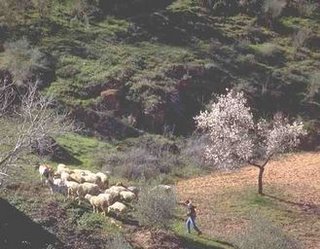
The Israelites were shepherds, do you remember what Joseph said about Egyptians and their view of the Israelite preoccupation? Sheepherding is an ancient occupation, one that Abraham, Isaac and Jacob prospered at, as well as cattle ranching and farming. But by the time we get to Exodus, there is no mention of Israel as shehperds, but as brick builders and slaves for the great construction projects of ancient Egypt. Why do you think they made the transition from prosperous shepherds to enslaved construction workers? Remember the famine, what did people have to do to get food to eat (thanks to Joseph's own policies!).
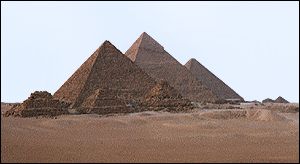
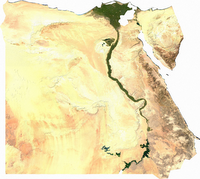
Egypt is a very dry place, except for where the Nile River runs through it (do you know which direction the river flows?). Egypt would be the home of Jacob's family for around 400 years...that is along time...along time for people to remember their God, their heritage, their historic occupations, their destiny, their identity. Egypt will take on much significance in the stories to come...
What about Moses, did you notice how often God got angry with him...what foreshadowing does that have for the nation as a whole? Note the confusion the people have, when they trust God and Moses, life gets harder before it gets better...how is that true in your life? Are you in Egypt? Do you need an Exodus? Do you need a New Genesis?
Several things to note in this story transition: remember that one of the purposes of Genesis is to give background to future characters, families and nations. The part of the story where Jacob blesses his sons and describes their futures was significant as background to future events (like Judah, for example...do you know why?). When Jacob blessed Ephraim instead of Mannaseh, did it remind you of another story? Again, this recorded event will come into play later in the life of the nation.
Did you know that the ancients would place their hand on the thigh of another man to make an oath - the thigh is the strongest muscle in the body, so it was figured that this act signified a strong bond of trust (we think it is normal to shake hands...an act that might strike them as very weird, if not wrong).
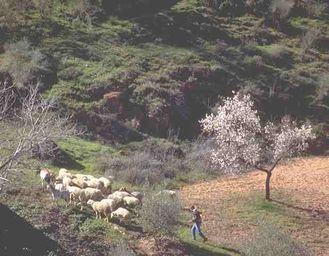
The Israelites were shepherds, do you remember what Joseph said about Egyptians and their view of the Israelite preoccupation? Sheepherding is an ancient occupation, one that Abraham, Isaac and Jacob prospered at, as well as cattle ranching and farming. But by the time we get to Exodus, there is no mention of Israel as shehperds, but as brick builders and slaves for the great construction projects of ancient Egypt. Why do you think they made the transition from prosperous shepherds to enslaved construction workers? Remember the famine, what did people have to do to get food to eat (thanks to Joseph's own policies!).

Egypt is a very dry place, except for where the Nile River runs through it (do you know which direction the river flows?). Egypt would be the home of Jacob's family for around 400 years...that is along time...along time for people to remember their God, their heritage, their historic occupations, their destiny, their identity. Egypt will take on much significance in the stories to come...
What about Moses, did you notice how often God got angry with him...what foreshadowing does that have for the nation as a whole? Note the confusion the people have, when they trust God and Moses, life gets harder before it gets better...how is that true in your life? Are you in Egypt? Do you need an Exodus? Do you need a New Genesis?

Tuesday, October 17, 2006
Hey Jude!
I have to admit...I'm behind on my reading. This past week was crazy. I'll get caught up soon though. Are some of you struggling with getting started? Staying with it? Catching up? Just do what you can. Read some everyweek. Tim Bauman suggested reading some sitting in your car before you head into work. Any other ideas to suggest?
About Jude...did you enjoy reading this short letter? It's kind of a weird epistle, the content includes a fascinating list of legendary, historical, and spiritual references to make a point: keep the faith, don't lost heart, stay holy, stick with Jesus.
Some interesting things to note: He is the brother of James (they guy who wrote the book you just finished reading the week before, which makes him a brother of Jesus Christ! Kind of a neat legacy for Jesus, two brothers contributing to the NT).
He says that Jesus led the people out of Egypt, though in Exodus it says that Moses did it.
He uses Sodom and Gomorrah as an example of how not to live.
He includes a legendary story about Michael the Archangel and the Devil - nowhere in Scripture does this little tiff get mentioned except here- and Jude uses it to teach how to respond to blasphemy...interesting use of legend.
He refers to Cain, Balaam, and Korah to discourage rebelliousness - do you know who he is referring to?
And the reference to Enoch? The quote comes from the Apocraphya...writings that Protestants don't include as Scripture, but the Catholics and Orthodox do.
Last observation, the prayer that Jude gives us to wrap up his letter is one of the most beautiful of the testament.
Why is this letter of Jude in the NT? You (and Jude's friends) live in a world where it is hard to stay with Jesus. It is easy to drift from Him. Do you feel like you are drifting? You never know you're drifting if you're eyes are on the boat or the water, only if you have the eyes up on the horizon... Have you been downcast lately? Downcastedness usually leads to drifting... Look up to Jesus. Now to him who is able to keep you from stumbling...
Tim
About Jude...did you enjoy reading this short letter? It's kind of a weird epistle, the content includes a fascinating list of legendary, historical, and spiritual references to make a point: keep the faith, don't lost heart, stay holy, stick with Jesus.
Some interesting things to note: He is the brother of James (they guy who wrote the book you just finished reading the week before, which makes him a brother of Jesus Christ! Kind of a neat legacy for Jesus, two brothers contributing to the NT).
He says that Jesus led the people out of Egypt, though in Exodus it says that Moses did it.
He uses Sodom and Gomorrah as an example of how not to live.
He includes a legendary story about Michael the Archangel and the Devil - nowhere in Scripture does this little tiff get mentioned except here- and Jude uses it to teach how to respond to blasphemy...interesting use of legend.
He refers to Cain, Balaam, and Korah to discourage rebelliousness - do you know who he is referring to?
And the reference to Enoch? The quote comes from the Apocraphya...writings that Protestants don't include as Scripture, but the Catholics and Orthodox do.
Last observation, the prayer that Jude gives us to wrap up his letter is one of the most beautiful of the testament.
Why is this letter of Jude in the NT? You (and Jude's friends) live in a world where it is hard to stay with Jesus. It is easy to drift from Him. Do you feel like you are drifting? You never know you're drifting if you're eyes are on the boat or the water, only if you have the eyes up on the horizon... Have you been downcast lately? Downcastedness usually leads to drifting... Look up to Jesus. Now to him who is able to keep you from stumbling...
Tim
Monday, October 16, 2006
Eight Years @ Anchor...
Sunday was a fun day for me. Parties are always fun, and I always enjoy our potlucks - especially the desserts. I was a bit disappointed there weren't more of them at this last potluck...there certainly was plenty of main courses though. Potlucks are always somewhat nostalgic for me, I remember as a kid meeting in the church basement, hanging out with all the other fifth graders, eating way too much good food. And desserts. Sometimes there were more desserts then main course...just the way I like it.
Hey, this post is supposed to be about Anchor...anyway, good potluck on Sunday.
Eight years...It's been a great time at Anchor...some of it has been very hard, but a lot of it has been very good.
If you want to walk down memory lane, go to the Anchor website and check out some of the pictures, there are lots of them there organized by year and event.
I think for me there have been different phases of my experience at Anchor. There was the start-up phase October 1998 - Summer 2000. There was the Hard Times phase Summer 2000 - Winter 2003. There was Lots of Change phase Spring 2003 - Spring 2007.
It's been a huge learning curve, being a pastor and starting a church. I've learned alot about people, about religion, about organizations, about expectations, about sin, about sorrow, about joy, about patience, about anger and frustration, about reconciliation, about deliverance, about failures, about getting back up, about trust, about letting go, about being content, about being ambitious, about being a leader, about being a teacher, about being a student, about being a husband, about being a father, about being a son, about being a brother, about being a nephew, about being an uncle, about being a friend, about being an acquaintance, about being...and becoming.
Some of my good memories of Anchor: the 2001 Mexico Mission Trip, the first Anchor anniversary 1999, the Tony/Marsha wedding 2005, softball and soccer, mens discipleship group, the Willow Creek Conference in 2003, the Neighborhood Relandscape Project 2006, and singing in church with my kids and wife. I also like to preach...I really, really enjoy it, alot.

What are some of your memories from the past eight years? We've had a lot of people come and bless Anchor, and Anchor has seen a lot of people go, to bless other churches and people. And we have lots and lots of people here as Anchor...which keeps me grateful and glad.
By the way - the best years are yet to come!
Tim
Hey, this post is supposed to be about Anchor...anyway, good potluck on Sunday.
Eight years...It's been a great time at Anchor...some of it has been very hard, but a lot of it has been very good.
If you want to walk down memory lane, go to the Anchor website and check out some of the pictures, there are lots of them there organized by year and event.
I think for me there have been different phases of my experience at Anchor. There was the start-up phase October 1998 - Summer 2000. There was the Hard Times phase Summer 2000 - Winter 2003. There was Lots of Change phase Spring 2003 - Spring 2007.
It's been a huge learning curve, being a pastor and starting a church. I've learned alot about people, about religion, about organizations, about expectations, about sin, about sorrow, about joy, about patience, about anger and frustration, about reconciliation, about deliverance, about failures, about getting back up, about trust, about letting go, about being content, about being ambitious, about being a leader, about being a teacher, about being a student, about being a husband, about being a father, about being a son, about being a brother, about being a nephew, about being an uncle, about being a friend, about being an acquaintance, about being...and becoming.
Some of my good memories of Anchor: the 2001 Mexico Mission Trip, the first Anchor anniversary 1999, the Tony/Marsha wedding 2005, softball and soccer, mens discipleship group, the Willow Creek Conference in 2003, the Neighborhood Relandscape Project 2006, and singing in church with my kids and wife. I also like to preach...I really, really enjoy it, alot.
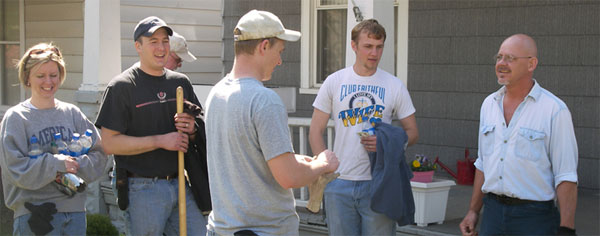
What are some of your memories from the past eight years? We've had a lot of people come and bless Anchor, and Anchor has seen a lot of people go, to bless other churches and people. And we have lots and lots of people here as Anchor...which keeps me grateful and glad.
By the way - the best years are yet to come!
Tim
Saturday, October 14, 2006
Tigers Win! Tigers Win! Tigers Win!

Did you see Ordonez's homerun? What a swing! What a hit! What a run!
Normally I would despise the Tigers. The animoisty was stoked while in middle school. I had just moved from Ontario, Canada to Michigan, USA. At that time, the Blue Jays and Tigers (1987) were both very competitve and big rivals. I was persecuted for my beliefs in the superiority of the Jays, but the infidel supporters of the Tigers could not dampen my enthusiasm for my team. But now almost twenty years later (did I just write that...twenty years!!! that's two decades...that's a long, long, long time...anyway), the Jays aren't able to compete with the Yankees or Bosox (teams which are a disgrace to the MLB).
So now the Tigers are hot, and I'll cheer for them instead of the Jays. I am a fan of the Cubs, but only because I like rooting for the underdog...which means I'll always be a Cubbie fan. The Tigers have been underdogs for years, which makes their spot in the world series so cool!
I love MLB playoffs...I try to watch all of the games, it's nostalgic. I remember watching MLB games as a little tyke up in the cold hinterland of Canada...we'd only get three channels in those days, and one of them was in French. Fortunately MLB was in English! Go Tigers!
Wednesday, October 11, 2006
Visitation in a Hospice Home

Today I visited in a hospice home with a long time member of our church. I've never been in a hospice center before. This particular one in Fort Wayne - Visiting Nurse and Hospice Home - is a beautiful facility on Homestead Road.
What was more beautiful was the atmosphere in the room, the attitude of Phyllis and her family. You only enter a hospice home if you are on the verge of death. You don't normally walk out of one alive, unless you went there prematurely. In hanging out with the Helvie family, I was moved by the total comfortableness they had with being there. Phyllis even said she had perfect peace about coming there... later she retracted the word perfect - at least she's honest. But it was easy to laugh about memories, talk candidly about facing death, to speak movingly about appreciating each day that comes.
Phyllis' daughter-in-law remarked that God must still want them to be together, since she'd been in the hospice home for over two weeks. It was clear that there was much affection and kindness being exuded in a most natural fashion amongst everyone. Life is on hold for the whole family, on standby, waiting for the phone call to come to the hospice home for that last moment together this side of heaven.
We talked about the advantage of taking plenty of time to prepare for death. Of making the choice to come to hospice and wait to die. But in this case, the waiting is reminescent of a daily family reunion and walks down pleasant memory lanes. And there is a strong anticipation of waking up one day adn instead of focusing eyes on the fluorescent lights on the ceiling, the eyes will be adjusting to The Light of the World...what a day that will be. Phyllis will be moving from one family reunion to another...she commented that she knows more people in Heaven than on Earth.
I read some Scripture with her - the text I am preaching from on Sunday. My theme for the sermon: become wise by binding up the brokenhearted; gain wisdom by attaching your life to one who suffers. My visit on Wednesday reminds me that this source of wisdom doesn't have to be morose. God gives beauty for ashes, joy for tears.
Tim
Joseph's Story
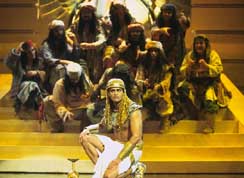
Have you ever seen the show, Joseph and the Amazing Technicolor Dreamcoat? I have once, while in college. My wife was played/danced in it - I think she was Zebulon's wife. Great show. I bought the soundtrack for my wife several years ago for Christmas - and my daughter "swiped" it and ended up listening and dancing to it all the time - great music. If you don't have the soundtrack - get it; if you've not seen the play, see it. And if you're like me, you've not read the story in Genesis for too long - what'd you think? Who could make up that kind of story?
Remember that one of the functions of this story is to provide historical background to how the Israelites ended up in Egypt. Moses (the supposed author) is writing this story (either while a student in Egypt or the leader in the wilderness) for his people. They've kept the oral tradition alive (who couldn't keep telling these stories!), and know he's putting it down on papyrus. People need to remember their past - where they've been, where they've come from, what they used to be, who they used to be... so that you can understand who you are becoming, where you are going, what you are doing. Joseph is what is best about Israel. Compared to the faults of Levi, Simeon, Reuben and Judah (do you remember what they're faults were? Do you know what the significance of Levi and Judah will be in the future?), Joseph is a saint. Notice that Joseph had the hand of God on him - for such a time as this (like Esther).
Do you know how Joseph proved who he was to his brothers? He lifted his skirt to show he was circumcised. (No wonder he told his attendents to leave the room!).
The phrase in chapter 37 "but his father kept the saying in mind" sounds a lot like Mary and her response to Jesus at the Temple (did you find any parallels between Jesus and Joseph...do you think Jesus annoyed anybody by being so brilliant...surely somebody got jealous!)
I found it interesting that Judah is interceeding on behalf of another, offering his life for the life of Benjamin (Judah is the ancestor of Jesus...not Joseph...how interesting!).
Joesph's name means "may he add" - how did Joseph live up to his name?
Judah's name means "praise" how did Judah not live up to his name?
Did you notice that Joseph told his brothers not to fight with each other while on their way home...what was that all about - he sounds like their father getting them ready for a long car ride.
What about Joseph's interpretation of God's reason for why Joseph is in captivity? Does that give you hope for your situation?
Tim
Tuesday, October 10, 2006
The Final Chapter of James
James hits the rich with a right hand hook, and then comes back with a left jab to the oppressed. This last chapter shoots straight - don't read through it quickly, unless you don't want to be convicted.
Verses 1-6 are for the rich. That is you and me. If you live in America, you are rich. Don't measure your're wealth compared to where you live in Fort Wayne, or in Indiana. If you own a car, compared to the 92% of the world's population that does not own a car - YOU ARE RICH. Which means you ought to be convicted by the words of James in this chapter. Take it personally. Go ahead and be offended...and then repent.
Verses 7-12 are for the oppressed. The disadvanaged. The abused. BE PATIENT & DON'T JUDGE! DON'T CRUMPLE UNDER INJUSTICE - let your yes be yes and your no be no...no quibbling or buttkissing to those in power.
Verses13-20 is for everyone - if you are sick or unwell, before you go to the doctor, confess your sins one to another for healing. For those of you skeptical of this verse - it would help if you didn't automatically think of broken arms, cancerous masses, and other external wounds. Most people get sick and need healing because of their lifestyle and choices - STRESS, LACK of SLEEP, EATING UNHEALTHY FOOD, Not MEDITATING are major causes of MOST ailments: high blood pressure, anxiety, heart problems, blah, blah, blah. Holding on to hurts and grudges, staying bitter or fearful, being mean or coldhearted, staying bigoted or racist, etc will ruin your health and make you sick. CONFESS YOUR SINS - get a clean heart. Asking for forgiveness from God is good, but confessing your sins to God in the presence of other believers is how you experience the forgiveness.
As your pastor I am here to hear your confessions. If someone has wronged you, or you have wronged others, and you are holding onto those wrongs in your heart, you will make wrong decisions and stay burdened. You are driving a sinful wedge between you and God and you and others. STOP IT!!!!!!!! Oh wait, that's right, you don't really sin...at least no serious sins...you just get impatient once in awhile... nothing that serious.
Whatever.
There has got to be more to the Christian life then is evidenced by the Christians I know.
Tim
(Does this blog entry sound a bit...harsh? I'm just trying to match the directness of James - I don't want to soften the blow of his words of wisdom. And I don't write it with a chip on my shoulder or a sense of superiority...I write it as a seeker, one who is deeply aware of my sins, but one who is also deeply aware of God's grace. But sugar-coating your life, or trying to view it as more holy then it really is won't get you anywhere. Call it for what it is...then you can move forward in Christ.)
(I also realize as a young man there are many older Christians who are wiser and holier then I am. But those Xians are also the ones who acknowledge their shortcomings and gratitude on God's grace. It's hard to handle those Christians who never seem to do anything wrong. It's hard not to be skeptical.)
(Maybe I'm being too honest with my thoughts...but it's how I see things at this point in my life...and I know I still have a lot to learn about what Christiantiy looks like in my life and in the lives of others...especially with others whose story I only know fragments.)
Verses 1-6 are for the rich. That is you and me. If you live in America, you are rich. Don't measure your're wealth compared to where you live in Fort Wayne, or in Indiana. If you own a car, compared to the 92% of the world's population that does not own a car - YOU ARE RICH. Which means you ought to be convicted by the words of James in this chapter. Take it personally. Go ahead and be offended...and then repent.
Verses 7-12 are for the oppressed. The disadvanaged. The abused. BE PATIENT & DON'T JUDGE! DON'T CRUMPLE UNDER INJUSTICE - let your yes be yes and your no be no...no quibbling or buttkissing to those in power.
Verses13-20 is for everyone - if you are sick or unwell, before you go to the doctor, confess your sins one to another for healing. For those of you skeptical of this verse - it would help if you didn't automatically think of broken arms, cancerous masses, and other external wounds. Most people get sick and need healing because of their lifestyle and choices - STRESS, LACK of SLEEP, EATING UNHEALTHY FOOD, Not MEDITATING are major causes of MOST ailments: high blood pressure, anxiety, heart problems, blah, blah, blah. Holding on to hurts and grudges, staying bitter or fearful, being mean or coldhearted, staying bigoted or racist, etc will ruin your health and make you sick. CONFESS YOUR SINS - get a clean heart. Asking for forgiveness from God is good, but confessing your sins to God in the presence of other believers is how you experience the forgiveness.
As your pastor I am here to hear your confessions. If someone has wronged you, or you have wronged others, and you are holding onto those wrongs in your heart, you will make wrong decisions and stay burdened. You are driving a sinful wedge between you and God and you and others. STOP IT!!!!!!!! Oh wait, that's right, you don't really sin...at least no serious sins...you just get impatient once in awhile... nothing that serious.
Whatever.
There has got to be more to the Christian life then is evidenced by the Christians I know.
Tim
(Does this blog entry sound a bit...harsh? I'm just trying to match the directness of James - I don't want to soften the blow of his words of wisdom. And I don't write it with a chip on my shoulder or a sense of superiority...I write it as a seeker, one who is deeply aware of my sins, but one who is also deeply aware of God's grace. But sugar-coating your life, or trying to view it as more holy then it really is won't get you anywhere. Call it for what it is...then you can move forward in Christ.)
(I also realize as a young man there are many older Christians who are wiser and holier then I am. But those Xians are also the ones who acknowledge their shortcomings and gratitude on God's grace. It's hard to handle those Christians who never seem to do anything wrong. It's hard not to be skeptical.)
(Maybe I'm being too honest with my thoughts...but it's how I see things at this point in my life...and I know I still have a lot to learn about what Christiantiy looks like in my life and in the lives of others...especially with others whose story I only know fragments.)
Monday, October 09, 2006
Psalm 119 - Letter "He" (pronounced "hchay")
I just finished up my Old Testament class on the Prophetic Books. My professor has been elaborating the point that one cannot understand the New Testament apart from the Old Testament. At first this may sound somewhat biased...of course an OT guy is going to say that to be true. But a simple reading of Jesus and Paul should quickly alert the reader that the OT is important, it is quoted directly and indirectly repeatedly throughout their teachings. As this class progressed, it became clearer and clearer to me how muddled my understanding of the Scriptures is, even after all of my studies. At first this sounds discouraging, but it is actually inspiring. Like you, I want to know my Bible better. And like you, I have so much more to learn. And like you, the more I get into it and study, the more I understand, and the more I understand, the more illumination I receive upon the truth.
This takes me to our Psalm 119 reading this past Sunday. In the ESV reading, it goes "Teach me, O Lord, the way of your statues, and I will keep it to the end". That is what Jesus did...he says in John that He only did what the Father instructed him to do...and he taught us the way of God, that we might follow it to the end. Verse 34 ends with "observe it with my whole heart" which sounds like the Great Commandment.
Basically, the more you understand the Old Testament, the more you'll understand the New Testament. Right now, in your Scripture reading, you are reading a lot of OT stuff...just know that the more you "get" the OT stuff, the more illuminating will be your NT readings. When you read the NT, be looking for OT connections.
If you have questions, post them...others are sure to have similar ones.
Tim
This takes me to our Psalm 119 reading this past Sunday. In the ESV reading, it goes "Teach me, O Lord, the way of your statues, and I will keep it to the end". That is what Jesus did...he says in John that He only did what the Father instructed him to do...and he taught us the way of God, that we might follow it to the end. Verse 34 ends with "observe it with my whole heart" which sounds like the Great Commandment.
Basically, the more you understand the Old Testament, the more you'll understand the New Testament. Right now, in your Scripture reading, you are reading a lot of OT stuff...just know that the more you "get" the OT stuff, the more illuminating will be your NT readings. When you read the NT, be looking for OT connections.
If you have questions, post them...others are sure to have similar ones.
Tim
Saturday, October 07, 2006
Emma's Haircut
1. Emma had her hair cut for the first time on Friday.


It was a Mommy/Daughter trip, but I at least was able to convince them not to cut too much of her golden locks off.

2. They had a wonderful time, Emma even had her fingernails painted pink! Very cute.

Emma is going to be 4 in March, so she's gone a long time without even a trim.

3. Now it is Saturday night and Emma is finishing her popcorn. She watched a Strawberry Shortcake movie. Every Saturday night is bath night, and movie night with popcorn - a nice little tradition.
4. After I finish writing this sentence Emma will be going to bed; she'll brush her teeth, we'll read a story to her, she'll receive a drink of water, we'll put the book away, we'll pray together, we'll hug and kiss, and then I'll turn on the music, we'll shut off the lights and then she tells me an impromptu story. It is always fun!
5. (the numbers were Emma's idea! - she even typed them herself...she insisted)
Tim


It was a Mommy/Daughter trip, but I at least was able to convince them not to cut too much of her golden locks off.

2. They had a wonderful time, Emma even had her fingernails painted pink! Very cute.

Emma is going to be 4 in March, so she's gone a long time without even a trim.

3. Now it is Saturday night and Emma is finishing her popcorn. She watched a Strawberry Shortcake movie. Every Saturday night is bath night, and movie night with popcorn - a nice little tradition.
4. After I finish writing this sentence Emma will be going to bed; she'll brush her teeth, we'll read a story to her, she'll receive a drink of water, we'll put the book away, we'll pray together, we'll hug and kiss, and then I'll turn on the music, we'll shut off the lights and then she tells me an impromptu story. It is always fun!
5. (the numbers were Emma's idea! - she even typed them herself...she insisted)
Tim
John 10-12
This section of the gospel is chock full of good stuff. As you read, you can sense the honest struggle that people are having with Jesus - what to do with him? Soren Kierkegaard points out that people living today would react the same way to Jesus if they lived back then, or if Jesus showed up now. Jesus would be just as confusing, just as brilliant, just as disturbing, just as free, just as powerful, just as frustrating, just as compassionate, just as infuriating, just as kind, just as patient, just as honest, just as itinerant today as he was then. When you read, do you just assume that you agree with what Jesus teaches and does?
Religious people had a hard time accepting Jesus- if you're religious now, you may struggle with accepting Jesus as he really is (you may prefer a sanitized version...) (see reaction to Jesus' Good Sheperd sermon)
Political people had a hard time accepting Jesus - if you're political now, you may resent Jesus since he can either make you look like power-grabber or a people-user. (see reaction to the Triumphal Entry & Lazarus' Resurrection)
Ordinary people had a hard time accepting Jesus - if you're part of the status quo, you don't want anyone to bring change that might result in you losing some of your preferred habits and privileges. (see John's quote of Isaiah)
JesusFollowers even had a hard time with Jesus - they often didn't understand what he was teaching, didn't know why he was doing what he was doing, bickered and argued amongst themselves; misunderstood what Jesus was all about (see Martha)
Maybe that is why belief is a main theme of these three chapters - what pleases Jesus is that we start off with belief...this must mean that belief is a radical step and is NOT as easy as we think it may be. "I have come into the world as light, so that whoever believes in me may not remain in darkness." (John 12:48)
What do you think that verse means? If you are not sure, reread John 1. What lights up your life? Don't be too quick to declare Jesus as your light...it might be worth examining what flashlights you hold in your hands as substitutes for belief in Jesus. It is hard to believe in Jesus...that's why it is so easy to live in the light of something other then Him.
"Sir, we wish to see Jesus." (John 12:21)
Tim
Religious people had a hard time accepting Jesus- if you're religious now, you may struggle with accepting Jesus as he really is (you may prefer a sanitized version...) (see reaction to Jesus' Good Sheperd sermon)
Political people had a hard time accepting Jesus - if you're political now, you may resent Jesus since he can either make you look like power-grabber or a people-user. (see reaction to the Triumphal Entry & Lazarus' Resurrection)
Ordinary people had a hard time accepting Jesus - if you're part of the status quo, you don't want anyone to bring change that might result in you losing some of your preferred habits and privileges. (see John's quote of Isaiah)
JesusFollowers even had a hard time with Jesus - they often didn't understand what he was teaching, didn't know why he was doing what he was doing, bickered and argued amongst themselves; misunderstood what Jesus was all about (see Martha)
Maybe that is why belief is a main theme of these three chapters - what pleases Jesus is that we start off with belief...this must mean that belief is a radical step and is NOT as easy as we think it may be. "I have come into the world as light, so that whoever believes in me may not remain in darkness." (John 12:48)
What do you think that verse means? If you are not sure, reread John 1. What lights up your life? Don't be too quick to declare Jesus as your light...it might be worth examining what flashlights you hold in your hands as substitutes for belief in Jesus. It is hard to believe in Jesus...that's why it is so easy to live in the light of something other then Him.
"Sir, we wish to see Jesus." (John 12:21)
Tim
Ministry on 3rd Street & Third Avenue
My Mum (Canadien for "Mom") sent me the following article about the Detroit Rescue Mission. A close relative of her father started that mission in 1909. I thought that it was a fascinating piece of personal history. Here I am, a hundred years later, trying to do ministry in the same spirit like my distant relative (my Mum informed me that David Stucky was her father's father's brother). The story is different, but the calling to serve is similar. It makes me proud to be a Stucky - even though I've not met many of them. I never knew my Grandpa Stucky, he died of a heart-attack when my Mum was in college. I hear lots of stories about him though...my Mum likes to tell stories of our family history. She likes to remind me that William Wallace, the Scottish liberator of the 13th century (fictionalized in the movie Braveheart) is part of our family tree! I'm glad my Mum passed this story on to me. It inspires me - you just can't know what God will do with you or your work a hundred years after you take the first step of obedience. Faith is the ground of action, and why obedience is the sign of love.
************
The Detroit Rescue Mission Ministries, a non-profit corporation, is committed to sharing the gospel of the love of Jesus Christ, providing hope to the hopeless, disadvantaged, abused and homeless men, women and children of our community. In "rebuilding the inner-city, one life at time" by ministering to the total person - body, soul and spirit - we help them become faithful Christians, discipled into a local church, rehabilitated, employed and living productive lives in restored families.
Description:
The Detroit Rescue Mission Ministries, one of the largest organization of its type in the country, helps over 900 individuals a day. It provides a variety of programs aimed at rebuilding lives "one life at a time". Our programs include emergency shelters, medical detox unit, residential substance abuse treatment programs, transitional housing programs, teen mom's program, Veterans programs, mental health programs, permanent housing and apartments, emergency food programs , prevention programs for children and summer camp opportunites . We also provide educational, tutorial and vocational services.
**History:
The Detroit Rescue Mission Ministries was founded by David C. Stucky on February 14, 1909. He moved his family to Detroit from Saginaw with a $1.50 to get medical treatment for his daughter who was stricken with polio. When he arrived here he felt that God wanted him to open a Mission. He rented an old poultry store to house the Mission. Mr. Stucky had to borrow and beg for chairs. He did not have music because he did not have $30.00 to purchase an organ. Following a strong prompting from the Lord, Mr. Stucky went home to find a letter containing a donation of $30.00. With a thankful heart, Mr. Stucky bought an organ for the first service on February 14th. The Mission grew over the years and moved to other sites to continue to help families in need. On January 30, 1963, the Mission moved into its present location at 3535 Third Avenue, in the heart of the Cass Corridor. While operating as a soup kitchen we began to notice that we were continually seeing the same people, we also noticed that many of these individuals were addicted to drugs and that the numbers were increasing. We were thankful to be able to provide services for these indivduals, however ... because we were Christians we wanted to do more to affect a permanent change in their lives. It was then that we began expanding our scope of services so that we could affect a permanent change in the lives of these individuals.
Today we are not only providing services for those who are addicted to drugs, we are also helping families who are homeless because of poor economic conditions and other social ills that plague our communities. We are currently operating out of 11 main facilites providing an array of services and programs to help the lost, the lonely abused men, women and children become rehabilitated, employed and living productive lives in restored families.
************
The Detroit Rescue Mission Ministries, a non-profit corporation, is committed to sharing the gospel of the love of Jesus Christ, providing hope to the hopeless, disadvantaged, abused and homeless men, women and children of our community. In "rebuilding the inner-city, one life at time" by ministering to the total person - body, soul and spirit - we help them become faithful Christians, discipled into a local church, rehabilitated, employed and living productive lives in restored families.
Description:
The Detroit Rescue Mission Ministries, one of the largest organization of its type in the country, helps over 900 individuals a day. It provides a variety of programs aimed at rebuilding lives "one life at a time". Our programs include emergency shelters, medical detox unit, residential substance abuse treatment programs, transitional housing programs, teen mom's program, Veterans programs, mental health programs, permanent housing and apartments, emergency food programs , prevention programs for children and summer camp opportunites . We also provide educational, tutorial and vocational services.
**History:
The Detroit Rescue Mission Ministries was founded by David C. Stucky on February 14, 1909. He moved his family to Detroit from Saginaw with a $1.50 to get medical treatment for his daughter who was stricken with polio. When he arrived here he felt that God wanted him to open a Mission. He rented an old poultry store to house the Mission. Mr. Stucky had to borrow and beg for chairs. He did not have music because he did not have $30.00 to purchase an organ. Following a strong prompting from the Lord, Mr. Stucky went home to find a letter containing a donation of $30.00. With a thankful heart, Mr. Stucky bought an organ for the first service on February 14th. The Mission grew over the years and moved to other sites to continue to help families in need. On January 30, 1963, the Mission moved into its present location at 3535 Third Avenue, in the heart of the Cass Corridor. While operating as a soup kitchen we began to notice that we were continually seeing the same people, we also noticed that many of these individuals were addicted to drugs and that the numbers were increasing. We were thankful to be able to provide services for these indivduals, however ... because we were Christians we wanted to do more to affect a permanent change in their lives. It was then that we began expanding our scope of services so that we could affect a permanent change in the lives of these individuals.
Today we are not only providing services for those who are addicted to drugs, we are also helping families who are homeless because of poor economic conditions and other social ills that plague our communities. We are currently operating out of 11 main facilites providing an array of services and programs to help the lost, the lonely abused men, women and children become rehabilitated, employed and living productive lives in restored families.
Thursday, October 05, 2006
Why I Keep My Mustang
When I was 16 my Aunts gave me a 1966 Ford Mustang. It was one of those gifts I never fathomed receiving. It was a speechless moment. I didn't deserve that car. I received it on a February night, following one of my high school basketball games. They made me drive the van home, and when I pulled up to our house, there was this car sitting on the driveway cement pad all bathed in lights with a big red bow on it. At first I wasn't sure what was going on...why was this really cool car sitting on my dad's driveway. And then came the explanation: I was supposed to get it on my birthday, but the car was not ready yet. Also, I got a huge speeding ticket days after my birthday - my parents grounded me for three months - which covered Christmas. So my aunts couldn't give me the car till my jail sentence was over. It was a very fun gift to receive and use! I obviously always drove the speed limit and obeyed every single traffic law, since my car was a precious gift to me...
It was a fun car to have in high school and college. My friends would ask to use my car to take a girl on a date. Or we would pile lots of people into it, head for town to a movie or something like that. When Tara and I got married in August, we had her Omni and my Mustang...I obviously had the coolest car! It was too cool though, cause in January when the temperature hit freezing, my heater quit working, and I didn't have enough money to fix it, and the Omni wasn't working well, and my wife didn't like driving the Mustang for reasons I'll never understand (!), so we shelved the Mustang and bought a Geo Metro!!!!! (it was black, so it was still cool to drive).
That was almost ten years ago. In those ten years I haven't driven my car very much. I've been busy, not enough money, no good reasons, afraid of messing up the engine, etc. And the car is not holding up as well. Whenever I go to my friends house for one of his kids birthday parties, a relative of his always offers to buy my Mustang. I always tell him no, but I think my wife keeps encouraging him! I don't have the money to fix it up right, or to pay insurance for it, or to keep it running. So why do I keep it?
I like to entertain the thought that someday me and the boys will spend lots of time together under the hood. My mechanic friends tell me that a 1966 Mustang is the perfect car to tinker on...I almost believe them. So I hang on to the car, even though others could take better care of it. I hang on to it because it was a gift, and I hope to use that gift to build some neat memories with my kids. Maybe someday, in 2026 my boys will be driving around a sixty year old car that they helped fix up...and when they drive it - going the speed limit and obeying all traffic laws and environmental reguluations - they'll have just as much fun remembering the stories we generated in trying to fix the car up.
I think a neat use for the car would be this: when Emma starts dating at age 29, (okay, at least maybe when she is sixteen...) I'll let her drive the Mustang for the date...or if I approve of her boyfriend, he can drive the car...but on one condition: she has to let her brothers sit in the back seat and go along on the date. I figure that the boyfriend will love the idea of driving the Mustang more then he loathes the idea of having Emma's brothers sitting in the back seat. This way Emma stays out of trouble, the Mustang gets put to good use, and I have nothing to worry about...
It was a fun car to have in high school and college. My friends would ask to use my car to take a girl on a date. Or we would pile lots of people into it, head for town to a movie or something like that. When Tara and I got married in August, we had her Omni and my Mustang...I obviously had the coolest car! It was too cool though, cause in January when the temperature hit freezing, my heater quit working, and I didn't have enough money to fix it, and the Omni wasn't working well, and my wife didn't like driving the Mustang for reasons I'll never understand (!), so we shelved the Mustang and bought a Geo Metro!!!!! (it was black, so it was still cool to drive).
That was almost ten years ago. In those ten years I haven't driven my car very much. I've been busy, not enough money, no good reasons, afraid of messing up the engine, etc. And the car is not holding up as well. Whenever I go to my friends house for one of his kids birthday parties, a relative of his always offers to buy my Mustang. I always tell him no, but I think my wife keeps encouraging him! I don't have the money to fix it up right, or to pay insurance for it, or to keep it running. So why do I keep it?
I like to entertain the thought that someday me and the boys will spend lots of time together under the hood. My mechanic friends tell me that a 1966 Mustang is the perfect car to tinker on...I almost believe them. So I hang on to the car, even though others could take better care of it. I hang on to it because it was a gift, and I hope to use that gift to build some neat memories with my kids. Maybe someday, in 2026 my boys will be driving around a sixty year old car that they helped fix up...and when they drive it - going the speed limit and obeying all traffic laws and environmental reguluations - they'll have just as much fun remembering the stories we generated in trying to fix the car up.
I think a neat use for the car would be this: when Emma starts dating at age 29, (okay, at least maybe when she is sixteen...) I'll let her drive the Mustang for the date...or if I approve of her boyfriend, he can drive the car...but on one condition: she has to let her brothers sit in the back seat and go along on the date. I figure that the boyfriend will love the idea of driving the Mustang more then he loathes the idea of having Emma's brothers sitting in the back seat. This way Emma stays out of trouble, the Mustang gets put to good use, and I have nothing to worry about...
Wednesday, October 04, 2006
Jacob's Story
So what do you think of Jacob, having read most of his life story? Please don't be pious or "spiritual" in your evaluation of him. Would you let this kind of husband or father be a member in your church?
As you read through Genesis, try to place yourself in the shoes (or sandals) of Israel - they are just settling into the Promised Land having spent 40 years in the wilderness. They are trying to remember their roots, trying to get a sense of who they are, how they got to where they are at now, and who they are to become. As you read Jacob's story, you find out where the nation Israel got its name...what does that story tell you about what the nation will become like? This is the man through whom a nation will be born that will bless the whole world...this is the nation that Jesus will come from...what does this tell you about whom God will use to bless the world? What does this tell you about Jesus?
What did you think of the stories about the women in Jacob's life? Very honest stories, did you catch any of the emotional depth rooted in the accounts? What must it have been like for Leah to be unloved? What was it like for Rachel to be loved, yet barren (a sign of cursedness - very undesirable)? What was it like for Dinah to be raped and then loved and then avenged? Why do you think that story is in there? What do the preceeding chapters and following chapters gain by having the story of Dinah included? (Hint, the story has alot to do with Simeon and Levi...this event will come up again near the end of the book).
Did you catch any of the humor? Rachel can't stand up off the camel saddle because it's "that time of the month" - what a deceiver, just like her hubby. Or the story of Jacob turning unblemished goats into spotted and striped ones. Or the story of Jacob convincing a whole town of men to get circumcised so the Prince can have Dinah. Or the story of Esau giving Jacob a big bear hug (who would have expected that?!?).
Did you also catch the "bartering" between Jacob and Laban and between Jacob and Esau?
Don't read the Scriptures as solemn words you have to read...these are ancient stories that have endured the ages because they contain profound truth - profound truth that is startling, disturbing, enlightening, encouraging, probing, memorable.
The story of Jacob is more then just about Jacob - it is the story of the foundations of Israel and Jesus; it is also the story of God. God identifies himself as the God of Jacob...so what kind of God do we serve? Do you remember the promise that God made to Jacob? It is a stunning promise that Paul rearticulates in Romans 8..."nothing can seperate us from the love of God"...Paul got most of his stuff from the OT - he didn't present much new material...he just understood Jesus as the fulfillment of everything in the OT.
Are you enjoying Genesis? What are you learning? Post a comment for others to read...
Tim
As you read through Genesis, try to place yourself in the shoes (or sandals) of Israel - they are just settling into the Promised Land having spent 40 years in the wilderness. They are trying to remember their roots, trying to get a sense of who they are, how they got to where they are at now, and who they are to become. As you read Jacob's story, you find out where the nation Israel got its name...what does that story tell you about what the nation will become like? This is the man through whom a nation will be born that will bless the whole world...this is the nation that Jesus will come from...what does this tell you about whom God will use to bless the world? What does this tell you about Jesus?
What did you think of the stories about the women in Jacob's life? Very honest stories, did you catch any of the emotional depth rooted in the accounts? What must it have been like for Leah to be unloved? What was it like for Rachel to be loved, yet barren (a sign of cursedness - very undesirable)? What was it like for Dinah to be raped and then loved and then avenged? Why do you think that story is in there? What do the preceeding chapters and following chapters gain by having the story of Dinah included? (Hint, the story has alot to do with Simeon and Levi...this event will come up again near the end of the book).
Did you catch any of the humor? Rachel can't stand up off the camel saddle because it's "that time of the month" - what a deceiver, just like her hubby. Or the story of Jacob turning unblemished goats into spotted and striped ones. Or the story of Jacob convincing a whole town of men to get circumcised so the Prince can have Dinah. Or the story of Esau giving Jacob a big bear hug (who would have expected that?!?).
Did you also catch the "bartering" between Jacob and Laban and between Jacob and Esau?
Don't read the Scriptures as solemn words you have to read...these are ancient stories that have endured the ages because they contain profound truth - profound truth that is startling, disturbing, enlightening, encouraging, probing, memorable.
The story of Jacob is more then just about Jacob - it is the story of the foundations of Israel and Jesus; it is also the story of God. God identifies himself as the God of Jacob...so what kind of God do we serve? Do you remember the promise that God made to Jacob? It is a stunning promise that Paul rearticulates in Romans 8..."nothing can seperate us from the love of God"...Paul got most of his stuff from the OT - he didn't present much new material...he just understood Jesus as the fulfillment of everything in the OT.
Are you enjoying Genesis? What are you learning? Post a comment for others to read...
Tim
Monday, October 02, 2006
Poetry of the OT
As you read the Psalms and other poetry of the OT, try and catch the overall theme of the section, rather than focusing on one verse. Hebrew poetry is about ideas, and poetry is about ideas that can't be expressed in story form, instruction manual form, or as a list. When you read Hebrew poetry, try to identify what the emotion was that drove the poet to write. Sometimes the main point of the poem is at the beginning, often it is in the middle, and sometimes it is at the end. Sometimes a poem will say the samething at the beginning and end, and something unique in the middle. Hebrew poets love patterns: abab, or aabb, or abba, or abccba. These patterns mean line one (a) and line two (b) don't just stand by themselves, they are used by the poet in an imaginative way to convey thoughts that can only be expressed in art.
Hope this helps...I'll try to make Hebrew poetry a delight (but most of that depends on the Spirit and you!).
Tim
Hope this helps...I'll try to make Hebrew poetry a delight (but most of that depends on the Spirit and you!).
Tim
Sunday, October 01, 2006
Disturbed by God's Word...
It is just after 6am and I just finished my readings for last week and for today. I had about five chapters to read, so not much...but what I did read this morning is bothering me. Earlier in the week I read the assigned chapters for Genesis, except the last chapter - 27. It is the story of Jacob decieving Esau. I just couldn't bring myself to read it earlier in the week...I hate that story. Maybe it is because I'm an older brother like Esau, maybe it is because I know I can be like Jacob. I'm bothered by the brazen deceptiveness of Rebekah, the mother. I pity Isaac, being played as a fool by his wife and son. My heart was bothered by the violent reaction of both Isaac and Esau when they discovered they were tricked, and I felt sorrow for Esau as he begged for a blessing. Even now, as I write, I find myself sighing in annoyance at Rebekah and Jacob...and God. What kind of God uses people like this to accomplish his holy and sovereign plan? This isn't how the story is supposed to go? God is only supposed to use people like...um...uh...hmmm.....well all I know is that the story still bothers me. Did it bother you?
Job's speech in chapter 3 bothered me...what graphic poetic language describing his disgust at the day he was born...
Psalm 10 bothered me...here is a man praying on behalf of the oppressed, the orphans, the widows, the innocent, the cheated, the victims of abuse and injustice...and his prayers question God...question his availability, his goodness, his power. And yet the Psalm ends with the poet affirming God's coming vengeance on the wicked. What bothered me was this: when's the last time I prayed for the people this man prayed for with this man's passion and urgency and sincerity? I know when the last time I prayed for myself like that...but for those kind of people? I'm bothered by my callous heart...(Here again I am bothered with something about me....someday soon I'll be bothered on behalf of other people....someday...).
I was disturbed by God's Word...were you?
Job's speech in chapter 3 bothered me...what graphic poetic language describing his disgust at the day he was born...
Psalm 10 bothered me...here is a man praying on behalf of the oppressed, the orphans, the widows, the innocent, the cheated, the victims of abuse and injustice...and his prayers question God...question his availability, his goodness, his power. And yet the Psalm ends with the poet affirming God's coming vengeance on the wicked. What bothered me was this: when's the last time I prayed for the people this man prayed for with this man's passion and urgency and sincerity? I know when the last time I prayed for myself like that...but for those kind of people? I'm bothered by my callous heart...(Here again I am bothered with something about me....someday soon I'll be bothered on behalf of other people....someday...).
I was disturbed by God's Word...were you?
Thursday, September 28, 2006
John 7-9
These three chapters of John contain some of the most famous quotes, quips and confrontations of Jesus' ministry. Chapter 7 contains a lively discussion between Jesus and some of his fellow citizens. Chapter 8 is the story of the Woman Caught in Adultery, and then the famous verse: the truth will set you free...if the Son sets you free, you are free indeed. Jesus ends the chapter with almost getting stoned by rocks. Chapter 9 is a funny, insightful and realistic story of two reactions to Jesus.
What themes did you find in these three chapters? Key words like light/dark, sin/freedom, belief/blindness, healing/hope.
C.S. Lewis famously described three options that people can have about Jesus: upon reading the Gospels you can come to one of three logical conclusions - Jesus was either a lunatic (see the comments about Jesus made in chapter 7), Jesus was a liar (see comments made about Jesus in chapter 9) or Jesus was Lord (see the response of Nicodemus, the Woman, the Blind Man).
As you read through the Scriptures, be praying for the Spirit to illuminate your mind and open up your heart to what He needs to teach/transform in you. Don't just read to get through the content, be reading to get God's Word in Your Heart.
Note also the contention surrounding Jesus: he is a prophet confronting the established religion of the day - he is getting the same general reception as all the other prophets (Isaiah was, according to legend, sawed in half; Jeremiah was put in stocks, thrown in a sewer pit, and beat up; Ezekiel was mocked...etc). Jesus came as a son of Abraham, the Blessing promised in Genesis 12. Jesus was come to fulfill the Torah and the Promises of the Prophets. What made it so hard to accept Jesus and his Message was that, in regard to the established religion people he undermined their power, exposed their falsity, pointed out their wickedness and greed; in regard to the average person Jesus' teachings were way too good to be true.
Jesus has the same effect today. He calls a spade a spade, and his promises seem too good to be true. We struggle with believing what Jesus teaches and we struggle with accepting it and we struggle with obeying it. We like to pretend something we're not (usually posing as better then we really are); and we get a bit jaded and cynical about what good can be done in the world. And yet for those that dare to believe and follow Jesus (Nicodemus & power, Woman and Blind man & news too good to be true), life ends up different...if the Son sets you free, you are free indeed...
...how free do you feel these days?
...how burdened do you feel?
...how blind do you feel?
"Does no one condemn you?"
"No one, Master."
"Neither do I" said Jesus. "Go on your way. From now on, don't sin."
Is that your story too?
Tim
What themes did you find in these three chapters? Key words like light/dark, sin/freedom, belief/blindness, healing/hope.
C.S. Lewis famously described three options that people can have about Jesus: upon reading the Gospels you can come to one of three logical conclusions - Jesus was either a lunatic (see the comments about Jesus made in chapter 7), Jesus was a liar (see comments made about Jesus in chapter 9) or Jesus was Lord (see the response of Nicodemus, the Woman, the Blind Man).
As you read through the Scriptures, be praying for the Spirit to illuminate your mind and open up your heart to what He needs to teach/transform in you. Don't just read to get through the content, be reading to get God's Word in Your Heart.
Note also the contention surrounding Jesus: he is a prophet confronting the established religion of the day - he is getting the same general reception as all the other prophets (Isaiah was, according to legend, sawed in half; Jeremiah was put in stocks, thrown in a sewer pit, and beat up; Ezekiel was mocked...etc). Jesus came as a son of Abraham, the Blessing promised in Genesis 12. Jesus was come to fulfill the Torah and the Promises of the Prophets. What made it so hard to accept Jesus and his Message was that, in regard to the established religion people he undermined their power, exposed their falsity, pointed out their wickedness and greed; in regard to the average person Jesus' teachings were way too good to be true.
Jesus has the same effect today. He calls a spade a spade, and his promises seem too good to be true. We struggle with believing what Jesus teaches and we struggle with accepting it and we struggle with obeying it. We like to pretend something we're not (usually posing as better then we really are); and we get a bit jaded and cynical about what good can be done in the world. And yet for those that dare to believe and follow Jesus (Nicodemus & power, Woman and Blind man & news too good to be true), life ends up different...if the Son sets you free, you are free indeed...
...how free do you feel these days?
...how burdened do you feel?
...how blind do you feel?
"Does no one condemn you?"
"No one, Master."
"Neither do I" said Jesus. "Go on your way. From now on, don't sin."
Is that your story too?
Tim
Wednesday, September 27, 2006
James 3
James 3 is a fascinating chapter. It has several layers to it that are worth noting. He starts the chapter with a warning: beware of becoming a teacher - the stakes are high and the accountability is higher. With that warning he launches into a masterful teaching of the tongue - masterful for his use of metaphor and simplicity. His teaching on the tongue is potent, and memorable. His brother was a masterful teacher, and so is he. The second half of the chapter takes an interesting twist. He moves from a fascinating section on the tongue (full of metaphors), to a section on wisdom that is unlike his section on the tongue. The section on wisdom sounds like he took some of Paul's teachings and Jesus' teachings and meshed them together. How do these three sections tie together (the warning to teachers, the metaphors on the danger of the tonue, and the benefits of wisdom)? A teacher must use the tongue wisely and use the tongue to teach wisdom, since teachers will be judged more strictly.
Did you notice how many questions James asks in this chapter? Do you prefer to have people ask you questions or tell you what to do? What did you learn from this chapter about teachers, your tongue, and the benefits of wisdom? Did you notice that the last verse of the chapter sounded a lot like one of the Beatitudes? Which Beatitude?
Tim
Did you notice how many questions James asks in this chapter? Do you prefer to have people ask you questions or tell you what to do? What did you learn from this chapter about teachers, your tongue, and the benefits of wisdom? Did you notice that the last verse of the chapter sounded a lot like one of the Beatitudes? Which Beatitude?
Tim
Tuesday, September 26, 2006
Genesis, Abraham, and the Origins of Israel's Enemies
As you read through Genesis, remember that the story (stories) is about people, specifically Abraham. In a larger context, the book of Genesis is about the origins of Israel, and Israel's enemies. The Hebrew people were meticulous in their geneaological records. You already read several geneaological records in the first eleven chapters. In one sense, Genesis 12-50 is a short geneological record with lots of stories attached to some of the characters. For example: the story of chapter 19 - what is the main point? Is it about Sodom and Gomorrah? No. Is it about Lot? No. Why even have Lot involved in the story, he doesn't even figure favorably in any of the situations. The story of Lot is included because of the two sons he fathered incestously via his daughters: Moab and Ammon. The end of chapter 19 is the clue to the point of the story: the future enemies of Israel- the Moabites and Ammonites came from an incestous relationship, from a dirty old man who lived in a dirty old city that God judged and punished in a most spectacular way. You can only imagine how much little Jewish boys loved telling that story, especially when they played on the recess playground with little Moabite and Ammonite boys. Or how about the story of Ishmael, what does it reveal historically? From him came twelve sons that would in the future be enemies to Israel. What's the story of Abimelech about? He is a Philistine, and the story shows that Abraham has more power then the king of the Philistines (future enemies of Israel). Again, a favorite story for little Jewish boys to recount when the Philistine bullies come down the alley.
The stories have many layers of value. We have just explored one layer of meaning - these chapters of Genesis 19-22 give the origins (genesis) of Israel's relationships with their future enemies. But within those stories are complex character themes regarding Abraham, Sarah, Lot, and others involved in their lives. For example, note the deceptiveness of Abraham's heart in chapter 20 as he deals with Abimelech. And then note the faith of Abraham's heart in chapter 22 as he deals with the sacrifice of his one and only Isaac. Maybe chapter 20 provides the background to why God needed to see what was in Abraham's heart, as unveiled in chapter 22.
One last note, did you have fun reading the barter story in chapter 23? Notice how Abraham and Ephron broker the deal - it is classic Middle Eastern deal-making.
So if you are willing, mark out the different character traits of Abraham that you discovered in reading about him in chapters 19-23. Abraham had the marks of a real human being - prone to goodness and wickedness, capable of greatness and of pettiness. A man alot like you and I. God is the God of Abraham...what does your study of Abraham reveal to you about God?
Let me know your thoughts...
The stories have many layers of value. We have just explored one layer of meaning - these chapters of Genesis 19-22 give the origins (genesis) of Israel's relationships with their future enemies. But within those stories are complex character themes regarding Abraham, Sarah, Lot, and others involved in their lives. For example, note the deceptiveness of Abraham's heart in chapter 20 as he deals with Abimelech. And then note the faith of Abraham's heart in chapter 22 as he deals with the sacrifice of his one and only Isaac. Maybe chapter 20 provides the background to why God needed to see what was in Abraham's heart, as unveiled in chapter 22.
One last note, did you have fun reading the barter story in chapter 23? Notice how Abraham and Ephron broker the deal - it is classic Middle Eastern deal-making.
So if you are willing, mark out the different character traits of Abraham that you discovered in reading about him in chapters 19-23. Abraham had the marks of a real human being - prone to goodness and wickedness, capable of greatness and of pettiness. A man alot like you and I. God is the God of Abraham...what does your study of Abraham reveal to you about God?
Let me know your thoughts...
Monday, September 25, 2006
A Note about Hebrew Poetry
About 75% of the Bible is Old Testament. And much of the Old Testament is poetry. Job, Psalms, Proverbs, Ecclesiastes, Song of Songs, all of the Minor Prophets and most of the Major Prophets; plus poetry shows up in all of the other books of the OT. Poetry shows up in the NT, but it is not as noticeable - I will help make it noticeable since it will be helpful towards your understanding of what Jesus and Paul (and others) are teaching (the Beatitudes are poetry, for example).
Briefly, OT Hebrew poetry has three basic patterns: Agreement, Contrast, Extension; Hebrew OT poetry generally has two lines as well. Thus Line One and Line Two agree with each other, but it is stated differently (Psalm 119:1 "Blessed are those whose way is blameless, who walk in the law of the LORD" ESV). In Contrast, Line One and Line Two state opposite statements to make a point (Psalm 119:3 "who also do no wrong, but walk in his ways!" ESV). In Extension, Line Two extends the thought begun in line one, (Psalm 119:9 "How can a young man keep his way pure? By guarding it according to your word." ESV).
I'll explain more about OT Hebrew poetry as we go along - it is a rich experience, and since the bulk of the OT is poetry, be sure to take the time to understand its significance, to understand what it is communicating.
For now, your task is to try and identify these three types of poetry when you read the Psalms, Job, Proverbs and wherever else you find it in Genesis, James and John. Look for Line One and Line Two to either Agree with each other in thought, to contrast each other, or extend the thought of the other.
Have Fun!
Tim
Briefly, OT Hebrew poetry has three basic patterns: Agreement, Contrast, Extension; Hebrew OT poetry generally has two lines as well. Thus Line One and Line Two agree with each other, but it is stated differently (Psalm 119:1 "Blessed are those whose way is blameless, who walk in the law of the LORD" ESV). In Contrast, Line One and Line Two state opposite statements to make a point (Psalm 119:3 "who also do no wrong, but walk in his ways!" ESV). In Extension, Line Two extends the thought begun in line one, (Psalm 119:9 "How can a young man keep his way pure? By guarding it according to your word." ESV).
I'll explain more about OT Hebrew poetry as we go along - it is a rich experience, and since the bulk of the OT is poetry, be sure to take the time to understand its significance, to understand what it is communicating.
For now, your task is to try and identify these three types of poetry when you read the Psalms, Job, Proverbs and wherever else you find it in Genesis, James and John. Look for Line One and Line Two to either Agree with each other in thought, to contrast each other, or extend the thought of the other.
Have Fun!
Tim
Children's Ministry Starts at Home
Today in my Anthropology for Missions class, the professor made a point to state boldly that a missionary's first and primary ministry is to his own wife and children. This is true for pastors, and it is true for all believers.
A father and mother ought to take their child's spiritual formation into their own hands. They, not the church community, bear the primary responsibility for raising up whole and holy children who love God and serve humanity as Jesus Christ.
So what is the role of the church community in helping parents raise up these kind of children? And what is the role of the church community when children are part of a church without their parents? Or just one of their parents? Or what if they only are with one parent at at a time? And so what does children's ministry look like in a local church? It depends on where that church is located. And it depends who are the people being that church and doing ministry.
I know for me, my two biggest success in ministry will be 1) Is my wife more beautiful, wise, loving, holy, just/merciful, serving due to my husbanding her over the years; 2) Are my children more beautiful/handsome, wise, loving, holy, just/merciful, serving due to my parenting (with their mother/my wife) of them? Following my ministry to my wife and children is my ministry to fellow believers. My effectiveness in ministering with other believers hinges on my ministry at home. And my ministry with other believers primarily consists of helping them minister to other believers.
The question ends up being - how does my ministry with other believers over time result in them becoming more beautiful, wise, loving, holy, just/merciful, serving? The church community is only as vibrant as the homes that make up that church. The children/youth ministry is only as vibrant as the homes they come from and the homes of the leaders that work with them. So where do I spend my time? Who helps me become more beautiful before God? Wise, loving, holy, just/merciful, serving? Out of what do I help that happen with my wife, children and fellow believers? It starts at home...what kind of home am I constructing...what is life like around my kitchen table...who am I inviting to sit around my kitchen table? Who's welcome?
The goal of my family and my church is not just to be healthy, vibrant, good - the goal is much larger then that. Health, vibrancy, goodness are means to another end - God's work on earth to bring about reconciliation in a fractured world, redemption for those enslaved to vices, renewal for those burnt out and dried up, restoration for those defiled and wounded. Jesus himself was good news - his words, his work, his way was the Gospel. You can leave the darkness behind, you can be full of light and life. God's work will result in a New Heaven and a New Earth - my work, my family's work, my church's work is in line with Jesus' - to BE good news, and thus live out the Kingdom of God. Our ways, our words, our work will be the means through which God helps our friends, family and enemies trust Him and join his redemptive, restorative, renewing work.
If this is to be...in my life...I must make sure that God's redemption, restoring, renewing, reconciling is at work in me...and then in my wife and my family...and then my church.
Hmmmm....I said more then I intended...
A father and mother ought to take their child's spiritual formation into their own hands. They, not the church community, bear the primary responsibility for raising up whole and holy children who love God and serve humanity as Jesus Christ.
So what is the role of the church community in helping parents raise up these kind of children? And what is the role of the church community when children are part of a church without their parents? Or just one of their parents? Or what if they only are with one parent at at a time? And so what does children's ministry look like in a local church? It depends on where that church is located. And it depends who are the people being that church and doing ministry.
I know for me, my two biggest success in ministry will be 1) Is my wife more beautiful, wise, loving, holy, just/merciful, serving due to my husbanding her over the years; 2) Are my children more beautiful/handsome, wise, loving, holy, just/merciful, serving due to my parenting (with their mother/my wife) of them? Following my ministry to my wife and children is my ministry to fellow believers. My effectiveness in ministering with other believers hinges on my ministry at home. And my ministry with other believers primarily consists of helping them minister to other believers.
The question ends up being - how does my ministry with other believers over time result in them becoming more beautiful, wise, loving, holy, just/merciful, serving? The church community is only as vibrant as the homes that make up that church. The children/youth ministry is only as vibrant as the homes they come from and the homes of the leaders that work with them. So where do I spend my time? Who helps me become more beautiful before God? Wise, loving, holy, just/merciful, serving? Out of what do I help that happen with my wife, children and fellow believers? It starts at home...what kind of home am I constructing...what is life like around my kitchen table...who am I inviting to sit around my kitchen table? Who's welcome?
The goal of my family and my church is not just to be healthy, vibrant, good - the goal is much larger then that. Health, vibrancy, goodness are means to another end - God's work on earth to bring about reconciliation in a fractured world, redemption for those enslaved to vices, renewal for those burnt out and dried up, restoration for those defiled and wounded. Jesus himself was good news - his words, his work, his way was the Gospel. You can leave the darkness behind, you can be full of light and life. God's work will result in a New Heaven and a New Earth - my work, my family's work, my church's work is in line with Jesus' - to BE good news, and thus live out the Kingdom of God. Our ways, our words, our work will be the means through which God helps our friends, family and enemies trust Him and join his redemptive, restorative, renewing work.
If this is to be...in my life...I must make sure that God's redemption, restoring, renewing, reconciling is at work in me...and then in my wife and my family...and then my church.
Hmmmm....I said more then I intended...
Saturday, September 23, 2006
Walking in the Woods
Emma, Levi, Isaac and I went walking through the woods again today. We went walking through them yesterday too. I never see other dads taking their kids for a walk through the woods. Today was a wet, yet warm morning - a perfect day to walk through the woods. You'd think other dads would want to take their kids walking through the woods - getting all dirty, picking up sticks, throwing leaves in the stream, wiping cobwebs off your face, slapping the occasional mosquito. Isaac likes to pick up as many twigs and acorns as possible and carry them to the bridge, and then he dumps them into the water. Levi likes to hold my hand and find just one or two sticks, and then throw them over the bridge. Emma likes to run ahead and pretend she is Dora and I am Boots - she is a very loud pretender. We always have fun in the woods. It reminds me of the few times me and my brothers walked through the woods out in the middle of my grandfather's farm. We'd have to walk through the corn field to get to this oasis of trees. There were trails, lots of fallen logs and plenty of birds. And no adults! Ah, what fun. Someday I'll maybe let my kids walk through the woods by themself...maybe. I don't want to miss the fun though!
Thursday, September 21, 2006
John 1-3 and Genesis 1-3
Take a few extra minutes and re-read the first three chapters of John and Genesis. They were placed as readings in the same weak purposefully. The John 1-3 chapters have been referred to as the Genesis account of the NT. Both John and Genesis begin with the same three words "In the beginning". That is not a coincedence. John wrote the first part of chapter one to sound similar to that of Genesis 1-2. What we have in John 1 is another side to the Creation story.
Look at how John uses the following words which are famously used in Genesis: beginning, light, dark, man, world/earth, flesh. In one sense John the Baptist is contrasted against Adam. What differences do you see between Adam's actions and John the Baptist's?
I don't want to push the similarities too far, but I think it is worthwhile to read the first three chapters of John and Genesis together and ask the question, "What is John teaching me about the Creation Story, and about the Creator, and about the New Work of the Creator come to the World?"
Look at how John uses the following words which are famously used in Genesis: beginning, light, dark, man, world/earth, flesh. In one sense John the Baptist is contrasted against Adam. What differences do you see between Adam's actions and John the Baptist's?
I don't want to push the similarities too far, but I think it is worthwhile to read the first three chapters of John and Genesis together and ask the question, "What is John teaching me about the Creation Story, and about the Creator, and about the New Work of the Creator come to the World?"
Wednesday, September 20, 2006
The Letter from James Chapter 1
Did you know that this James is a brother of Jesus? James was also the bishop of Jerusalem. Initially James had rejected his brother Jesus as the Messiah. But following his resurrection, Jesus appeared to James and they had a little chat. Life was never the same for James after that.
What is unique about James' letter is its strong Jewish feel to it. The letter is addressed to the twelve tribes of Israel - this is in contrast to Paul's letters, which are addressed to mostly Gentiles. Reading James' letter is a different experience then reading Paul's, and interesting enough, it seems that James' letter tends to be more popular and more often a favorite then any of Paul's letters.
James is writing about a very Jewish Christianity. His background is thoroughly Hebrew, and his conversion to Jesus did not change his background. Paul was a Hebrew as well as James, but Paul seemed to be influenced by much more Greek philosophy and Roman law then James. James hits on key themes with direct force: don't play favorites between rich and poor; ask for wisdom without doubting, suffering leads to righteousness, etc. These are themes taken right out of the Old Testament.
The major theme of James is not about faith and works. The major theme of James is about true religion: taking care of the widows and orphans. The suffering referred to at the beginning of the chapter is a reference to the hard times that the poor endure at the hands of the greedy and wealthy. Faith and works is stressed as a motivation for Christians to take care of the poor. As you read James 1, think hard about what he has to say about favoritism, true religion and holiness. How true is your religion. Be slow to speak/answer....
Tim
What is unique about James' letter is its strong Jewish feel to it. The letter is addressed to the twelve tribes of Israel - this is in contrast to Paul's letters, which are addressed to mostly Gentiles. Reading James' letter is a different experience then reading Paul's, and interesting enough, it seems that James' letter tends to be more popular and more often a favorite then any of Paul's letters.
James is writing about a very Jewish Christianity. His background is thoroughly Hebrew, and his conversion to Jesus did not change his background. Paul was a Hebrew as well as James, but Paul seemed to be influenced by much more Greek philosophy and Roman law then James. James hits on key themes with direct force: don't play favorites between rich and poor; ask for wisdom without doubting, suffering leads to righteousness, etc. These are themes taken right out of the Old Testament.
The major theme of James is not about faith and works. The major theme of James is about true religion: taking care of the widows and orphans. The suffering referred to at the beginning of the chapter is a reference to the hard times that the poor endure at the hands of the greedy and wealthy. Faith and works is stressed as a motivation for Christians to take care of the poor. As you read James 1, think hard about what he has to say about favoritism, true religion and holiness. How true is your religion. Be slow to speak/answer....
Tim
Tuesday, September 19, 2006
The Book of Genesis Characters
The stories in Genesis move fast, and each is rich in content - don't rush through them. The characters in Genesis are the main focal point - if you read the book and don't really notice the characters, you've missed the joy of reading Genesis. The word Genesis means "beginning", which is what all the stories of the book are about. Adam is the beginning of the human race, Noah is the beginning of a covenant people (God makes a covenant with humanity - the rainbow is a sign of his promise); Abraham is the beginning of the Chosen People, Isaac is the beginning of the Promised People, Jacob is the beginning of the Israelite people, Joseph is the beginning of the Blessed People (see the promise to Abraham in chapter 12 - and see how it partly comes true in the life of Joseph).
Each of these characters are crucial to the identity of Israel, of how they would think of themselves, and how God would think of them. In the future, God will refer to himself - not as Sovereign Lord, All-knowing and All-powerful, BUT as God of Abraham, Isaac and Jacob! So as you read through the first eighteen chapters, take time to notice what the characters are like. What is likable about them, what is sad, what is wrong with them, what is right with them. They are very real people, and God is able to use them as they are....that should be an enouragement to you.
Come up with a one or two word description of each of the main characters of Genesis, as you read their stories, try to see yourself in them, and in others. And note how God is faithful to them.
Enjoy!
Tim
Each of these characters are crucial to the identity of Israel, of how they would think of themselves, and how God would think of them. In the future, God will refer to himself - not as Sovereign Lord, All-knowing and All-powerful, BUT as God of Abraham, Isaac and Jacob! So as you read through the first eighteen chapters, take time to notice what the characters are like. What is likable about them, what is sad, what is wrong with them, what is right with them. They are very real people, and God is able to use them as they are....that should be an enouragement to you.
Come up with a one or two word description of each of the main characters of Genesis, as you read their stories, try to see yourself in them, and in others. And note how God is faithful to them.
Enjoy!
Tim
Monday, September 18, 2006
The Book of Genesis
Did you know that the Book of Genesis is background story to the Book of Exodus?
The point of Genesis for the Israelites was to give them a history, to explain how they ended up in Egypt.
The nation of Israel did not exist until they left Egypt (which is called an exodus...hence the name of the book). The book of Exodus is the story of Moses leading the twelve tribes of Jacob (whose other name is Israel) out of Egypt, of Moses leading the exodus out of slavery into the promised land.
Tradition teaches us that Moses wrote the first five books of the Old Testament, the first five books are called the Torah. Torah is a Hebrew word that can have several translations depending on the context. A good word to use is "instruction", the purpose of the first five books was to instruct the nation of Israel about their God, their calling, their purpose, their history (mistakes and victories) and to forge an identity for them.
The book of Genesis clearly describes God as the sole source of the nation of Israel: he creates Adam and Eve, and from Adam and Eve come Seth, and from Seth (you can trace the many geneologies provided in Genesis) comes Noah, and from Noah comes Shem, and from Shem comes Abraham and from Abraham comes Isaac and from Isaac comes Jacob and from Jacob comes the Twelve Tribes, and from the Twelve Tribes comes Moses and the nation of Israel. We have Genesis so we know where Moses came from, how the Israelites got to Egypt. The Exodus is the birth place of the nation of Israel. Genesis is the pre-history of Israel. So when you read the first 9 chapters, you're reading ancient history. The point of the stories about Creation, Adam and Eve, Cain and Able, Lamech, the Flood, Babel is not so much the truth of the stories (it is very valuable to read them as true), the stories are stories which help explain why the world is the way it is, and for Israel, they are the foundational stories for how they got to where they are, and why they are to do what they are called/created to do.
Hope this background information helps. Feel free to ask for clarifications, post questions or make comments.
There's more background to this Genesis story...check the next post later today...or tomorrow...
Tim
The point of Genesis for the Israelites was to give them a history, to explain how they ended up in Egypt.
The nation of Israel did not exist until they left Egypt (which is called an exodus...hence the name of the book). The book of Exodus is the story of Moses leading the twelve tribes of Jacob (whose other name is Israel) out of Egypt, of Moses leading the exodus out of slavery into the promised land.
Tradition teaches us that Moses wrote the first five books of the Old Testament, the first five books are called the Torah. Torah is a Hebrew word that can have several translations depending on the context. A good word to use is "instruction", the purpose of the first five books was to instruct the nation of Israel about their God, their calling, their purpose, their history (mistakes and victories) and to forge an identity for them.
The book of Genesis clearly describes God as the sole source of the nation of Israel: he creates Adam and Eve, and from Adam and Eve come Seth, and from Seth (you can trace the many geneologies provided in Genesis) comes Noah, and from Noah comes Shem, and from Shem comes Abraham and from Abraham comes Isaac and from Isaac comes Jacob and from Jacob comes the Twelve Tribes, and from the Twelve Tribes comes Moses and the nation of Israel. We have Genesis so we know where Moses came from, how the Israelites got to Egypt. The Exodus is the birth place of the nation of Israel. Genesis is the pre-history of Israel. So when you read the first 9 chapters, you're reading ancient history. The point of the stories about Creation, Adam and Eve, Cain and Able, Lamech, the Flood, Babel is not so much the truth of the stories (it is very valuable to read them as true), the stories are stories which help explain why the world is the way it is, and for Israel, they are the foundational stories for how they got to where they are, and why they are to do what they are called/created to do.
Hope this background information helps. Feel free to ask for clarifications, post questions or make comments.
There's more background to this Genesis story...check the next post later today...or tomorrow...
Tim
Sunday, September 17, 2006
Reading the Scriptures in a Year
If you are reading this post, I hope that means you've chosen to try and spend the year reading the Scriptures on a regular basis. It will be fun to be spend the year reading with a bunch of your friends at Anchor.
Please give me some feedback on what I can do to encourage you to keep reading. If you have questions about any of the material you are reading (either in the Bible or content I provide), please leave a comment on this blog (just hit the comment button and follow the VERY SIMPLE instructions).
If you choose to start this week you'll find that the issue is not whether you have the time to read it, it will be trying to remember to read it. Please give me suggestions to pass on to others of tips to remember to read the Scriptures regularly.
Did you you know that Psalm 119 has 22 sections to it? Each section has eight verses. Each section corresponds with a letter from the Hebrew alphabet. Some of your Bibles may write the Hebrew letter. There are 22 letters in the Hebrew alphabet, and each of the eight verses begins with that corresponding letter. It is called an acrostic poem. Obviously in the English language this kind of acrostic poetry is not noticeable. But it helps to know the background of the psalm. And just so you know, the reason they did Psalm 119 as an acrostic poem was so that it was easier to memorize: that's right, easier to MEMORIZE! It is not uncommon for many orthodox Jews even today to memorize the whole Psalter! That's right, they commit all 150 Psalms to memory. But they also chant the songs, and songs are easier to remember, and you probably know the lyrics to more songs then you realize. If you can find a way to put the Psalms to music, let me know and we'll try to sing them on Sundays.
Check in later this week for more background on the Scripture readings for this week,
Tim
Please give me some feedback on what I can do to encourage you to keep reading. If you have questions about any of the material you are reading (either in the Bible or content I provide), please leave a comment on this blog (just hit the comment button and follow the VERY SIMPLE instructions).
If you choose to start this week you'll find that the issue is not whether you have the time to read it, it will be trying to remember to read it. Please give me suggestions to pass on to others of tips to remember to read the Scriptures regularly.
Did you you know that Psalm 119 has 22 sections to it? Each section has eight verses. Each section corresponds with a letter from the Hebrew alphabet. Some of your Bibles may write the Hebrew letter. There are 22 letters in the Hebrew alphabet, and each of the eight verses begins with that corresponding letter. It is called an acrostic poem. Obviously in the English language this kind of acrostic poetry is not noticeable. But it helps to know the background of the psalm. And just so you know, the reason they did Psalm 119 as an acrostic poem was so that it was easier to memorize: that's right, easier to MEMORIZE! It is not uncommon for many orthodox Jews even today to memorize the whole Psalter! That's right, they commit all 150 Psalms to memory. But they also chant the songs, and songs are easier to remember, and you probably know the lyrics to more songs then you realize. If you can find a way to put the Psalms to music, let me know and we'll try to sing them on Sundays.
Check in later this week for more background on the Scripture readings for this week,
Tim
Wednesday, September 06, 2006
Soul Care
Today a friend asked me about the condition of my soul. We hadn't met for several years, and he noted in me note of hurriedness that is uncharacteristic of maturing Christians. I'm glad he called me on it. He commented that becoming more like Christ translates into a less frenetic pace of life. Steps are slower, thoughts are slower, actions are more measured. Not out of doubt, uncertainty, indecisiveness; but out of wise contemplation. I feel busy and at times frenzied, and I also concurrently feel unsuccessful. I'm going to fast to really help anybody who is standing alongside the road needing help. And in passing by the opportunity to be like Christ, I pass into a darkness of soul. But to walk in the light is to walk in the way of Jesus. And that has to do more with how I use my time, and who I spend it with. If I want my soul to grow wise in Christ, I need to unclutter my heart with the fear and anxiety that fills the space. If I want to care for the souls of others, I need to have Christ working through my soul, working in my soul. Marana tha - Come Lord Jesus.
Tuesday, September 05, 2006
Neighborhood Churches Working Together
I met for lunch today with the pastor of a Mennonite church. His church is located a few blocks away from where Anchor meets. We're farily different people, but one thing we have in common is to make a difference in our neighborhood as Christ-ones, and to do it in step with other churches. It's a new thing for me to be part of a church that wants to do ministry with another church down the street.
I am energized by it, because I think that if done well, the neighborhood can be better served by the Gospel. I think that when several churches commit together to serve their neighborhood together, good things can happen. People will see our good works and give glory to our Father in Heaven. Especially when we demonstrate Christ in our serving. Christ promises the restoration of all things, his salvation from sin is how all things are renewed. If we want to see renewal in our own lives, renewal in neighborhood families , the the Gospel must come to them in such a way that they actually experience restoration.
Maybe it starts with bread, or clothing, or shelter - but then it moves to mind, and heart, and soul.
I am energized by it, because I think that if done well, the neighborhood can be better served by the Gospel. I think that when several churches commit together to serve their neighborhood together, good things can happen. People will see our good works and give glory to our Father in Heaven. Especially when we demonstrate Christ in our serving. Christ promises the restoration of all things, his salvation from sin is how all things are renewed. If we want to see renewal in our own lives, renewal in neighborhood families , the the Gospel must come to them in such a way that they actually experience restoration.
Maybe it starts with bread, or clothing, or shelter - but then it moves to mind, and heart, and soul.
Saturday, September 02, 2006
Stage of Life
It's difficult to appreciate each day for what it is. My tendency is to value a future scenario instead of value what is current in my life. This is true of my relationship with my wife, my children, my family and my ministry. My tendency is to also be foggy on past details, it is easy for me to become absentminded about how I got to where I am at today. Maybe that is why it is so easy to daydream and drift out of today's events.
Maybe I am too busy? Maybe I am too unfocused? Maybe I am too indecisive? I don't know...
I know that I want to enjoy each day. I also know that in order to enjoy each day, it is vital to have some sense of purpose, of vision of where these days are heading, how do they fit together. And I know that it is important to remember the past...I would be better served to remember and review how I arrived to this current day.
If I want tomorrow to be better then today, I have to reflect and then act on what I learned yesterday. I need to learn more about who I am and who I am supposed to become. And then I need to find work and play that molds well with me. But more important then my work and play is my family, my life as a husband and father. I don't want to ever forget that no matter what kind of contribution I make to ministry, my most important success will be with my children and wife. I hope and plan to be successful in my work and to have lots of fun at play.
But instead of daydreaming so much, I need to remember and learn. And then act wisely. Oh God, that you might continue to grant me wisdom.
Maybe I am too busy? Maybe I am too unfocused? Maybe I am too indecisive? I don't know...
I know that I want to enjoy each day. I also know that in order to enjoy each day, it is vital to have some sense of purpose, of vision of where these days are heading, how do they fit together. And I know that it is important to remember the past...I would be better served to remember and review how I arrived to this current day.
If I want tomorrow to be better then today, I have to reflect and then act on what I learned yesterday. I need to learn more about who I am and who I am supposed to become. And then I need to find work and play that molds well with me. But more important then my work and play is my family, my life as a husband and father. I don't want to ever forget that no matter what kind of contribution I make to ministry, my most important success will be with my children and wife. I hope and plan to be successful in my work and to have lots of fun at play.
But instead of daydreaming so much, I need to remember and learn. And then act wisely. Oh God, that you might continue to grant me wisdom.
Subscribe to:
Posts (Atom)