Holy Spirit Who?
Even with the proliferation of the charismatic and pentecostal Christian movements, there is plenty of ignorance and uncertainty amongst most of the Christians I know about who is the Holy Spirit and what kind of work he does.
I distinctly remember many times while in high school praying very earnestly that the Holy Spirit would come into my life. But I never knew if the prayer was answered. So the prayers became less earnest and uttered less often. I may have heard many clear and compelling sermons about the Holy Spirit, but my dense head didn't make sense of it. Even now I feel confused about the identity and role of the Holy Spirit within the Trinity and amongst the Church.
Today I scanned through the Gospel of Luke and the Acts of the Apostles, looking for mention of the Holy Spirit to provide clues to his work and purpose. I also scanned through Romans 8, Galatians, Ephesians, Philippians, Colossians, 1 Thessalonians to get clues from St. Paul on his articulation of the Holy Spirit. Finally I did a concordance search for the Holy Spirit and Spirit in the whole Scriptures; Holy Spirit shows up over 100 times, and Spirit over 400 times - I've not yet scanned through those verses yet.
Some observations already: the Holy Spirit of the Gospels and Acts comes across different in Paul's epistles. The first four chapters of Luke are full of activity by the Holy Spirit; Elizabeth, Mary, John the Baptist and Jesus are all filled with the Holy Spirit in a way that is not the same as being saved; their being filled is an issue of power/ability; energy/capacity; life. The Holy Spirit of Acts comes across as a source of power for service within believers, and as a sign of salvation. Paul writes about the Holy Spirit in a variety of ways, usually focusing on his work in us to produce moral purity and ethical righteousness.
My friend Donnie Gentry urged me to pick up some books by R.A. Torrey on the Holy Spirit. I finally received them in the email the other day and have greatly benefited from them. He writes in a clear and straightforward manner, as one who has real experiences with the Holy Spirit. I am looking forward to learning more about the Holy Spirit from what is revealed in Scriptures and what other wise believers have experienced in the past.
I'm not trying to decide whether to be charismatic, pentecostal or dispensational in my view of the Holy Spirit; I just want to come to a clear understanding of who he is and in what way am I to be obedient to him. My gut sense is that the vibrancy and dynamism of Anchor is deeply connected to our understanding and obedience to the Holy Spirit. And considering Anchor is in a refocusing phase, I want to make sure that out of all the things we focus on, the Holy Spirit is in the center.
Thursday, September 20, 2007


Wednesday, September 19, 2007
Sustain Me According to Your Promise
Samek
Fifteenth letter of the Hebrew Alephbeth
The poet introduces two interesting, intertwining themes: God "rejects all who stray from [his] decrees", yet God is the one who "sustain[s] me" and "uphold[s] me". Of course keeping the commands of God is vital to going His Way, of experiencing the blessings of His Covenant, but the only way to not stray from the decrees is to rely on the LORD's help to stay obedient. This pious poet pleas with the LORD: "do not let my hopes be dashed; uphold me and I will be delivered."
There is something to be said for wanting to go God's Way in everyday life, there is also something to be said for the man or woman who actually does it through ongoing and expectant reliance on Him. It strikes me - both in myself and most of the Christians I know - that there is a disconnect between doing their life and doing their life God's Way. There is the Christian stuff they do, and then there is everything else. But it would seem that God's Way ought to permeate every relationship, every schedule, every task, every concern, every burden.
This songwriter shouts: "Away from me, you evildoers, that I may keep the commands of my God!" Have you ever read through the commands of the LORD? They are very much concerned with the everyday stuff of life: how to purchase stuff in the marketplace, how to treat your animals, how to relate to your family and friends, how to pray and worship, how to treat your neighbor, how to work, etc. The evildoer is the one who goes about their week driven by their own whims and worries, with no actual reliance on the LORD for help to keep his commands in everyday life.
This psalmist ends his song with: "My flesh trembles in fear of you; I stand in awe of your laws." I just don't know many Christians who fear/revere God in Christ; and that nonfear/respect of God is evident in how they spend their week/energies - disconnected from God. There is no or little input from God on how to spend the day, who to contact, what to say in a conversation, how to respond to someone in need. It seems that people just respond to their gut - which is another way of saying that their belly is their god?
My hope is that I and so many other of the Christians I know would take up this psalm: You are my refuge and shield; I have put my hope in your word."
Fifteenth letter of the Hebrew Alephbeth
The poet introduces two interesting, intertwining themes: God "rejects all who stray from [his] decrees", yet God is the one who "sustain[s] me" and "uphold[s] me". Of course keeping the commands of God is vital to going His Way, of experiencing the blessings of His Covenant, but the only way to not stray from the decrees is to rely on the LORD's help to stay obedient. This pious poet pleas with the LORD: "do not let my hopes be dashed; uphold me and I will be delivered."
There is something to be said for wanting to go God's Way in everyday life, there is also something to be said for the man or woman who actually does it through ongoing and expectant reliance on Him. It strikes me - both in myself and most of the Christians I know - that there is a disconnect between doing their life and doing their life God's Way. There is the Christian stuff they do, and then there is everything else. But it would seem that God's Way ought to permeate every relationship, every schedule, every task, every concern, every burden.
This songwriter shouts: "Away from me, you evildoers, that I may keep the commands of my God!" Have you ever read through the commands of the LORD? They are very much concerned with the everyday stuff of life: how to purchase stuff in the marketplace, how to treat your animals, how to relate to your family and friends, how to pray and worship, how to treat your neighbor, how to work, etc. The evildoer is the one who goes about their week driven by their own whims and worries, with no actual reliance on the LORD for help to keep his commands in everyday life.
This psalmist ends his song with: "My flesh trembles in fear of you; I stand in awe of your laws." I just don't know many Christians who fear/revere God in Christ; and that nonfear/respect of God is evident in how they spend their week/energies - disconnected from God. There is no or little input from God on how to spend the day, who to contact, what to say in a conversation, how to respond to someone in need. It seems that people just respond to their gut - which is another way of saying that their belly is their god?
My hope is that I and so many other of the Christians I know would take up this psalm: You are my refuge and shield; I have put my hope in your word."
Thursday, September 13, 2007
Sunday Sermon Notes - 9.16.07
Ruth 3-4
Sunday we wrap up our brief sermon series based on the Story of Ruth. Never having preached through this book before, it has been an enjoyable and challenging experience. Last summer for my Hebrew language classes we translated the first two chapters or Ruth, thus we did extensive word studies, grammatical and syntactical analysis, as well as exploration to the different themes of the story. Since then I've been eager to preach through the book, and I've not been disappointed.
One of the main themes of the story focuses on the relationship between the LORD and Naomi: the story of Ruth is about the LORD providing for Naomi through Boaz and Ruth. I know that some preachers and commentaries focus on the role of the kinsman-redeemer, but I don't think that it merits the primary focus. There are parallels to Boaz and Jesus as kinsman-redeemers, but just because of that connection, it doesn't make the concept of kinsman-redeemer the primary issue of the story of Ruth. That said, the story beautifully illustrates what a righteous kinsman-redeemer is to be like.
In short, a kinsman-redeemer is a Hebrew male who has the privilege or opportunity to rescue/help a near relative that is in distress, danger or in need of vindication due to some injustice. This could include paying off the debts of a near relative to prevent their land from leaving their family inheritance, or purchasing the land itself to keep it within the family name. The kinsman could also be called upon to care for a widow and produce a son through her to preserve the family name and inheritance. If a family member was killed, a kinsman-redeemer could be called upon to track down the killer and bring him to justice.
Naomi was delighted when she discoverd that Ruth had befriended Boaz, for he was a kinsman-redeemer. The question was whether or not he was the closest one, and if he would be willing and able to redeem the property. Naomi began planning out a way for Boaz to purchase the property that belonged to her dead husband Elimelech; along with that purchase would be Ruth as widow of the deceased son Mahlon who was to inherit the land. Thus Naomi would have Boaz as a redeemer, as a son-in-law, and possible father of a grandson for whom she would receive as her own son to carry on the family name of Elimelech.
Boaz was willing and able to redeem the property, he was willing and able to wed Ruth and produce a son through her; and Ruth and Boaz were willing to give their son Obed to Naomi to care for him as her own, to renew her life now and sustain her in her old age. Jesus is willing to redeem our lives now, and he is willing to renew our life now, and sustain us in our life now. Just as the LORD provided for Naomi through the righteous deeds of Ruth and Boaz, so the LORD provides for us through the righteousness of Jesus and all those who follow His Way.
If you need the LORD to provide for you, consider the righteousness of your own Way, as well as that of those who surround you. By placing yourself in a community of righteous men and women, you help yourself become more righteous, which makes you more willing and able to receive the help the LORD is ready to give you. Commit to righteousness, which is the Way of Jesus. You need it, and others need the goodness that comes from what God can provide through your righteousness.
Sunday we wrap up our brief sermon series based on the Story of Ruth. Never having preached through this book before, it has been an enjoyable and challenging experience. Last summer for my Hebrew language classes we translated the first two chapters or Ruth, thus we did extensive word studies, grammatical and syntactical analysis, as well as exploration to the different themes of the story. Since then I've been eager to preach through the book, and I've not been disappointed.
One of the main themes of the story focuses on the relationship between the LORD and Naomi: the story of Ruth is about the LORD providing for Naomi through Boaz and Ruth. I know that some preachers and commentaries focus on the role of the kinsman-redeemer, but I don't think that it merits the primary focus. There are parallels to Boaz and Jesus as kinsman-redeemers, but just because of that connection, it doesn't make the concept of kinsman-redeemer the primary issue of the story of Ruth. That said, the story beautifully illustrates what a righteous kinsman-redeemer is to be like.
In short, a kinsman-redeemer is a Hebrew male who has the privilege or opportunity to rescue/help a near relative that is in distress, danger or in need of vindication due to some injustice. This could include paying off the debts of a near relative to prevent their land from leaving their family inheritance, or purchasing the land itself to keep it within the family name. The kinsman could also be called upon to care for a widow and produce a son through her to preserve the family name and inheritance. If a family member was killed, a kinsman-redeemer could be called upon to track down the killer and bring him to justice.
Naomi was delighted when she discoverd that Ruth had befriended Boaz, for he was a kinsman-redeemer. The question was whether or not he was the closest one, and if he would be willing and able to redeem the property. Naomi began planning out a way for Boaz to purchase the property that belonged to her dead husband Elimelech; along with that purchase would be Ruth as widow of the deceased son Mahlon who was to inherit the land. Thus Naomi would have Boaz as a redeemer, as a son-in-law, and possible father of a grandson for whom she would receive as her own son to carry on the family name of Elimelech.
Boaz was willing and able to redeem the property, he was willing and able to wed Ruth and produce a son through her; and Ruth and Boaz were willing to give their son Obed to Naomi to care for him as her own, to renew her life now and sustain her in her old age. Jesus is willing to redeem our lives now, and he is willing to renew our life now, and sustain us in our life now. Just as the LORD provided for Naomi through the righteous deeds of Ruth and Boaz, so the LORD provides for us through the righteousness of Jesus and all those who follow His Way.
If you need the LORD to provide for you, consider the righteousness of your own Way, as well as that of those who surround you. By placing yourself in a community of righteous men and women, you help yourself become more righteous, which makes you more willing and able to receive the help the LORD is ready to give you. Commit to righteousness, which is the Way of Jesus. You need it, and others need the goodness that comes from what God can provide through your righteousness.
Wednesday, September 05, 2007
Your Word is a Lamp to My Feet
Nun
Fourteenth Letter of the Hebrew AlephBeth
Tanakh
Your word is a lamp to my feet,
a light for my path.
The Torah as a lamp is not of much use when the sun is out, the sky is clear, the clouds have rolled away, and the brightness of the day fills my eyes. It still has its uses, but not as a lamp. Ah, but when dusk comes, and the stars do not come out, and the wind picks up, the chill sets in, and darkness prevails - then the Torah has its use as a lamp. When the heart is dark, when the soul has lost its light, and it needs to know which way to go; when it can't rely on its own common sense of direction, then the Torah as a lamp is the perfect tool. There is so much that is uncertain to me about the Scriptures themselves, and thus any theology derived from them; yet I choose to believe that the Word is a trustworthy lamp. Because I choose to follow it, it will direct my feet along the path of wisdom and life. I don't have to understand it all, but I do need to trust it...even if it is mixed with some doubts.
I have firmly sworn
to keep Your just rules.
Ha, if only I had that much integrity and character. It's not that I'm in favor of keeping unjust rules, but to firmly swear to keeping all of the LORD's just rules...well that seems so definitive. Where is the wiggle room? But if I'm not vowing to keep God's way, whose way am I upholding? Anything else is tainted and corrupted. So what keeps me from knowing God's rules and vowing to abide by them?
I am very much afflicted;
O LORD, preserve me in accordance with Your word.
This ought to be my prayer every morning. Pastoral life, lately for me, has been a crucible of affliction. I suppose it is an affliction of the mind, the anxious uncertainty of not knowing how a decision is going to play out. I want so much to succeed as a pastor, but I won't settle in my mind what "success" looks like. I want so much to see lives changed, but then I don't seem to know how to go about contributing towards that, since it doesn't seem to be happening much around my church. Where are the conversions? Where are the baptisms? Where is the life-turn-around? Where is the radical committment? The absence afflicts my soul and faith. Am I a failure? Am I in the wrong profession? Did I misread my calling? Do I still believe? The doubts are so treacherous and overwhelming, yet the teachings of my Lord preserve me. Jesus, I believe; help me in my unbelief.
Accept, O LORD, my freewill offerings;
teach me Your rules.
There is much I am thankful for, much that I thank you for; when I open up my soul to you in praise, continue to illuminate my mind about your Way.
Though my life is always in danger,
I do not neglect Your teaching.
Fear can have a crippling effect; my life is not in danger of death everyday - unlike our brothers and sisters in Iraq, Sudan, India, Pakistan and other sites around the world. I don't fear death, but I do fear failure, and sometimes in a weird way I fear success. My life is in danger of succumbing to fear; yet I continue to read and study and apply Your teaching to my life. May my fear for You overcome my fear of me.
Though the wicked have set a trap for me,
I have not strayed from Your precepts.
Always there is the temptations to buy into the materialistic, secular, deterministic values of our culture. There are those that pump out the fumes of this pollution that they may sway and confuse, that they may distort truth and lead astray. Don't let me buy into lies, but help me to join those millions who seek the truth. May those who desire truth find the Way. I have tried to not stray from Your precpts, though I am full of doubts of what others have articulated as our teaching.
Your decrees are my eternal heritage;
they are my heart's delight.
May this come to be true for me. May there be a day when the Torah, the Writings, the Prophets, the Gospels, The Epistles are my heart's delight. Now, for me, they are a challenge to understand, a locked up mystery box of truth; may there be a day when they are a delight to me and not a text of doubt.
I am resolved to follow Your laws
to the utmost forever.
Deep down, this is the way it is for me; as a doubter, as one who is unstable in my ways, as one who seeks wisdom and doesn't seem to get it, I am still resolved to follow. Someday the doubts may drift away, someday wisdom will take its place. In the meantime, I'll keep my resolve, even if it is by a thread; I will follow Your Way.
Fourteenth Letter of the Hebrew AlephBeth
Tanakh
Your word is a lamp to my feet,
a light for my path.
The Torah as a lamp is not of much use when the sun is out, the sky is clear, the clouds have rolled away, and the brightness of the day fills my eyes. It still has its uses, but not as a lamp. Ah, but when dusk comes, and the stars do not come out, and the wind picks up, the chill sets in, and darkness prevails - then the Torah has its use as a lamp. When the heart is dark, when the soul has lost its light, and it needs to know which way to go; when it can't rely on its own common sense of direction, then the Torah as a lamp is the perfect tool. There is so much that is uncertain to me about the Scriptures themselves, and thus any theology derived from them; yet I choose to believe that the Word is a trustworthy lamp. Because I choose to follow it, it will direct my feet along the path of wisdom and life. I don't have to understand it all, but I do need to trust it...even if it is mixed with some doubts.
I have firmly sworn
to keep Your just rules.
Ha, if only I had that much integrity and character. It's not that I'm in favor of keeping unjust rules, but to firmly swear to keeping all of the LORD's just rules...well that seems so definitive. Where is the wiggle room? But if I'm not vowing to keep God's way, whose way am I upholding? Anything else is tainted and corrupted. So what keeps me from knowing God's rules and vowing to abide by them?
I am very much afflicted;
O LORD, preserve me in accordance with Your word.
This ought to be my prayer every morning. Pastoral life, lately for me, has been a crucible of affliction. I suppose it is an affliction of the mind, the anxious uncertainty of not knowing how a decision is going to play out. I want so much to succeed as a pastor, but I won't settle in my mind what "success" looks like. I want so much to see lives changed, but then I don't seem to know how to go about contributing towards that, since it doesn't seem to be happening much around my church. Where are the conversions? Where are the baptisms? Where is the life-turn-around? Where is the radical committment? The absence afflicts my soul and faith. Am I a failure? Am I in the wrong profession? Did I misread my calling? Do I still believe? The doubts are so treacherous and overwhelming, yet the teachings of my Lord preserve me. Jesus, I believe; help me in my unbelief.
Accept, O LORD, my freewill offerings;
teach me Your rules.
There is much I am thankful for, much that I thank you for; when I open up my soul to you in praise, continue to illuminate my mind about your Way.
Though my life is always in danger,
I do not neglect Your teaching.
Fear can have a crippling effect; my life is not in danger of death everyday - unlike our brothers and sisters in Iraq, Sudan, India, Pakistan and other sites around the world. I don't fear death, but I do fear failure, and sometimes in a weird way I fear success. My life is in danger of succumbing to fear; yet I continue to read and study and apply Your teaching to my life. May my fear for You overcome my fear of me.
Though the wicked have set a trap for me,
I have not strayed from Your precepts.
Always there is the temptations to buy into the materialistic, secular, deterministic values of our culture. There are those that pump out the fumes of this pollution that they may sway and confuse, that they may distort truth and lead astray. Don't let me buy into lies, but help me to join those millions who seek the truth. May those who desire truth find the Way. I have tried to not stray from Your precpts, though I am full of doubts of what others have articulated as our teaching.
Your decrees are my eternal heritage;
they are my heart's delight.
May this come to be true for me. May there be a day when the Torah, the Writings, the Prophets, the Gospels, The Epistles are my heart's delight. Now, for me, they are a challenge to understand, a locked up mystery box of truth; may there be a day when they are a delight to me and not a text of doubt.
I am resolved to follow Your laws
to the utmost forever.
Deep down, this is the way it is for me; as a doubter, as one who is unstable in my ways, as one who seeks wisdom and doesn't seem to get it, I am still resolved to follow. Someday the doubts may drift away, someday wisdom will take its place. In the meantime, I'll keep my resolve, even if it is by a thread; I will follow Your Way.
Friday, August 31, 2007
August Antics
August is almost over, so here are a few pics from the last couple weeks of some of the fun we had at our home.
Emma and Alia pose outside the door of their Great-Grandma Johnson's old farmhouse. The property is being auctioned off next week, so Tara and Amy brought the kids over to visit the place one last time. Our children had never been here before; Tara's Grandma Johnson died two springs past, and prior to that had been in an assisted care center for a few years. It was sad to see the place rundown, but it was important to us to take some pics and let our kids run around there.
After we left the farmhouse, Papa Jim and I went to get Nelsons BBQ Chicken (part of a local church community fundraiser for Habitat for Humanity) and brought it back to our place for a tasty lunch. Jim and Naomi hung around with the kids for the afternoon while I went to lead a funeral service.
Poor Hannah didn't have a big enough diaper...good thing she fits in Eli's clothes.
Emma and Isaac enjoyed quick bath together; they love to pose for the camera!
Happy Five Month Birthday to Eli on 8/26! He's got a great toothy grin, and once in awhile he looks at the camera for a norma picture. Well, almost normal..at least he's happy in this one.
Like I said, he has a toothy grin...he has two bottom teeth come through already, so now he drips like a leaky faucet.
Yes, Eli does get enough to eat; he's not eating the bear, he just likes to put everything in his mouth...which means there is lots of wet stuff wherever he has laid. Ech...
Emma's doing a little dance, the brothers finally through away their pacifiers! They only used them at night, but now they are big boys, and they don't want them anymore! Finally...
Levi is all smiles in getting ready to throw away his paci. He's excited, we went to Cracker Barrell for dinner, and then they were both able to pick out a stuffed animal to sleep with instead of using their pacifer. They both picked out a big stuffed Gumby horse!
Isaac is ready...he refused to put them in his mouth for one last picture! I was so proud of him, he's ready to sleep with Gumby, he's a big boy now!
Emma and Alia pose outside the door of their Great-Grandma Johnson's old farmhouse. The property is being auctioned off next week, so Tara and Amy brought the kids over to visit the place one last time. Our children had never been here before; Tara's Grandma Johnson died two springs past, and prior to that had been in an assisted care center for a few years. It was sad to see the place rundown, but it was important to us to take some pics and let our kids run around there.

After we left the farmhouse, Papa Jim and I went to get Nelsons BBQ Chicken (part of a local church community fundraiser for Habitat for Humanity) and brought it back to our place for a tasty lunch. Jim and Naomi hung around with the kids for the afternoon while I went to lead a funeral service.

Poor Hannah didn't have a big enough diaper...good thing she fits in Eli's clothes.

Emma and Isaac enjoyed quick bath together; they love to pose for the camera!

Happy Five Month Birthday to Eli on 8/26! He's got a great toothy grin, and once in awhile he looks at the camera for a norma picture. Well, almost normal..at least he's happy in this one.

Like I said, he has a toothy grin...he has two bottom teeth come through already, so now he drips like a leaky faucet.

Yes, Eli does get enough to eat; he's not eating the bear, he just likes to put everything in his mouth...which means there is lots of wet stuff wherever he has laid. Ech...

Emma's doing a little dance, the brothers finally through away their pacifiers! They only used them at night, but now they are big boys, and they don't want them anymore! Finally...

Levi is all smiles in getting ready to throw away his paci. He's excited, we went to Cracker Barrell for dinner, and then they were both able to pick out a stuffed animal to sleep with instead of using their pacifer. They both picked out a big stuffed Gumby horse!

Isaac is ready...he refused to put them in his mouth for one last picture! I was so proud of him, he's ready to sleep with Gumby, he's a big boy now!

Thursday, August 30, 2007
Sunday Sermon Notes - 9.4.07
Ruth 2
What's going to happen to Naomi?
The author hints at the hope-lined clouds, revealing that the sun is about to break up the dark storm. Naomi is full of bitterness, particularly towards Yahweh, the Almighty; her situation is bleak - she is a old widow, poor, grieving the death of her two sons, accompanied by two barren daughters in law of a foreign land. But...despite her bitterness towards God, Naomi is willing to return home when she hears that the Almighty has given aid to his people, he has had mercy on them and ended the famine. Though she is resentful, she is willing to return home to God...rather then disbelieve in God, or mistrust Him, she is willing to place her life in his hands still. Remarkable.
NOTE: once she makes this decision, it sets in motion the remarkable actions of Ruth - her surprising and beautiful pledge of loyalty to Naomi changes everything.
Naomi and Ruth return home at the beginning of the barley harvest season...it is a wise time to return. The author, with a fascinating air for drama, tells us at the beginning of the chapter that Naomi has a kinsman named Boaz...and he tells us that Ruth has decided to go out and glean in the fields so that the she and Naomi may have food for the coming year. And guess in which field she gleans? And guess who shows up while Ruth is gleaning there? Boaz...whose name means "strength". The author has introduced two common Torah-instructions each centered on caring for the widow, the poor, and even the foreigner. The two Torah-instructions are the Law of Gleaning, and the Law of Land Redemption. The rest of the dialogue of the story is rooted in these two characters, Ruth and Boaz, fulfilling the first law and setting up the fulfillment of the second.
Basic overview of these two Torah-instructions:
Law of Gleaning - upon harvest time, harvesters were not to pick up any grain that fell to the ground while collecting the sheaves; and also were not to harvest the edges/wings of the field. The poor of the area were invited to come to the fields and follow the harvesters, picking up the fallen grain and collecting the sheaves from the edges/wings of the fields. It was a brilliant way for the local economy to support the poor, while providing the poor with dignity and an opportunity to earn their food through hardwork; to read more see Leviticus 19 (the source of the second half of Jesus' Great Commandment).
Law of Land Redemption - each tribe of Israel (Judah, Reuben, Ephraim, Benjamin, etc) was assigned land from the LORD; each tribe was to hold onto their land forever. Within each tribe, clans of families were also assigned portions forever, and within those clans families were assigned lands forever. Land would pass from one family generation to another through the eldest son. But what happens if the oldest son dies? Well then it would pass to the next son. But what if no sons are born, or what if all the sons die before they are able to have children? Then the brother of the deceased husband/father would take the widow to be his wife and produce a child through her, and that child would then be the rightful heir to the land; he would not belong to the brother, but to the widow. This way the family was able to hold onto their land in hard times. Often the brother would purchase the property of his deceased brother, along with the wife and other daughters/possessions; to read more see Deuteronomy 25.
Think through the implications of how this sustains the economy, lifts up the value of the extended family, and how the widows, oprhans, and poor are provided for through sacrifice and hardwork. Keep this in mind as you read through Ruth 2, about how Ruth and Boaz interact in light of these two laws; keep this mind as we wonder what will happen to Naomi.
Will God provide for you through the righteousness of others? Through your righteousness, will God provide for others?
What's going to happen to Naomi?
The author hints at the hope-lined clouds, revealing that the sun is about to break up the dark storm. Naomi is full of bitterness, particularly towards Yahweh, the Almighty; her situation is bleak - she is a old widow, poor, grieving the death of her two sons, accompanied by two barren daughters in law of a foreign land. But...despite her bitterness towards God, Naomi is willing to return home when she hears that the Almighty has given aid to his people, he has had mercy on them and ended the famine. Though she is resentful, she is willing to return home to God...rather then disbelieve in God, or mistrust Him, she is willing to place her life in his hands still. Remarkable.
NOTE: once she makes this decision, it sets in motion the remarkable actions of Ruth - her surprising and beautiful pledge of loyalty to Naomi changes everything.
Naomi and Ruth return home at the beginning of the barley harvest season...it is a wise time to return. The author, with a fascinating air for drama, tells us at the beginning of the chapter that Naomi has a kinsman named Boaz...and he tells us that Ruth has decided to go out and glean in the fields so that the she and Naomi may have food for the coming year. And guess in which field she gleans? And guess who shows up while Ruth is gleaning there? Boaz...whose name means "strength". The author has introduced two common Torah-instructions each centered on caring for the widow, the poor, and even the foreigner. The two Torah-instructions are the Law of Gleaning, and the Law of Land Redemption. The rest of the dialogue of the story is rooted in these two characters, Ruth and Boaz, fulfilling the first law and setting up the fulfillment of the second.
Basic overview of these two Torah-instructions:
Law of Gleaning - upon harvest time, harvesters were not to pick up any grain that fell to the ground while collecting the sheaves; and also were not to harvest the edges/wings of the field. The poor of the area were invited to come to the fields and follow the harvesters, picking up the fallen grain and collecting the sheaves from the edges/wings of the fields. It was a brilliant way for the local economy to support the poor, while providing the poor with dignity and an opportunity to earn their food through hardwork; to read more see Leviticus 19 (the source of the second half of Jesus' Great Commandment).
Law of Land Redemption - each tribe of Israel (Judah, Reuben, Ephraim, Benjamin, etc) was assigned land from the LORD; each tribe was to hold onto their land forever. Within each tribe, clans of families were also assigned portions forever, and within those clans families were assigned lands forever. Land would pass from one family generation to another through the eldest son. But what happens if the oldest son dies? Well then it would pass to the next son. But what if no sons are born, or what if all the sons die before they are able to have children? Then the brother of the deceased husband/father would take the widow to be his wife and produce a child through her, and that child would then be the rightful heir to the land; he would not belong to the brother, but to the widow. This way the family was able to hold onto their land in hard times. Often the brother would purchase the property of his deceased brother, along with the wife and other daughters/possessions; to read more see Deuteronomy 25.
Think through the implications of how this sustains the economy, lifts up the value of the extended family, and how the widows, oprhans, and poor are provided for through sacrifice and hardwork. Keep this in mind as you read through Ruth 2, about how Ruth and Boaz interact in light of these two laws; keep this mind as we wonder what will happen to Naomi.
Will God provide for you through the righteousness of others? Through your righteousness, will God provide for others?
Tuesday, August 28, 2007
The Summer of Melons
 This summer we consumed more watermelon and canteloupes than any other year. Tara and the kids love watermelon, but I've never been a big fan of it; it's okay to eat, but I'm okay with out it. Until this summer. It seems like I'm buying a watermelon everyweek at the grocery store, and we devour it...mmmmmm good.
 Canteloupe is another story; I've never liked it. My parents really liked it, but not me. It would be a common experience to hear my parents discussing the merits of canteloupe; it was like each melon was its own entity, you enver knew how good one was going to taste - and every time I worked up the courage to try a piece, blech, yuck. Apparently each canteloupe can vary greatly in its quality of sweetness, texture, and overall flavor (this comes from my farmer father who has seventy years experience with consuming the fruit...). But for whatever reason this year, my tastebuds rejoiced at the taste of canteloupe, and the kids like it too. So now each week we get a canteloupe and dice it up along with the watermelon and enjoy the tasty snack in the heat of the afternoon, or for dessert.
Sunday, August 26, 2007
Your Word...Sweeter Than Honey
Mem
Thirteenth Letter of the Hebrew Alephbeth
 "Oh how I love Your teaching!" This author is exuberant over the Torah; I don't know that I've ever expressed that kind of delight over the details of Deuteronomy. For my part, when I'm looking through Leviticus, the effect is more a of a dull fog on my mind; I'm reading about ancient rituals and covenant commands that are so far removed from my postmodern 21st century life. But this student savors the Word, it's sweeter than honey...? If honey was a delicacy, a food of high value, then the Torah is valued even more than food, even more than the most valued treasure of the plate. Is it for me? No...
For this poet's part, his experience has been wonderful: his studying has resulted in greater wisdom than his enemies, more insight than his teachers, more understanding than his elders, and avoidance of every evil way. Hmmmmm...sounds like a little exaggeration going on...but that's what you do when you try to put words to the object of your deep affection. I can't fault him, I've not expressed that kind of love for God's Word; not even for honey - even the Canadian kind.
What is it about the Torah, the instructions and commands of the LORD, that fascinates this man? Other ancient nations had commands and regulations given to them by the gods. Others had rituals and rites given to them from the heavens; what made Yahweh's word superior? Truth; Righteousness. Following the laws of the LORD, the faithful student avoids falsehoods, they gain a deeper grasp of reality, of what is right and good. This knowledge enables them to create a vibrant community of families, of individuals committed to doing what is pure, noble, lovely, beautiful, wise, good - something to be savored like the sweetest honey. All that is wicked, loathsome, evil was to be abandoned, rejected, avoided.
Just the other day an accountant friend of mine commented on the giving patterns of her clients: Christians and Jews are more generous than the non-religious. Even when we don't love the Torah like we should, even when we don't devour the Gospels like we could, what we do know gets inside of us like leaven in bread, and raises up in us a sweetness through which God feeds and blesses the world.
"How pleasing is Your word to my palate, sweeter than honey.
I ponder your precepts; therefore I hate every false way."
Thirteenth Letter of the Hebrew Alephbeth
 "Oh how I love Your teaching!" This author is exuberant over the Torah; I don't know that I've ever expressed that kind of delight over the details of Deuteronomy. For my part, when I'm looking through Leviticus, the effect is more a of a dull fog on my mind; I'm reading about ancient rituals and covenant commands that are so far removed from my postmodern 21st century life. But this student savors the Word, it's sweeter than honey...? If honey was a delicacy, a food of high value, then the Torah is valued even more than food, even more than the most valued treasure of the plate. Is it for me? No...
 For this poet's part, his experience has been wonderful: his studying has resulted in greater wisdom than his enemies, more insight than his teachers, more understanding than his elders, and avoidance of every evil way. Hmmmmm...sounds like a little exaggeration going on...but that's what you do when you try to put words to the object of your deep affection. I can't fault him, I've not expressed that kind of love for God's Word; not even for honey - even the Canadian kind.
What is it about the Torah, the instructions and commands of the LORD, that fascinates this man? Other ancient nations had commands and regulations given to them by the gods. Others had rituals and rites given to them from the heavens; what made Yahweh's word superior? Truth; Righteousness. Following the laws of the LORD, the faithful student avoids falsehoods, they gain a deeper grasp of reality, of what is right and good. This knowledge enables them to create a vibrant community of families, of individuals committed to doing what is pure, noble, lovely, beautiful, wise, good - something to be savored like the sweetest honey. All that is wicked, loathsome, evil was to be abandoned, rejected, avoided.
Just the other day an accountant friend of mine commented on the giving patterns of her clients: Christians and Jews are more generous than the non-religious. Even when we don't love the Torah like we should, even when we don't devour the Gospels like we could, what we do know gets inside of us like leaven in bread, and raises up in us a sweetness through which God feeds and blesses the world.
"How pleasing is Your word to my palate, sweeter than honey.
I ponder your precepts; therefore I hate every false way."
Thursday, August 23, 2007
Hey Ben...
Hey Ben,
We stopped by your tombstone this evening. Thirteen years now, we've been gathering on the worn grass above your buried body. You lived with us for thirteen years, and now you've been absent from us for thirteen years. Next year you will reach the age where you will have been dead longer than you were alive.
Sorry for the melancholy letter; I am sad - I miss you, your big smile, your silly antics, your loud jokes, your ambling walk, your butch-wax lathered hair, your amiable attitude, your budding faith. August 23 is always a different day; I want to remember your life, but that means also remembering you are dead.
The gatherings get more fun as the years go by, your neices and nephews add a lot of noise and silliness to the event. Though they never knew you, we tell them stories, show them pictures; we constantly tell Emma that she has inherited your booming voice! Tonight Emma, Levi and Isaac were playing on your tombstone, happily oblivious to the pain of death.
As I watched them frolic, holding Eli close to my chest, I felt a deep strain in my soul. There was this angry surge, this stubborn resistance to reality, to the fact of your absence. Though it lasted only for a few seconds, it was a powerful moment; I don't want you dead, I want you here. It's one of the few things I want more than anything, and it is completely impossible to resolve.
You know all of this; I suppose having been dead for thirteen years, you've had plenty of time to reflect on what you are missing out on as well. Your 27th birthday is coming up...hard to imagine you all grown up, responsible, with a family. I like to imagine it though, it makes me smile.
We think of you often, we miss you always, and we seek to honor your life by laughing, by singing silly ditties; by enduring hardships with quiet resolve, by relying on God's providence when what we want is unattainable.
Here are some pics of the day together. We got together at my house first for pizza, fruit, cupcakes and icecream. We also gave Eli his first haircut, Tara reluctantly cut off the long hair hanging over his collar. No more mullet!


Just before leaving, Emma, in her boistrous enthusiasm, grabbed Eva in a bear hug and started waddling down the hallway. She lost her balance and Eva's forehead fell into some metal part of Grandpa's old desk he made for us when we were wee little tykes. It left a nasty gash; after the bleeding stopped Eva began to get sick. Jerm and Maria had to take her to the ER where she got stitches. Emma felt so bad about it, but we're glad Eva will be alright. The rest of us set off to Huntington to visit your tombstone and tell stories. What good stories you lived...


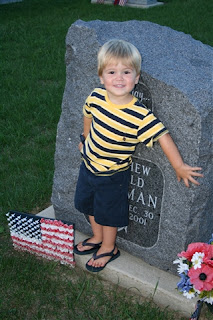

We stopped by your tombstone this evening. Thirteen years now, we've been gathering on the worn grass above your buried body. You lived with us for thirteen years, and now you've been absent from us for thirteen years. Next year you will reach the age where you will have been dead longer than you were alive.
Sorry for the melancholy letter; I am sad - I miss you, your big smile, your silly antics, your loud jokes, your ambling walk, your butch-wax lathered hair, your amiable attitude, your budding faith. August 23 is always a different day; I want to remember your life, but that means also remembering you are dead.
The gatherings get more fun as the years go by, your neices and nephews add a lot of noise and silliness to the event. Though they never knew you, we tell them stories, show them pictures; we constantly tell Emma that she has inherited your booming voice! Tonight Emma, Levi and Isaac were playing on your tombstone, happily oblivious to the pain of death.

As I watched them frolic, holding Eli close to my chest, I felt a deep strain in my soul. There was this angry surge, this stubborn resistance to reality, to the fact of your absence. Though it lasted only for a few seconds, it was a powerful moment; I don't want you dead, I want you here. It's one of the few things I want more than anything, and it is completely impossible to resolve.
You know all of this; I suppose having been dead for thirteen years, you've had plenty of time to reflect on what you are missing out on as well. Your 27th birthday is coming up...hard to imagine you all grown up, responsible, with a family. I like to imagine it though, it makes me smile.
We think of you often, we miss you always, and we seek to honor your life by laughing, by singing silly ditties; by enduring hardships with quiet resolve, by relying on God's providence when what we want is unattainable.
Here are some pics of the day together. We got together at my house first for pizza, fruit, cupcakes and icecream. We also gave Eli his first haircut, Tara reluctantly cut off the long hair hanging over his collar. No more mullet!


Just before leaving, Emma, in her boistrous enthusiasm, grabbed Eva in a bear hug and started waddling down the hallway. She lost her balance and Eva's forehead fell into some metal part of Grandpa's old desk he made for us when we were wee little tykes. It left a nasty gash; after the bleeding stopped Eva began to get sick. Jerm and Maria had to take her to the ER where she got stitches. Emma felt so bad about it, but we're glad Eva will be alright. The rest of us set off to Huntington to visit your tombstone and tell stories. What good stories you lived...


Sunday Sermon Notes - 8.26.07
Ruth 1
The story of Ruth is a classic tale; the one recorded in Scripture is a crown jewel of ancient classical literature. It is full of the fully human themes of tragic loss, bitter hope, unexpected help, reversal of fortune, a new life. It is also an oddity in Scripture, for God's role is relegated to behind the scenes; he doesn't talk, he doesn't speak through anyone, he doesn't perform any miracles. God is mentioned a couple of times, but he is not central to the story. What is central is the crucial importance of God's people doing what is good and right; what is central is God's providence given through the righteous deeds of humans.
Any human that does good, does what is right, opens themself up to being an agent of God's providence, of provision for those in need. In the story of Ruth, the great need that sets off the story is one of famine. But it is not just a famine of food to sustain health and life; it is also a famine of justice and righteousness. Those that ruled did as they pleased; those that were ruled also lived as they pleased, each one doing as he saw fit. This moral breakdown caused a spiritual famine; God being starved of affection from his people.
At the beginning of the story, we find Naomi as the central character; the famine forces her family out of their homeland, they become refugees in the land of their ancestral enemies. There her husband dies, and her two sons end up marrying Moabite women - what a disgrace! Then her two sons die, and Naomi is left with two barren, Moabite daughter-in-laws; she is a disgrace to Israel and to her God.
But she hears that the famine has ended; God has been merciful to his people - they have repented, and so Naomi seeks to return home...maybe the famine can end for her as well.
What is the famine in your life? Have you heard of others returning home? Do you need to repent of something to God? What keeps you from returning to God? God provides through righteous people; who are some righteous people you might want to spend some more time around? How might God be using this hard time to help you become more righteous, that you might be used by him to bless others with provisions for the mouth as well as the heart?
The story of Ruth is a classic tale; the one recorded in Scripture is a crown jewel of ancient classical literature. It is full of the fully human themes of tragic loss, bitter hope, unexpected help, reversal of fortune, a new life. It is also an oddity in Scripture, for God's role is relegated to behind the scenes; he doesn't talk, he doesn't speak through anyone, he doesn't perform any miracles. God is mentioned a couple of times, but he is not central to the story. What is central is the crucial importance of God's people doing what is good and right; what is central is God's providence given through the righteous deeds of humans.
Any human that does good, does what is right, opens themself up to being an agent of God's providence, of provision for those in need. In the story of Ruth, the great need that sets off the story is one of famine. But it is not just a famine of food to sustain health and life; it is also a famine of justice and righteousness. Those that ruled did as they pleased; those that were ruled also lived as they pleased, each one doing as he saw fit. This moral breakdown caused a spiritual famine; God being starved of affection from his people.
At the beginning of the story, we find Naomi as the central character; the famine forces her family out of their homeland, they become refugees in the land of their ancestral enemies. There her husband dies, and her two sons end up marrying Moabite women - what a disgrace! Then her two sons die, and Naomi is left with two barren, Moabite daughter-in-laws; she is a disgrace to Israel and to her God.
But she hears that the famine has ended; God has been merciful to his people - they have repented, and so Naomi seeks to return home...maybe the famine can end for her as well.
What is the famine in your life? Have you heard of others returning home? Do you need to repent of something to God? What keeps you from returning to God? God provides through righteous people; who are some righteous people you might want to spend some more time around? How might God be using this hard time to help you become more righteous, that you might be used by him to bless others with provisions for the mouth as well as the heart?
Thursday, August 16, 2007
Sunday Sermon Notes - 8.19.07
1Peter 5
How Can A Local Church Handle Hardships?
According to the text for our Sunday sermon, Peter suggests that humility is a key; we should humbly help one another resist the evil one.
Some hardships come from just being alive, but some hardships come from evil at work in our world, in our life, in our home. Sometimes it is not enough to just muster up more resolve, pull ourselves up by our bootstraps and leave our hardships behind. Most of the time, someone needs to insert their hand into someone elses hardship, to offer them some grace, a new way of going about so that they can get a handle on their hardships.
But what do you do when the local church you are part of feels like it is going through hard times? What do you do when this is compounded by all the individual hardships that members are struggling with? With everyone wrestling with their own hardships, does that excuse everyone from helping one another? What if someone has a harder hard time, are they free from the responsibility of helping others with less hard hardships?
Peter suggests three positions that people find themselves in as part of a local church: the first is that of one who is older; if you are older than someone, you have a responsibility to help the one younger than you get through their hardships, no matter how hard your life is. Peter also suggests that if you are younger, and going through a hard time, you ought to put your hand up for help, and then take the help that is offered. Lastly, Peter calls out to everyone in the church: just put your hands out, clasp the hands of those around you and together walk through the hardships.
Many people wilt under their hardships, others whine that it isn't fair; and there are those who at some point just walk away when life gets too hard. But Peter insists there is something subversive, something potent about humility. Humility changes your posture, it is a conforming to the way of Jesus. His example of putting his hands out to help us is to inspire us, and model for us what we are to do for others, even amidst our own hardships.
Ultimately, one must decide how much to trust God for steadfast help, restoration, renewal of strength; when one puts your hand out to help, one must do so by the urging of the Spirit. When the Spirit prompts you to take your hand out of your pocket, put it in the hand of the one God has put in front of you; then lean hard on God's help as you wade through the hardships. A humble attitude towards those that make your life hard, towards those that you are helping, and towards those you suffer with...that seems to be a key towards helping a local church handle its hardships. Becoming more like Jesus always seems to be a good outcome of hardships. May that be so for Anchor.
How Can A Local Church Handle Hardships?
According to the text for our Sunday sermon, Peter suggests that humility is a key; we should humbly help one another resist the evil one.
Some hardships come from just being alive, but some hardships come from evil at work in our world, in our life, in our home. Sometimes it is not enough to just muster up more resolve, pull ourselves up by our bootstraps and leave our hardships behind. Most of the time, someone needs to insert their hand into someone elses hardship, to offer them some grace, a new way of going about so that they can get a handle on their hardships.
But what do you do when the local church you are part of feels like it is going through hard times? What do you do when this is compounded by all the individual hardships that members are struggling with? With everyone wrestling with their own hardships, does that excuse everyone from helping one another? What if someone has a harder hard time, are they free from the responsibility of helping others with less hard hardships?
Peter suggests three positions that people find themselves in as part of a local church: the first is that of one who is older; if you are older than someone, you have a responsibility to help the one younger than you get through their hardships, no matter how hard your life is. Peter also suggests that if you are younger, and going through a hard time, you ought to put your hand up for help, and then take the help that is offered. Lastly, Peter calls out to everyone in the church: just put your hands out, clasp the hands of those around you and together walk through the hardships.
Many people wilt under their hardships, others whine that it isn't fair; and there are those who at some point just walk away when life gets too hard. But Peter insists there is something subversive, something potent about humility. Humility changes your posture, it is a conforming to the way of Jesus. His example of putting his hands out to help us is to inspire us, and model for us what we are to do for others, even amidst our own hardships.
Ultimately, one must decide how much to trust God for steadfast help, restoration, renewal of strength; when one puts your hand out to help, one must do so by the urging of the Spirit. When the Spirit prompts you to take your hand out of your pocket, put it in the hand of the one God has put in front of you; then lean hard on God's help as you wade through the hardships. A humble attitude towards those that make your life hard, towards those that you are helping, and towards those you suffer with...that seems to be a key towards helping a local church handle its hardships. Becoming more like Jesus always seems to be a good outcome of hardships. May that be so for Anchor.
But Take Heart!
John 16 (The Message)
"I've told you all this so that trusting me,
you will be unshakable and assured,
deeply at peace.
In this godless world
you will continue to experience difficulties.
But take heart!
I've conquered the world."
With all of the ministry challenges that have been ever present that last few years, it is easy for me to focus on me and my reactions, my experiences with the problems. People are in pain, and then somehow they end up talking with a pastor; but the suffering seems so complicated, intertwined like cancerous tentacles into their soul and heart; they hurt because of their habits and patterns in life, as well as bearing the consequences of their environmnet. And as marriages crumble, as faith dissapates, as love sours, as children wander, as culture pollutes...and as I feel it in my soul, bothered and disturbed...what do I do with it?
For awhile I focused on good listening skills, hoping that if I heard right, I could direct them more rightly. Then I focused on speaking rightly, if I spoke the cultural language more skillfully, then they would hear more correctly the remedy, and then act on it. I tried studying up on all sorts of sciences, thinking that if I increased my knowledge base, I'd be more helpful. And there are other tactics; and I don't think that I should draw the conclusion that my efforts have been in vain, that they were misguided, or steeped in misunderstanding. My observation has been, though, that I've let my soul absorb the suffering of my friends and let it shake the foundations of my faith. Which, if that is the case, I seriously minimize my ability to direct them to God. This is what has been slowly been unveiled to me through my experiences: people don't need me to suffer alongside them, they need me to trust Jesus as I suffer with them, trusting Jesus and letting him produce in me, and thus in them, a steadfastness, an assurance, a deep shalom.
What can I do when the people I care about continue to experience more and more heart-ache? Trust Jesus more, trust his words about truth and reality, and trust his way of dealing with a godless world and God-seekers in this world. Continue to incorporate the best of the sciences and technology in fostering healing, but seek first God's Way in this world, his Right Way in bringing shalom to shattered lives. Trust God with their problems, because that's what I want them to do: Trust God in Jesus with their problems.
Duh...how do I forget this stuff?
Father In Heaven,
May the people in my life,
and the people in their life,
Seek Forgiveness of their Sins from You,
and may they forgive those that have sinned against them.
May they receive your generous grace and steadfast strength from Jesus,
and May they follow the everyday promptings of the Spirit.
May the people in my life choose to Trust Jesus more often,
May they Listen to His Words and Follow His Way;
thus may they then act righteously towards those who wrong them,
may they let you restore their heart and redeem their soul from the sins of their fathers.
Amen.
"I've told you all this so that trusting me,
you will be unshakable and assured,
deeply at peace.
In this godless world
you will continue to experience difficulties.
But take heart!
I've conquered the world."
With all of the ministry challenges that have been ever present that last few years, it is easy for me to focus on me and my reactions, my experiences with the problems. People are in pain, and then somehow they end up talking with a pastor; but the suffering seems so complicated, intertwined like cancerous tentacles into their soul and heart; they hurt because of their habits and patterns in life, as well as bearing the consequences of their environmnet. And as marriages crumble, as faith dissapates, as love sours, as children wander, as culture pollutes...and as I feel it in my soul, bothered and disturbed...what do I do with it?
For awhile I focused on good listening skills, hoping that if I heard right, I could direct them more rightly. Then I focused on speaking rightly, if I spoke the cultural language more skillfully, then they would hear more correctly the remedy, and then act on it. I tried studying up on all sorts of sciences, thinking that if I increased my knowledge base, I'd be more helpful. And there are other tactics; and I don't think that I should draw the conclusion that my efforts have been in vain, that they were misguided, or steeped in misunderstanding. My observation has been, though, that I've let my soul absorb the suffering of my friends and let it shake the foundations of my faith. Which, if that is the case, I seriously minimize my ability to direct them to God. This is what has been slowly been unveiled to me through my experiences: people don't need me to suffer alongside them, they need me to trust Jesus as I suffer with them, trusting Jesus and letting him produce in me, and thus in them, a steadfastness, an assurance, a deep shalom.
What can I do when the people I care about continue to experience more and more heart-ache? Trust Jesus more, trust his words about truth and reality, and trust his way of dealing with a godless world and God-seekers in this world. Continue to incorporate the best of the sciences and technology in fostering healing, but seek first God's Way in this world, his Right Way in bringing shalom to shattered lives. Trust God with their problems, because that's what I want them to do: Trust God in Jesus with their problems.
Duh...how do I forget this stuff?
Father In Heaven,
May the people in my life,
and the people in their life,
Seek Forgiveness of their Sins from You,
and may they forgive those that have sinned against them.
May they receive your generous grace and steadfast strength from Jesus,
and May they follow the everyday promptings of the Spirit.
May the people in my life choose to Trust Jesus more often,
May they Listen to His Words and Follow His Way;
thus may they then act righteously towards those who wrong them,
may they let you restore their heart and redeem their soul from the sins of their fathers.
Amen.
Wednesday, August 15, 2007
Marriages in America
 Spent the afternoon trying to help a worried wife salvage her marriage. The cops were called. Stood in the living room of a red-eyed couple, holding a cooing baby, and a policeman handing over their domestic nightmare to the local pastor. Then we spent an emotional hour together, me praying like crazy while the couple cried and pleaded, defended and mourned...
Then I get home and go out on a date with my wife and three boys, we have a fun time at Panera, we get tasty drinks at Starbucks, and then play at the fountain. The contrast couldn't have been more stark. I almost feel guilty for enjoying my family so much, having previously spent time with a family that is barely hanging together. I wonder: in what way can the joys and strengths of my family benefit this wounded and scared couple?
Obviously it would be easier for my family to isolate itself, spend the bulk of the time with other healthy families so that we can be even more healthy. But what about the decaying and fraying marriages all around us, the ones we cluck our tongues at when they make a scene at the checkoutline? We can offer up a prayer for them as we walk briskly away to the safety of our oversized and overpriced vehicle...but what does that do to our soul? How healthy is my family if we are isolated from the tear-wracked marriages around us?
 Stats (somewhere from Barna) state that the more often you attend a church service, the more likely your marriage will last; the less likely you attend church, the more likely your marriage will fail. Once you get divorced, the odds go way up that you will get divorced again. So if healthy families are regularly attending church, what obligation do they have to go out of their way to help unhealthy families get to church more often?
 Can the goal of building a healthy family become an idol for a Christian home if it is simultaneous with a neglect for the struggling and stranded families in the neighborhood?
Is God pleased with a healthy family if it is isolated from unhealthy families?
How intentional should churches be about attracting and keeping unhealthy families in their sphere of influence and love?
And what is it about regular attendance in a good church that makes for stronger families?
A Better Driver

Yesterday I finished my four hour course on how to be a better driver. Apparently the state of Indiana felt that I needed a remedial course in traffic safety. For some reason I was deemed, for a time, as a menace to pedestrians and fellow drivers. In the old days when I got speeding tickets I would get fined, I would get points on my license, and then my insurance rates would go up. But that is not enough anymore! Now, if you get two or more infractions within a sixmonth period, they inflict more punishment...the hazard level goes up! Four hours of reading about how to use my left arm to signal if my lights go out in my car, four hours of reading about how to merge into traffic, how not to back up on a freeway if I miss my exit, and most importantly to dim my headlights from bright to dim when I am 500 feet from an oncoming car, or 300 feet behind a car.
So now I am a better driver, I passed my final exam answering 24 of 25 questions correctly. The one I missed was a trick question: True or False - You are never allowed to pass on the right side when traveling in the right lane. I answered True, because on a prior chapter quiz when I answered a similar answer with False, I got it wrong. Arrgh...stupid trick questions.
If you ever find yourself accumulating enough points that Indiana BMV decides to assign you some remedial traffic courses, I recommend ABetterDriver.com, it is completely online and easy to do.
One thing I did learn, a cop can pull you over at any time for speeding and give you a ticket even if there is no speed limit signs posted - the driver must always know the appropriate speed required, and should assume a lower speed rather than the assumed maximum speed. Just a helpful tip inspired by ABetterDriver.com!
Monday, August 13, 2007
His Way is In the Whirlwind
Nahum 1-3
Nahum is an Israelite prophet proclaiming God's vengeance upon the wickedness of the Assyrians; he is also singing of the coming restoration of Israel. The LORD God is the avengeing force that will bring judgment upon Assyria, but it is the caustic cruelty of the Ninevites that is causing their downfall.
Nothing can heal you;
your wound is fatal.
All who hear the news about you
clap their hands at your fall,
for who has not felt
your endless cruelty.
When bad things happen to people who do bad things, how much of it is God at work bringing mysterious problems into their life, and how much of it is the natural consequences of living a life dripping with wickedness? Nations rise and fall due to their words and deeds; they do good and they do great deeds, they might stay might for a time but if they do wicked, they may conquer and kill for a time, but then their day of reckoning will come.
Nahum calls out the words of a powerful and raging God; not like the one Elijah encounters in the stillness that follows the storm:
The LORD is a jealous and avenging God;
the LORD takes vengeance and is filled with wrath.
The LORD takes vengeance on his foes
and vents his wrath against his enemies.
The LORD is slow to anger but great in power;
the LORD will not leave the guilty unpunished.
His way is in the whirlwind and the storm,
and clouds are the dust of his feet.
For all the men and women I know who have been bruised, beaten, battered, beleagured, abused, berated, abandoned, and broken...they need to know that the God who made them was sinned against along with them, and he will not let it go unpunished. The LORD gets riled up when the wicked pour out their cruelty on others, just as we should. But here is the catch: God brings justice through his people...when Christians don't step in and stop the bad things in this world, who will? Some do, and thank God they don't wait on us...but when people ask where was God when their life was hell...they are asking where was the Church...where were the Christians...where were the Jesus-followers.
It's hard to conceive of someone calling themself a Jesus-follower, a church-member, if they don't spend part of their life stopping bad things from happening to others, and helping hurt people get healed up.
The LORD is good,
a refuge in times of trouble.
He cares for those who trust in him,
but with an overwhelming flood
he will make an end of Nineveh;
he will pursue his foes into darkness.
How's that for a description of Godliness? What if that were a required action fo local church-membership?
That last line of the prophecy reminds me of Samwise in Shelob's lair, of Harry Potter and the Horcruxes, of Aslan and the Stone Table, of the Dread Pirate Roberts and the Cliffs of Insanity. It also reminds me of my friends, the ones who keep walking with those in their life who find themselves surrounded my dark times, dark thoughts, and dark futures. They will know that the LORD is good, a refuge...when you are one to them.
Nahum is an Israelite prophet proclaiming God's vengeance upon the wickedness of the Assyrians; he is also singing of the coming restoration of Israel. The LORD God is the avengeing force that will bring judgment upon Assyria, but it is the caustic cruelty of the Ninevites that is causing their downfall.
Nothing can heal you;
your wound is fatal.
All who hear the news about you
clap their hands at your fall,
for who has not felt
your endless cruelty.
When bad things happen to people who do bad things, how much of it is God at work bringing mysterious problems into their life, and how much of it is the natural consequences of living a life dripping with wickedness? Nations rise and fall due to their words and deeds; they do good and they do great deeds, they might stay might for a time but if they do wicked, they may conquer and kill for a time, but then their day of reckoning will come.
Nahum calls out the words of a powerful and raging God; not like the one Elijah encounters in the stillness that follows the storm:
The LORD is a jealous and avenging God;
the LORD takes vengeance and is filled with wrath.
The LORD takes vengeance on his foes
and vents his wrath against his enemies.
The LORD is slow to anger but great in power;
the LORD will not leave the guilty unpunished.
His way is in the whirlwind and the storm,
and clouds are the dust of his feet.
For all the men and women I know who have been bruised, beaten, battered, beleagured, abused, berated, abandoned, and broken...they need to know that the God who made them was sinned against along with them, and he will not let it go unpunished. The LORD gets riled up when the wicked pour out their cruelty on others, just as we should. But here is the catch: God brings justice through his people...when Christians don't step in and stop the bad things in this world, who will? Some do, and thank God they don't wait on us...but when people ask where was God when their life was hell...they are asking where was the Church...where were the Christians...where were the Jesus-followers.
It's hard to conceive of someone calling themself a Jesus-follower, a church-member, if they don't spend part of their life stopping bad things from happening to others, and helping hurt people get healed up.
The LORD is good,
a refuge in times of trouble.
He cares for those who trust in him,
but with an overwhelming flood
he will make an end of Nineveh;
he will pursue his foes into darkness.
How's that for a description of Godliness? What if that were a required action fo local church-membership?
That last line of the prophecy reminds me of Samwise in Shelob's lair, of Harry Potter and the Horcruxes, of Aslan and the Stone Table, of the Dread Pirate Roberts and the Cliffs of Insanity. It also reminds me of my friends, the ones who keep walking with those in their life who find themselves surrounded my dark times, dark thoughts, and dark futures. They will know that the LORD is good, a refuge...when you are one to them.
Sunday, August 12, 2007
Summer Fun w/ the Guys

Big Brother Levi taking care of his baby brother Eli!


Big brother Isaac giving his baby brother Eli some love


Papa Ger reading a bedtime story up at the lake

Levi and Isaac spraying water all over their backyard - it was a very hot day, but it was fun in the shade

Eli recently discovered the joy of sticking out his tongue

Nothing like lunch on the patio during a lazy summer afternoon

Eli finally enjoys bouncing in his saucer, though I think he sometimes gets overstimulated...

Eli on his four month birthday

Guess who likes to be on their belly?

Isaac and Levi going for a spin on the fast boat up at the lake...they like it fast!

Daddy, Isaac and Levi on the carousel at Fun Spot

Isaac the bikerider

Give'em a smile Eli!

Relaxing after a fun day at the lake

Levi showing Eli how to play with some of his new toys

Happy Anniversary #12!
Today, August 12, is anniversary #12!
In the old days we'd take a whole week off during August 12; but now that school starts on the 13th, and now that we have four children age four and under, and since we already took a three week trip to California earlier in the summer, we just took the weekend off. The last couple years have been either a weekend at home with no kids, or Tara on the couch pregnant with no kids around. This year we took the kids up to the lake Thursday night and slept in on Friday. Then Tara and I headed up to Kendallville to the Elks golf course there where Jamil is the Head Pro. We played eighteen holes and had lots of fun; it's the first time since Emma was born that the two of us have played golf together. We love playing golf together!
We headed back to the lake, grabbed Eli and headed for home before the older three woke up from their naps. Once home, I ran out to get carry-out Chinese and rented the four Harry Potter movies out on DVD. We've yet to see the fifth movie in theatres. We stayed up late watching the first two, and then spent the morning and afternoon watching the next two; it was very relaxing and fun.


After mowing the yard we three went back up to the lake for supper and a pontoon ride around the lake. Then we did bathtime, got the kiddos in the pjs, and made for home. So this morning, we slept in till 8am, ate blueberries with our cereal for breakfast, and then headed to the FW Children's Zoo! It was fun and hot. We were ready for naps, all six of us. We spent the evening eating watermelon, riding bikes on the sidewalk, killing Japanese beetles, playing basketball, watching our wedding video while munching on popcorn, and then a late bedtime. And so Tara and I end our anniversary - she's feeding Eli while reading through the Deathly Hallows...she's reading the chapter of the Battle for Hogwarts...she can't put it down...and I'm watching Sportscenter while typing this blog. Oh happy bliss! Really!
In the old days we'd take a whole week off during August 12; but now that school starts on the 13th, and now that we have four children age four and under, and since we already took a three week trip to California earlier in the summer, we just took the weekend off. The last couple years have been either a weekend at home with no kids, or Tara on the couch pregnant with no kids around. This year we took the kids up to the lake Thursday night and slept in on Friday. Then Tara and I headed up to Kendallville to the Elks golf course there where Jamil is the Head Pro. We played eighteen holes and had lots of fun; it's the first time since Emma was born that the two of us have played golf together. We love playing golf together!
We headed back to the lake, grabbed Eli and headed for home before the older three woke up from their naps. Once home, I ran out to get carry-out Chinese and rented the four Harry Potter movies out on DVD. We've yet to see the fifth movie in theatres. We stayed up late watching the first two, and then spent the morning and afternoon watching the next two; it was very relaxing and fun.
After mowing the yard we three went back up to the lake for supper and a pontoon ride around the lake. Then we did bathtime, got the kiddos in the pjs, and made for home. So this morning, we slept in till 8am, ate blueberries with our cereal for breakfast, and then headed to the FW Children's Zoo! It was fun and hot. We were ready for naps, all six of us. We spent the evening eating watermelon, riding bikes on the sidewalk, killing Japanese beetles, playing basketball, watching our wedding video while munching on popcorn, and then a late bedtime. And so Tara and I end our anniversary - she's feeding Eli while reading through the Deathly Hallows...she's reading the chapter of the Battle for Hogwarts...she can't put it down...and I'm watching Sportscenter while typing this blog. Oh happy bliss! Really!
Thursday, August 09, 2007
The King and Prophet Comedy Routine
2Chronicles 18
This is one of my favorite chapters in the book, a smart and fascinating dialogue between two kings, a bunch of false prophets and one true prophet of God.
The context: Evil King Ahab of Northern Israel has invited Good King Jehoshaphat of Southern Israel over to his palace to plot war against Despicable King of Ramoth Gilead. Ahab is a pagan king, little regard for Yahweh but lots for the gods of Sidon and Tyre, he's particularly fond of the prophets who tell him what he wants to hear. As the two kings conspire, they come to a conclusion: attack; but before they announce it the Good King inquires, "First seek the counsel of the LORD." So Ahab brings in four hundred prophets who tell the kings to go for it (they are very affirming, encouraging, uplifting, positive prophets). For some reason, the good king has his doubts and asks, "Is there no longer a prophet of the LORD here whom we can inquire of?" Ouch. How did Jehoshaphat know the difference?
Ahab, now insulted and shamed, explains his disdain for Micaiah the prophet: There is still one through whom we can inquire of the LORD, but I hate him because he never prophesies anything good about me, but always bad." It struck me when I read this, that Ahab was one of those men who deep down wanted to be known for doing good, but was compelled to do what he felt like doing, which always took him down the wrong road; he had enough of a conscience to feel pangs of guilt for doing wrong and hated to be told of his wicked deeds, but he also didn't want anyone to stop him from his desired course of actions. Poor guy.
The good king, upon hearing this confession, responds with shock: The king should not say such a thing!" One can imagine King J scooting over to escape the thunderbolt about to smite the defamer. So, here they two kings are, all dressed up in their royal garb, sitting outside the city gates where throngs of people are exchanging goods, loitering, traveling, etc; up comes one false prophet who holds up iron horns and declares that Abahn will gore the enemies unto victory; and the other four hundred prophets chime in resoundingly. The messenger who retrieved Micaiah whispers in his ear as they approach the kings: Look, the other prophets without exception are predicting success for the king. Let your word agree with their and speak favorably." Micaiah wisely, and predictably responds with the standard speech: As surely as the LORD lives, I can tell him only what my God says.
Ahab leans forward as Micaiah walks up...anticipating that finally he will get a good word from the LORD, especially since King J is sitting next to him...finally an affirming word from God (reminds me of the emperor's son in Gladiator...). King J sits back, stroking his beard, wondering what this prophet will speak. King A poses the question: Micaiah, shall we go to war against Ramoth Gilead, or shall I not? One can only imagaine that Ahab asks it in such a way that the desired answer is palpable.
Micaiah tiredly responds: Attack and be victorious, for they will be given into your hands.
The king explodes out of his throne, hands in the air, exasperation in his voice: How many times must I make you swear to tell me nothing but the truth in the name of the LORD?"
Ha ha ha ha! How many times did they do that dance?
Ahab wants the truth, but he doesn't. He wants to know the LORD's will, but he doesn't. He wants to obey, but he doesn't.
Oh that I would speak as Micaiah, and that we would request truth like King J, and avoid the shallowness of Ahab.
This is one of my favorite chapters in the book, a smart and fascinating dialogue between two kings, a bunch of false prophets and one true prophet of God.
The context: Evil King Ahab of Northern Israel has invited Good King Jehoshaphat of Southern Israel over to his palace to plot war against Despicable King of Ramoth Gilead. Ahab is a pagan king, little regard for Yahweh but lots for the gods of Sidon and Tyre, he's particularly fond of the prophets who tell him what he wants to hear. As the two kings conspire, they come to a conclusion: attack; but before they announce it the Good King inquires, "First seek the counsel of the LORD." So Ahab brings in four hundred prophets who tell the kings to go for it (they are very affirming, encouraging, uplifting, positive prophets). For some reason, the good king has his doubts and asks, "Is there no longer a prophet of the LORD here whom we can inquire of?" Ouch. How did Jehoshaphat know the difference?
Ahab, now insulted and shamed, explains his disdain for Micaiah the prophet: There is still one through whom we can inquire of the LORD, but I hate him because he never prophesies anything good about me, but always bad." It struck me when I read this, that Ahab was one of those men who deep down wanted to be known for doing good, but was compelled to do what he felt like doing, which always took him down the wrong road; he had enough of a conscience to feel pangs of guilt for doing wrong and hated to be told of his wicked deeds, but he also didn't want anyone to stop him from his desired course of actions. Poor guy.
The good king, upon hearing this confession, responds with shock: The king should not say such a thing!" One can imagine King J scooting over to escape the thunderbolt about to smite the defamer. So, here they two kings are, all dressed up in their royal garb, sitting outside the city gates where throngs of people are exchanging goods, loitering, traveling, etc; up comes one false prophet who holds up iron horns and declares that Abahn will gore the enemies unto victory; and the other four hundred prophets chime in resoundingly. The messenger who retrieved Micaiah whispers in his ear as they approach the kings: Look, the other prophets without exception are predicting success for the king. Let your word agree with their and speak favorably." Micaiah wisely, and predictably responds with the standard speech: As surely as the LORD lives, I can tell him only what my God says.
Ahab leans forward as Micaiah walks up...anticipating that finally he will get a good word from the LORD, especially since King J is sitting next to him...finally an affirming word from God (reminds me of the emperor's son in Gladiator...). King J sits back, stroking his beard, wondering what this prophet will speak. King A poses the question: Micaiah, shall we go to war against Ramoth Gilead, or shall I not? One can only imagaine that Ahab asks it in such a way that the desired answer is palpable.
Micaiah tiredly responds: Attack and be victorious, for they will be given into your hands.
The king explodes out of his throne, hands in the air, exasperation in his voice: How many times must I make you swear to tell me nothing but the truth in the name of the LORD?"
Ha ha ha ha! How many times did they do that dance?
Ahab wants the truth, but he doesn't. He wants to know the LORD's will, but he doesn't. He wants to obey, but he doesn't.
Oh that I would speak as Micaiah, and that we would request truth like King J, and avoid the shallowness of Ahab.
Tuesday, August 07, 2007
Barry Bonds & Homerun #756
 Over the right field wall, I witnessed the historic and controversial homerun in the bottom of the fifth, a 3-2 count, against the Washington Nationals in San Fransisco. He crushed it to the deepest part of the park, so says ESPN announcer Rick Sutcliffe. Tara and I have mixed emotions about it all; we love homeruns like most people, but the steroids scandal seems to sap some of the thrill out of this homerun achievement. We also had mixed emotions about the fanfare around the homerun...maybe a bit over the top...they stop the game, family rushes on the field for hugs, Willie Mays comes out for an announcement, Hank Aaron provides a digital video congrats, Barry speaks... and there are still two outs to get in the bottom of the fifth. Just go on with the game, and do the special congrats after the game is finished. But no one asked my opinion.
The anonymous fan was escorted by a thick cavalcade of police officers, the camera quickly panned to him as he was carried along by the police. He was all grins, slapping hands of fellow fans, the ball likely clutched in one of his trembling hands. It was a funny clip; the second one showed him wearing a Mets jersey! Which reminds me, while we are handing out congrats, here's one for Tom Glavine, for 300 wins!
Maybe now the controversy will get resolved; either Bonds will go away in a month after the regular season ends, or the MLB will efficiently and effectively settle the case and serve justice for the game and its fans.
Dr. Paul Hiebert's Final Message to Students Read at TEDS Commencement
One of the main reasons for choosing to attend Trinity Evangelical Divinity School is the professors, brilliant, godly, engaging men and women. Dr. Paul Hiebert was one of those men whom I hoped to be able to take a class with, and it worked out the fall semester of 2006. The Anthropology for Missions class was stimulating, challenging, and rewarding; and Hiebert did not dissapoint. His teaching style was almost laid back, but he was very intense, very knowledgable and wise, and very interested in us understanding his lessons. He was a good model, as a Christian man, as a teacher, as a missionary, as a leader. I was saddened by his death, though he is much relieved; he joins his wife Frances who died almost a decade ago. He still had so much to teach, his Anabaptist voice is now diffused amongst his students; I hope to be one who can apply what he taught to my life, my ministry.
The commencement address that he prepared, but was unable to deliver, is classic Hiebert; simple to grasp, poetic, and true. I've reread it several times, and wanted to share it with others, that they might enjoy a small sample of Hiebert's lessons.
------------------
The late Dr. Paul Hiebert, a renown missiologist, missionary to India, and distinguished TEDS professor of mission and anthropology, was invited to deliver the Commencement address for Trinity Evangelical Divinity School and Trinity Graduate School on May 12, 2007. Dr. Hiebert died of cancer on Sunday, March 11, 2007, but his message was read at Commencement by his close friend and colleague, TEDS Academic Dean Dr. Tite Tienou.
 TEDS Academic Dean Dr. Tite Tienou reading Dr. Paul Hiebert's Commencement address on May 12, 2007.
Graduating Class of 2007:
We, your families, churches and colleagues at Trinity, gather to celebrate your completion of this major step in your lives. There have been steps before, and will be more, but today we want to rejoice that God has given you the strength and wisdom to complete your degrees and is sending many of you out in your life ministries.
Take a minute as you gather and celebrate, and look at your fellow graduates. Yes, you see a joyful crowd of new graduates. Look deeper and more carefully, and you see the leaders in the global church in the 21st century. But, you say, we are such ordinary people. God needs extraordinary people for extraordinary times. But down through the centuries God has chosen ordinary people like you to accomplish his extraordinary ministries around the world, because God's mission and ministry is ultimately God's work. So stop and look, really look around at your colleagues. You are God's leaders and coworkers for the coming years.
A Rapidly Changing World
The world in which you minister is radically different from the one Frances and I entered in 1960. Then it took us three months by ship to reach India; three weeks for mail to go and return, and three days to book an underseas cable to phone the U.S. People returned once every seven years on furlough. Today transcultural flights and instant communication have become routine.
Every few centuries, we seem to pass through an "Alice in Wonderland's mirror" and enter a world radically different from the one we left. In the past we adjusted old theories and methods of ministry to a changing world. Today we do not need old theories and methods. We need new kinds of ministers and missionaries who learn to think in new ways, to exegete their social and cultural contexts as well as others, and faithfully communicate the Gospel to our new world. Most of us leave seminary with a deep understanding of the Gospel, but with few ways to exegete humans. The message we preach often touches the surface of people's lives but does not transform them deeply. We must develop more effective methods of understanding and go deeper to understand the central questions people are facing. We need to show them that the Gospel provides definitive answers to their felt needs and their deep theological needs. In other words, we need theologians and missionaries who do both theological and anthropological reflections on the human scene more deeply and who learn how to incarnate faithfully the Gospel in contemporary human contexts.
Our Unchanging Lord
In our fractured, changing world, the great news is that Jesus Christ, the lord of all history, and the commander in world mission is the same today as he was with Adam, Moses and David. He is the Lord who took on human flesh to bring us salvation, and a new creation.
We who have walked before, commend you into God's hand. We have lived in changing worlds, and have experienced our Lord's faithfulness and constancy throughout our lives. If you asked us: if we had the chance would we live differently, I know most of us would say no, not at the deepest levels of our lives. As we grow old, we can look back at the story, "the plot" of our lives, and see that God has been writing a drama in our years of living. When we were young we sometimes saw our life stories as detective stories, as mysteries, as tragedies, possibly as comedies, but in looking back we realize that these are great Love Stories. He who created us is coming back to bring us home as his bride.
Our Challenge to You
We who have gone before today charge you in the presence of God and Christ Jesus: be ready to minister in season and out of season; reproving, rebuking and exhorting with complete patience and teaching. Like Paul we encourage you to share the Gospel you have heard among us at TEDS and TGS with the world. YOU are already the leaders of the world church in the 21st century. Remember, central to your task is to train leaders who will, in turn, train leaders—not followers. Remember that God is writing a story in your lives as you minister in his kingdom, but your story takes on meaning because it is part of an eternal story. Paul received that Gospel and passed it on to Timothy, who passed it on to those who followed . That Gospel has come down through the centuries through our spiritual genealogy, and we must pass it on to those who follow us. When Christ returns, he will continue establishing his eternal reign of peace, justice and love over the universe.
*************
 Paul G. Hiebert was distinguished professor of mission and anthropology at Trinity Evangelical Divinity School in Deerfield, Illinois. He began teaching at Trinity in 1990. He went to be with the Lord on Sunday, March 11, 2007.
After spending three years as pastor, Dr. Hiebert served for six years with the Mennonite Brethren Board of Missions and Services in India. During that time he was principal of Bethany Bible School and College. Since then, he has taught anthropology at Kansas State University in Manhattan, Kansas, and the University of Washington in Seattle, Washington, and anthropology and missions at Fuller Theological Seminary. Dr. Hiebert also taught as a visiting professor at Mennonite Brethren Seminary and the University of Wisconsin. He was Fulbright visiting professor at Osmania University in India for one year.
Dr. Hiebert earned the Doctor of Philosophy and the Master of Arts in anthropology from the University of Minnesota; the Master of Arts in missions from Mennonite Brethren Biblical Seminary; and the Bachelor of Arts in Bible and history from Tabor College.
Dr. Hiebert's areas of expertise include anthropology, missions, South Asia, folk religions, urban ministries, anthropological research methods, and Hinduism. He is a member of the Association of Asian Studies, the American Anthropological Association, and the Association of Professors of Mission.
Dr. Hiebert has published numerous articles, book reviews, and books in both anthropology and missions. Among his books in anthropology are Konduru: Structure and Integration in a South Indian Village (Univ. of Minnesota Press) and Cultural Anthropology (J.B. Lippincott 1976). Among his books in missions are Case Studies in Missions (written with his wife; Baker 1987), Anthropological Insights for Missionaries (Baker 1985), Anthropological Reflections on Missiological Issues (Baker 1995), and numerous chapters and essays in other volumes. Most recently, he coauthored Incarnational Ministry with his daughter, Eloise Hiebert Meneses (Baker 1996).
The commencement address that he prepared, but was unable to deliver, is classic Hiebert; simple to grasp, poetic, and true. I've reread it several times, and wanted to share it with others, that they might enjoy a small sample of Hiebert's lessons.
------------------
The late Dr. Paul Hiebert, a renown missiologist, missionary to India, and distinguished TEDS professor of mission and anthropology, was invited to deliver the Commencement address for Trinity Evangelical Divinity School and Trinity Graduate School on May 12, 2007. Dr. Hiebert died of cancer on Sunday, March 11, 2007, but his message was read at Commencement by his close friend and colleague, TEDS Academic Dean Dr. Tite Tienou.
 TEDS Academic Dean Dr. Tite Tienou reading Dr. Paul Hiebert's Commencement address on May 12, 2007.
Graduating Class of 2007:
We, your families, churches and colleagues at Trinity, gather to celebrate your completion of this major step in your lives. There have been steps before, and will be more, but today we want to rejoice that God has given you the strength and wisdom to complete your degrees and is sending many of you out in your life ministries.
Take a minute as you gather and celebrate, and look at your fellow graduates. Yes, you see a joyful crowd of new graduates. Look deeper and more carefully, and you see the leaders in the global church in the 21st century. But, you say, we are such ordinary people. God needs extraordinary people for extraordinary times. But down through the centuries God has chosen ordinary people like you to accomplish his extraordinary ministries around the world, because God's mission and ministry is ultimately God's work. So stop and look, really look around at your colleagues. You are God's leaders and coworkers for the coming years.
A Rapidly Changing World
The world in which you minister is radically different from the one Frances and I entered in 1960. Then it took us three months by ship to reach India; three weeks for mail to go and return, and three days to book an underseas cable to phone the U.S. People returned once every seven years on furlough. Today transcultural flights and instant communication have become routine.
Every few centuries, we seem to pass through an "Alice in Wonderland's mirror" and enter a world radically different from the one we left. In the past we adjusted old theories and methods of ministry to a changing world. Today we do not need old theories and methods. We need new kinds of ministers and missionaries who learn to think in new ways, to exegete their social and cultural contexts as well as others, and faithfully communicate the Gospel to our new world. Most of us leave seminary with a deep understanding of the Gospel, but with few ways to exegete humans. The message we preach often touches the surface of people's lives but does not transform them deeply. We must develop more effective methods of understanding and go deeper to understand the central questions people are facing. We need to show them that the Gospel provides definitive answers to their felt needs and their deep theological needs. In other words, we need theologians and missionaries who do both theological and anthropological reflections on the human scene more deeply and who learn how to incarnate faithfully the Gospel in contemporary human contexts.
Our Unchanging Lord
In our fractured, changing world, the great news is that Jesus Christ, the lord of all history, and the commander in world mission is the same today as he was with Adam, Moses and David. He is the Lord who took on human flesh to bring us salvation, and a new creation.
We who have walked before, commend you into God's hand. We have lived in changing worlds, and have experienced our Lord's faithfulness and constancy throughout our lives. If you asked us: if we had the chance would we live differently, I know most of us would say no, not at the deepest levels of our lives. As we grow old, we can look back at the story, "the plot" of our lives, and see that God has been writing a drama in our years of living. When we were young we sometimes saw our life stories as detective stories, as mysteries, as tragedies, possibly as comedies, but in looking back we realize that these are great Love Stories. He who created us is coming back to bring us home as his bride.
Our Challenge to You
We who have gone before today charge you in the presence of God and Christ Jesus: be ready to minister in season and out of season; reproving, rebuking and exhorting with complete patience and teaching. Like Paul we encourage you to share the Gospel you have heard among us at TEDS and TGS with the world. YOU are already the leaders of the world church in the 21st century. Remember, central to your task is to train leaders who will, in turn, train leaders—not followers. Remember that God is writing a story in your lives as you minister in his kingdom, but your story takes on meaning because it is part of an eternal story. Paul received that Gospel and passed it on to Timothy, who passed it on to those who followed . That Gospel has come down through the centuries through our spiritual genealogy, and we must pass it on to those who follow us. When Christ returns, he will continue establishing his eternal reign of peace, justice and love over the universe.
*************
 Paul G. Hiebert was distinguished professor of mission and anthropology at Trinity Evangelical Divinity School in Deerfield, Illinois. He began teaching at Trinity in 1990. He went to be with the Lord on Sunday, March 11, 2007.
After spending three years as pastor, Dr. Hiebert served for six years with the Mennonite Brethren Board of Missions and Services in India. During that time he was principal of Bethany Bible School and College. Since then, he has taught anthropology at Kansas State University in Manhattan, Kansas, and the University of Washington in Seattle, Washington, and anthropology and missions at Fuller Theological Seminary. Dr. Hiebert also taught as a visiting professor at Mennonite Brethren Seminary and the University of Wisconsin. He was Fulbright visiting professor at Osmania University in India for one year.
Dr. Hiebert earned the Doctor of Philosophy and the Master of Arts in anthropology from the University of Minnesota; the Master of Arts in missions from Mennonite Brethren Biblical Seminary; and the Bachelor of Arts in Bible and history from Tabor College.
Dr. Hiebert's areas of expertise include anthropology, missions, South Asia, folk religions, urban ministries, anthropological research methods, and Hinduism. He is a member of the Association of Asian Studies, the American Anthropological Association, and the Association of Professors of Mission.
Dr. Hiebert has published numerous articles, book reviews, and books in both anthropology and missions. Among his books in anthropology are Konduru: Structure and Integration in a South Indian Village (Univ. of Minnesota Press) and Cultural Anthropology (J.B. Lippincott 1976). Among his books in missions are Case Studies in Missions (written with his wife; Baker 1987), Anthropological Insights for Missionaries (Baker 1985), Anthropological Reflections on Missiological Issues (Baker 1995), and numerous chapters and essays in other volumes. Most recently, he coauthored Incarnational Ministry with his daughter, Eloise Hiebert Meneses (Baker 1996).
Subscribe to:
Posts (Atom)